First separate young leaves from smaller mature growth
A new leaf may simply be smaller because it is still expanding. If several successive leaves have finished growing and each stays smaller than the last, compare light, roots, watering conditions, and recent changes. Leaf size alone cannot tell you whether the plant needs fertilizer.
Leaf age, position, and the plant’s growth stage help decide which leaves are useful to compare.
First ask whether the leaf is still expanding
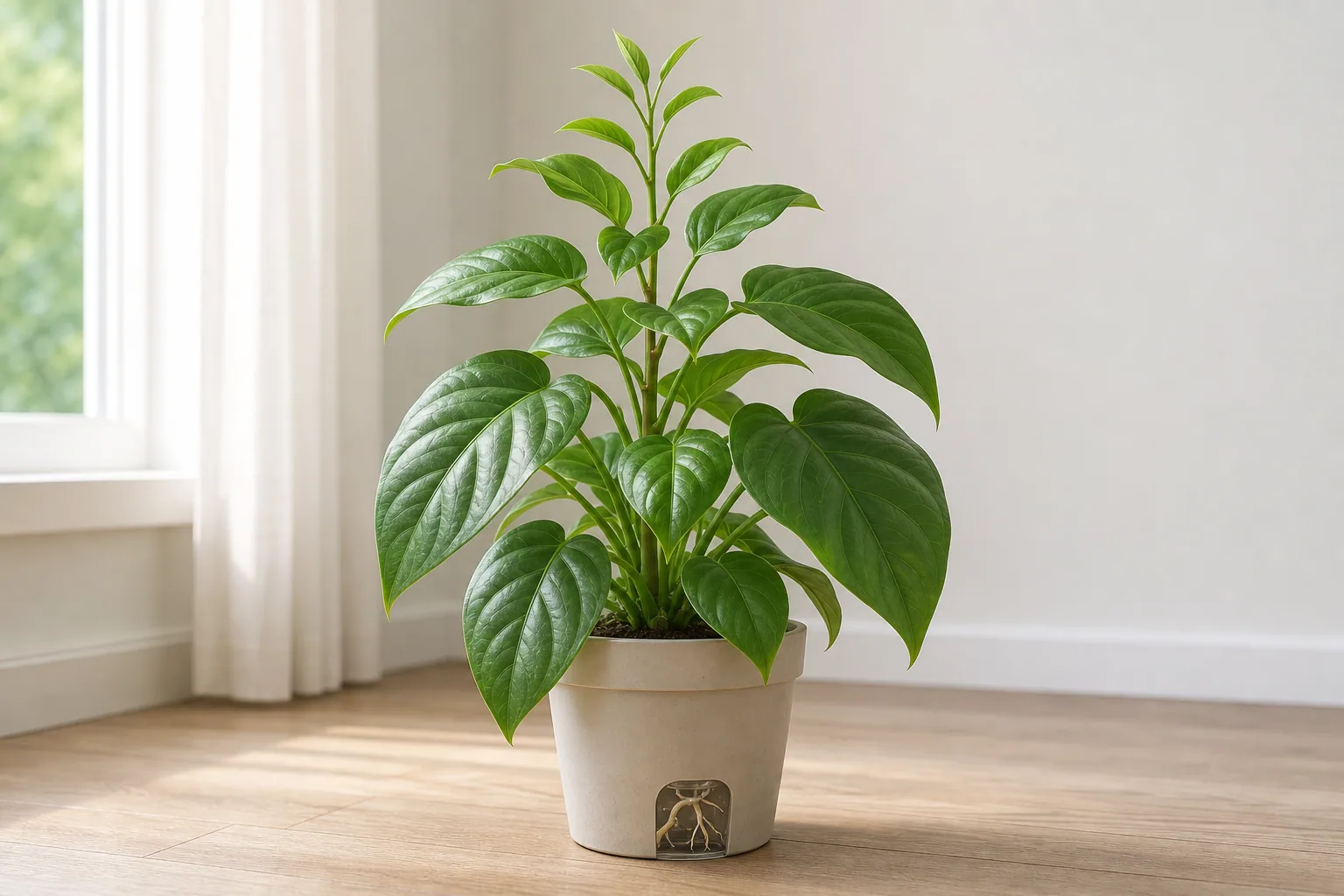
Many leaves do not appear at their final size the moment they emerge. A newly unfolding leaf can be smaller, softer, thinner, and lighter in color than an older mature leaf. Judging too early can make a normal young leaf look like a problem.
A better comparison is to wait until the leaf is fully expanded and looks closer to mature. Then compare it with the previous few mature leaves. One small young leaf is less important than a repeated pattern: several mature new leaves getting smaller in sequence, especially with longer internodes, paler color, old leaf drop, or roots crowding the pot.
Most leaves have a limited growth period. Once a leaf has matured, it usually will not keep enlarging indefinitely. If one leaf has already matured small, the useful question is not whether that leaf will become large later. The useful question is whether the next round of new growth becomes steadier.
| What looks smaller? | What to compare first |
|---|---|
| One leaf that is still expanding | Follow the same leaf and note whether its size and texture are still changing |
| Several successive leaves that have finished growing | Compare them with earlier mature leaves, alongside light, roots, and recent changes |
| Small leaf-like structures near flower buds | First distinguish foliage leaves from bracts, then compare like structures at similar positions |
Low light can make new growth weaker
Leaves are major sites of photosynthesis. Through photosynthesis, a plant uses light energy to make organic materials that support new leaves, roots, and stems. In indoor conditions, a plant may stay alive in low light while still producing slower or weaker new growth.
Low-light clues often appear together. Stems may become long and thin. Spaces between leaves can stretch. The plant may lean toward the window. Leaf color may become paler, variegated leaves may turn greener, and older leaves may drop more easily. If smaller new leaves appear with these clues, light is one of the first things to check.
Light is not just a question of whether a room looks bright to people. Direction of the window, curtains, distance from the glass, season, nearby buildings, and shade all change the amount of usable light that reaches the plant. This is one reason a plant may have large leaves when purchased, then produce smaller new leaves at home: the new leaves are growing under the conditions your home actually provides.
Root restriction can affect the leaves above the pot
New leaves grow above the pot, but the limiting clue can be below the surface. Roots absorb water and minerals, and they also need air spaces in the potting mix. Over time, a container plant can fill much of the pot with roots, leaving less media and a less stable water-air balance.
When roots are crowded or the potting mix has changed, you may see several clues: the pot dries very quickly after watering, roots grow out of drainage holes, many roots are visible along the surface or pot edge, growth slows down, new leaves become smaller, or older leaves yellow and drop. Extension sources list smaller new leaves as one possible clue of an excessively pot-bound plant, but similar symptoms can come from other causes too.
The opposite pot problem also matters. A pot that is much too large, or a mix that stays wet for too long, can leave roots in an air-poor environment. If root uptake is poor, new growth may be weak even though the pot contains water. Pot size is not simply “bigger is better.” It has to fit the root system, media structure, drainage, and aeration.
Water, air, and nutrients all shape new growth
To expand well, a new leaf needs water, minerals, and materials made by photosynthesis. If the potting mix repeatedly dries to the point of wilting, if watering only wets the surface, or if the mix stays wet and airless for long periods, new growth may slow down or stay smaller.
Nutrients can also be part of the picture. Plants need nitrogen, phosphorus, potassium, and other mineral elements for growth. Some nutrient problems can show up as stunted plants or smaller leaves. But in everyday houseplant care, “small new leaves” alone is not enough to identify a specific deficiency. If light is low or roots are stressed, adding fertilizer may not solve the problem and can add more pressure around the roots.
A steadier way to read the nutrient question is to keep it on the observation list. Has the plant stayed in old media for a long time? Has growth stopped for months? Are there color changes as well as small leaves? Did growth worsen soon after fertilizing? These questions help place nutrition alongside the plant’s overall growing conditions.
Season, recent moves, and plant habit also matter
Plants do not always grow at the same speed all year. Shorter winter days, cooler rooms, lower indoor light, and changing air movement can slow many indoor plants. A plant that has just been moved, repotted, root-pruned, purchased, or shifted to a new window may also produce smaller leaves for a while as it adjusts.
Different plants have different habits. Some plants are naturally slow-growing, and some show more variation in leaf size under indoor conditions. One or two leaves are rarely enough to judge the whole plant. For plants such as pothos, philodendron, and monstera, avoid turning smaller leaves into one automatic instruction. Start with light, roots, water rhythm, and recent changes.
If smaller leaves arrive during a broader winter slowdown, why plants grow more slowly in winter explains how seasonal light and indoor conditions can overlap.
Example: compare leaf position around zinnia flower buds
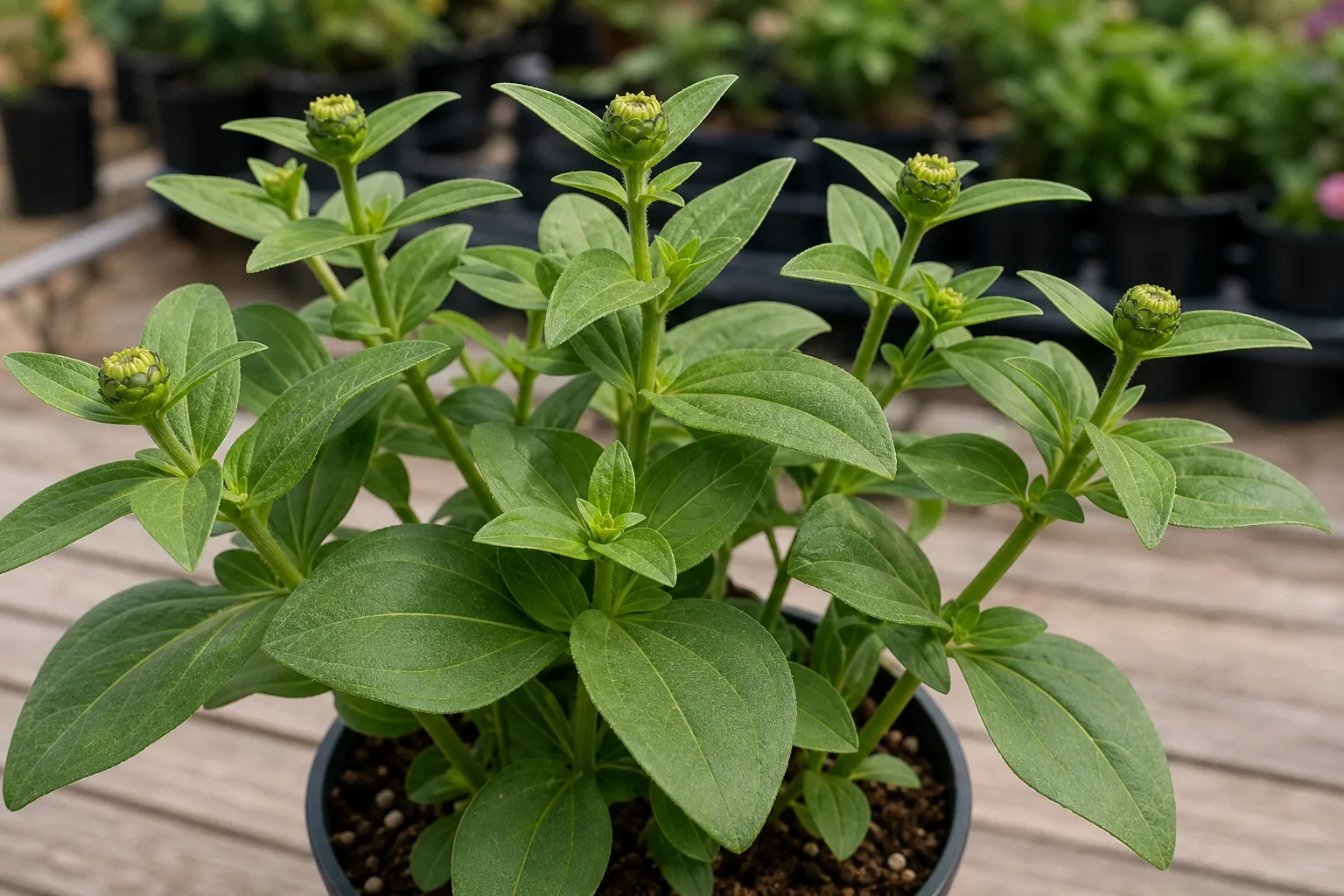
Zinnias can have larger leaves lower on the stem and smaller leaves nearer the flower heads. The flower head is also surrounded by bracts, which are not the same structure as an ordinary foliage leaf.
When a dwarf zinnia forms buds, compare the small structures near those buds with their position on the shoot. This is a different observation from several fully expanded foliage leaves becoming smaller. A photograph of the pattern does not establish a particular hormonal cause.
A practical order for checking smaller new leaves
When new leaves keep getting smaller, sort the clues in this order:

- Wait for the leaf to mature: make sure it is not simply a newly unfolded leaf that is still expanding.
- Look for a pattern: is it one small leaf, or several new mature leaves getting smaller in sequence?
- Check light: is the plant farther from a window, growing in winter light, shaded by curtains or buildings, or also becoming leggy?
- Check the root zone: has the plant been in the same pot for years, are roots visible through drainage holes, does water run through quickly, or does the mix stay wet and heavy?
- Check watering frequency: does the plant often dry to wilting, swing sharply between wet and dry, or only get wet at the surface?
- Check recent changes: was it moved, repotted, pruned, purchased, or exposed to a seasonal shift?
- Check flowering clues: on zinnia-type bedding plants, are the shoot tips forming buds, with smaller leaves or bracts clustered near those buds?
- Check nutrient context: has the plant been in exhausted media for a long time, or are there color symptoms too? Do not diagnose a fertilizer problem from leaf size alone.
The goal is not to force one answer. The goal is to separate clues that often overlap.
Common mix-ups
- ✕ Smaller new leaves mean the plant just needs fertilizer.
- ✓ Nutrient supply can affect growth, but light, roots, water rhythm, and season are also common. Leaf size alone cannot identify a specific fertilizer need.
- ✕ A tiny newly emerged leaf is already a problem.
- ✓ A young leaf may simply still be expanding. Compare after it matures.
- ✕ Moving the plant into the strongest direct sun will make the next leaves large.
- ✓ Low light is worth checking, but sudden strong sun and heat can also stress foliage. Match the plant to an appropriate light range.
- ✕ A bigger pot always means bigger leaves.
- ✓ Roots need room, but an oversized pot can keep too much mix wet for too long. Pot size has to work with root mass, drainage, and aeration.
- ✕ A small leaf that has already matured will later grow into a much larger mature leaf.
- ✓ Once a leaf has matured, its size usually changes only slightly. Watch the next new leaves instead.
- ✕ Smaller leaves near dwarf zinnia flower buds mean the plant is deficient or in bad condition.
- ✓ Compare leaf position and distinguish foliage leaves from bracts around zinnia flower heads. A smaller structure near a bud does not by itself identify a growth problem.
Frequently Asked Questions
Are small newly emerged leaves normal?
They can be. New leaves often start smaller, softer, thinner, and lighter in color than mature leaves. Wait until the leaf has fully expanded before comparing it with older leaves.
Does low light always cause smaller new leaves?
Not always, but it is a common direction to check. If smaller leaves appear with long internodes, leaning toward a window, paler color, loss of variegation, or older leaf drop, low light becomes more likely.
Should I fertilize when new leaves are small?
Not from this clue alone. If light is too low, roots are airless, or the potting mix is unstable, fertilizer may not fix the problem and may add stress. Check light, water, roots, and media first.
Can a small pot make leaves smaller?
It can. In an excessively pot-bound plant, roots may crowd the container, reduce usable media space, and make water and air less stable. Smaller new leaves can be one clue, but it should be read with the whole plant.
Do small structures around zinnia buds mean all new leaves are shrinking?
No. First distinguish foliage leaves from the bracts surrounding the flower head, and compare leaf position. Zinnia leaves lower on the stem can be larger. That positional difference alone does not establish poor growth or a particular hormonal cause.
Why were the old leaves large, but the new leaves at home are small?
The older leaves may have formed in a store or greenhouse under different light, humidity, temperature, and watering conditions. New leaves reflect the conditions in your current space.
Will a small leaf become large later?
If it is still expanding, it may continue to grow for a while. If it is already mature, it usually will not become dramatically larger. The next new leaves are the better signal to watch.
Do pothos, philodendron, and monstera follow the same rule?
The broad observation route is similar: check light, roots, watering rhythm, and recent changes. Different plants naturally vary in leaf shape, leaf expansion speed, and mature leaf size. Do not apply one plant’s splits, holes, or growth habit to all houseplants.
How many days should I wait before judging a new leaf’s size?
There is no fixed number of days for every plant. Follow the same leaf as it unfolds, expands, and develops a more mature texture. Compare it with earlier mature leaves once it is no longer visibly expanding.
Related Terms
- New growth: recently produced leaves, shoots, or stems that may still be expanding.
- Leaf expansion: the period when a young leaf unfolds and approaches mature size.
- Internode: the stem segment between two nodes, often longer under low-light stretching.
- Leggy growth: thin, stretched growth with longer spaces between leaves.
- Root-bound or pot-bound: a container condition where roots are crowded and media space becomes limited.
- Stunted growth: growth that continues but is slower, smaller, or weaker than expected.
- Vegetative growth: growth focused on roots, stems, and leaves.
- Reproductive growth: growth focused on flowers, fruits, and seeds.
Read next
Evidence
References
These sources were used to check the plant-science concepts and gardening context in this article.
View sources and further reading (17)
- usanpn.org — Nugget7
- extension.umn.edu — lighting indoor plants
- lsuagcenter.com — page1505480034837
- uaex.uada.edu — 20210428RepottingHouseplants.aspx
- extension.wvu.edu — common houseplant care
- openstax.org — 30 1 the plant body
- openstax.org — 30 2 stems
- openstax.org — 30 6 plant sensory systems and responses
- openstax.org — 32 1 reproductive development and structure
- bio.libretexts.org — 05: Leaves
- labs.plb.ucdavis.edu — development.html
- usanpn.org — USA NPN PhenophasePrimer Section1 June2017.pdf
- bio.libretexts.org — 40.2.1: Flowering
- extension.umn.edu — foliar nutrient tests
- extension.oregonstate.edu — environmental factors affecting plant growth
- plants.ces.ncsu.edu — zinnia elegans
- missouribotanicalgarden.org — PlantFinderDetails.aspx