Thinning Seedlings Means Redistributing Growing Space After Germination
Thinning seedlings can be understood as one simple idea: after seeds germinate, not every seedling is left to keep growing in the same small space.
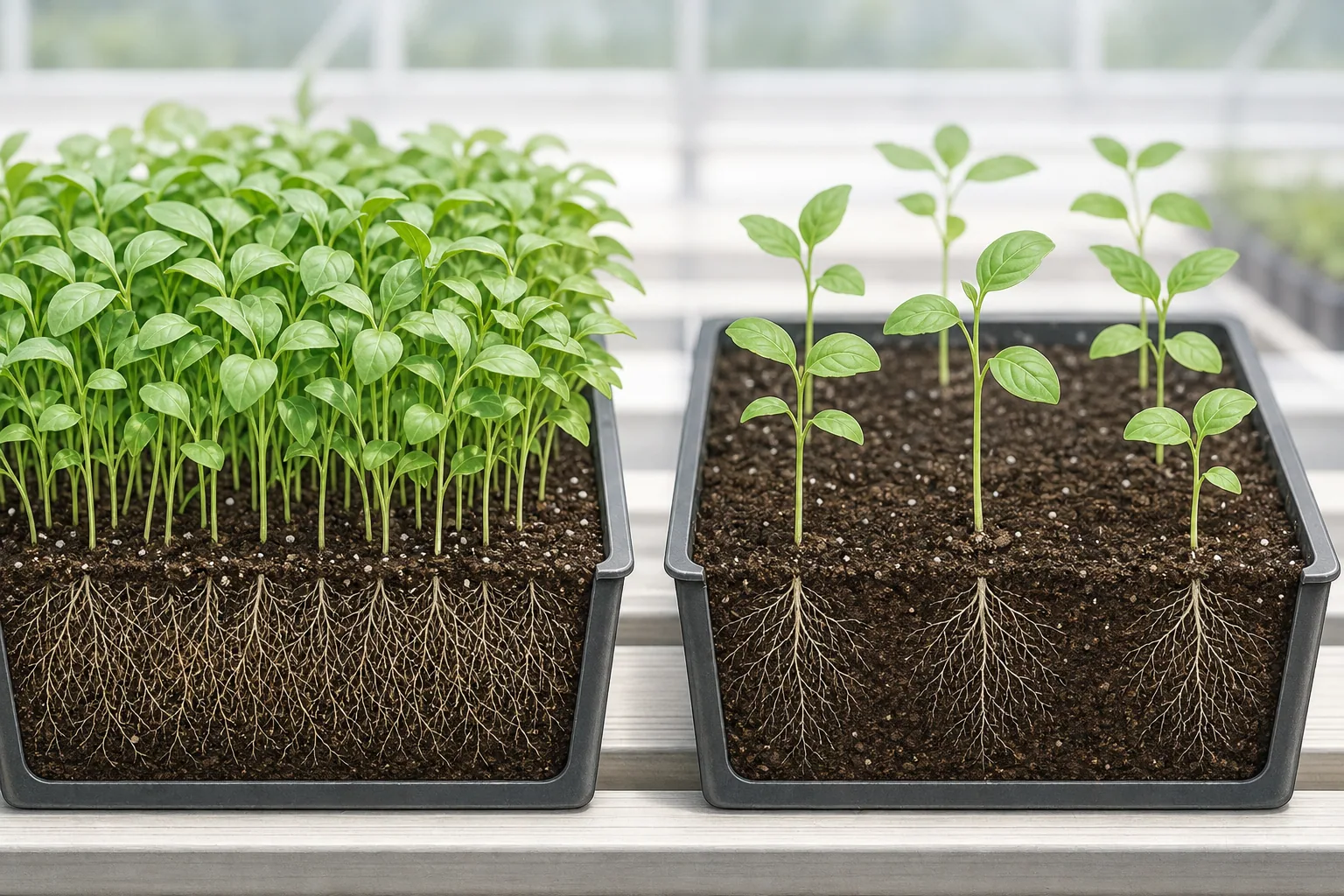
At first, this may sound like “making fewer plants.” But the real issue is space and resources. Even very young seedlings already need light, water, mineral nutrients, air, and room for their roots to work. If too many seedlings are crowded into one small area, they do not only grow side by side. They compete above the surface for light, and below the surface for root space, water, and mineral nutrients.
So thinning is not a magic trick, and it does not guarantee healthy plants. It is better understood as a way to reduce crowding while young plants are beginning to organize their basic jobs: roots below, stems connecting the plant, and leaves reaching toward light.
Why Are Seeds Often Sown More Densely Than the Final Number of Plants?
People often sow more seeds than the number of plants they expect to keep. The reason is practical: not every seed germinates, and not every newly germinated seedling grows with the same strength.
That does not mean the sowing failed. It simply increases the chance that there will be seedlings to observe and choose from. Once the seedlings have actually emerged, the question changes: are the extra seedlings now crowding one another in the same small space?
From a plant biology point of view, germination is only the beginning. A seedling must then build a working root, stem, and leaf system. Roots need to enter the growing medium and contact water and mineral nutrients. Leaves need to open and receive light. Stems connect the upper and lower parts of the plant. When seedlings are too dense, these jobs become something many young plants are trying to do in the same place at the same time.
Above Ground, Seedlings Compete for Light; Below Ground, They Compete for Space
When seedlings are too dense, the easiest thing to see is leaf overlap. Seedlings near the outside or seedlings that are slightly taller may receive light first. Seedlings inside the cluster or lower in the canopy receive less light.
Plants can sense their light environment. When light is limited or shaded by nearby plants, seedlings may become thinner and more elongated as they grow toward brighter areas or upward through the crowd. This is one reason crowded seedlings can look stretched or uneven.
But crowding is not only an above-ground issue. Roots are also active in the same small volume of growing medium. Roots help anchor the plant, absorb water, and take up mineral nutrients. If many root systems are packed together, each seedling has a smaller area to explore. Water and mineral nutrients are not automatically divided evenly among all seedlings. What each plant can access depends on where its roots are, how much water is present, and what mineral nutrients are available in that part of the medium.
This is the core idea behind thinning: when plant density is too high, shoots compete for light, while roots compete for water, mineral nutrients, and growing space.
Airflow Is Also Part of the Seedling Environment
When seedlings are packed closely together, air movement between leaves, stems, and the surface of the growing medium may also become poorer. Poorer air movement can let moisture linger around the seedlings, making the small growing environment more still and humid. In some situations, that kind of environment may also make disease more likely to occur.
This relates to growing medium aeration, but it is not the same thing. Medium aeration is mainly about the balance of water and air in the root zone. Seedling crowding involves several layers at once: air around leaves, space for roots, and the small microenvironment of the whole seedling area.
Seen this way, thinning is not only about making a tray look neat. It reduces several forms of crowding that can happen at the same time: shading, overlapping roots, and limited air movement.
Thinning and Transplanting Are Not the Same Thing
Thinning is often mentioned together with transplanting, but they are not the same process.
Thinning means reducing the number of seedlings left in the same area. Transplanting means moving a plant from one place to another. In some situations, people may thin seedlings and move some of them elsewhere. In other situations, thinning simply means removing extra seedlings, with no transplanting involved.
What Can You Observe in a Seedling Tray?
If you want to think about thinning as a plant biology observation instead of a step-by-step recipe, a few clues are useful.
First, look at whether the leaves are already covering one another. This helps you understand light competition.
Second, notice whether many seedlings are stretching toward the same bright direction, or whether seedlings inside the cluster look thinner or weaker than those outside.
Third, imagine what is happening below the surface. From above, you may see only a few small leaves. Under the medium, however, many young roots may already be exploring the same layer.
These observations connect thinning back to basic plant science. After seed germination, a seedling becomes a young plant. It uses leaves to receive light, roots to contact water and mineral nutrients, and stems with vascular tissues to connect the upper and lower parts. Thinning is one way people adjust plant density during that process.
Common Confusions
- ✕ Thinning means the earlier sowing failed.
- ✓ Thinning often happens because extra seeds were sown as a backup, and crowding is reduced after germination.
- ✕ More seedlings always lead to a better result.
- ✓ When seedlings are too dense, light, root space, water, mineral nutrients, and airflow can all become sources of competition.
- ✕ Thinning is the same as transplanting.
- ✓ Thinning reduces the number of seedlings left in one area. Transplanting moves a plant to another place. The two can happen together, but they are different ideas.
- ✕ If seedlings are not thinned, they will definitely die.
- ✓ Not necessarily. But competition may become stronger, and differences in size, stretched growth, or difficulty observing individual seedlings may become more obvious.
- ✕ All plants can be thinned at the same time and distance.
- ✓ Different plants and growing goals vary widely. This article explains the concept and does not provide a fixed gardening prescription.
Frequently Asked Questions
What does thinning seedlings mean?
Thinning seedlings means reducing the number of seedlings left in the same small area after seeds have germinated. The usual purpose is to reduce crowding so the remaining seedlings have clearer access to light, root space, water, mineral nutrients, and airflow.
Why not leave every seedling after germination?
Because germination is only the beginning. Seedlings still need to grow leaves, extend roots, absorb water, take up mineral nutrients, and receive light. If all seedlings remain crowded together, both the shoots and roots may compete, and having more seedlings is not always more helpful.
When seedlings are too crowded, do they compete for light first or root space first?
Both can happen. Light competition is usually easier to see because leaves overlap and shade one another. Root competition happens below the surface, where roots explore the same small volume of growing medium. Thinning is not about one single cause. It is about the whole growing space.
Does thinning always mean pulling seedlings out?
Not always. Different situations may involve different actions. Some seedlings may be removed, and in some cases some may be moved elsewhere. This article only explains the plant biology concept. It does not provide timing, spacing, or crop-specific instructions.
What happens if seedlings are not thinned?
There may not be an immediate problem, but competition between seedlings can increase. You may see overlapping leaves, larger differences in seedling size, thinner elongated growth, or a seedling area that becomes harder to observe clearly.
Is thinning the same as selection?
Not exactly. Thinning mainly adjusts seedling density. Selection involves choosing which plant traits to keep. These ideas can meet in gardening and plant growing, but they are not the same concept.
Related Terms
- Thinning seedlings: Reducing the number of seedlings left in one area after germination to lower crowding and competition.
- Seedling: A young plant shortly after germination, while roots, stems, and leaves are still becoming established.
- Plant density: The number of plants in a given space; it can affect light, root space, and resource competition.
- Shading: When leaves block light from reaching other leaves or seedlings.
- Root space: The area where roots can explore the growing medium for water, mineral nutrients, and air spaces.
- Mineral nutrients: Inorganic elements plants take up from their environment and use for growth and normal plant functions.
Read Next
Evidence
References
These sources were used to check the plant-science concepts and gardening context in this article.