A pine cone may look like a fruit, but a typical woody pine cone is not a fruit in the botanical sense. It is the mature female, or seed, cone of a pine. Earlier in its development, ovules occur near the base of the inner surfaces of fertile cone scales rather than inside an ovary.
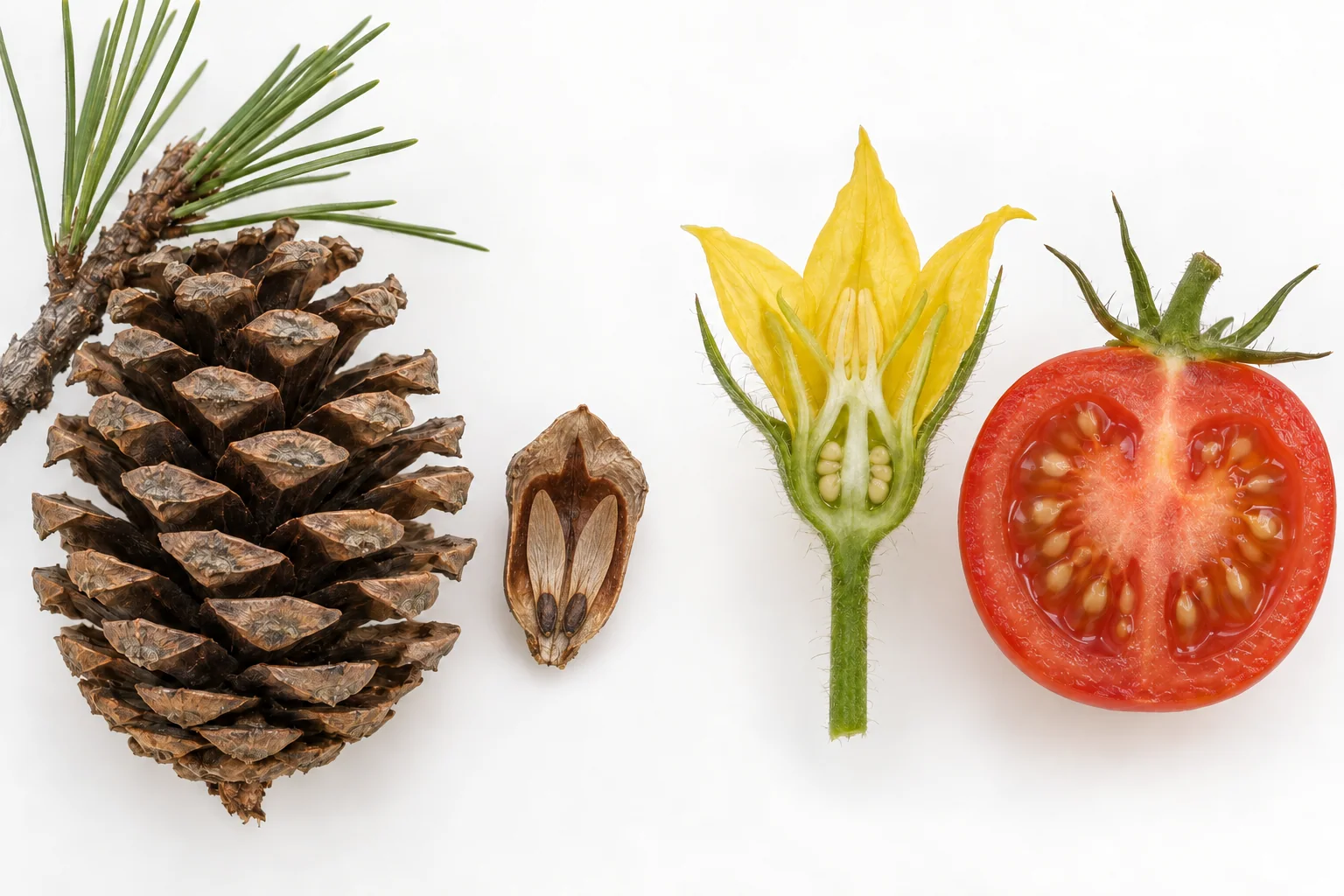
Gymnosperms and angiosperms are both seed plants. Both produce pollen, ovules, and seeds. The key difference is simple: angiosperm ovules are enclosed in an ovary, while gymnosperm ovules are not. This is why a pine cone is not a fruit.
Both groups are seed plants
Start by separating three terms:
- Pollen carries the male reproductive material.
- An ovule is a female reproductive structure before fertilization.
- After successful fertilization and later development, an ovule can become a seed.
A seed usually contains an embryo, protective tissues, and some form of stored or nutritive tissue. Gymnosperms and flowering plants both produce seeds. Their difference lies in how the ovules are enclosed and where pollen must arrive.
The steps are still not interchangeable. Pollination is the arrival of pollen at the appropriate female structure; fertilization is the later fusion of male and female gametes. Seeing pollen does not prove that fertilization has occurred. For a basic introduction to the first step, see What Is Pollination?.
The clearest dividing question: where are the ovules?
Gymnosperms: the ovules are not inside an angiosperm ovary
The name gymnosperm is often explained as “naked-seed plant.” Here, “naked” is a relative term. The ovule, and later the seed, is not enclosed in the kind of ovary formed by an angiosperm carpel. It does not mean that the ovule has no integument or that the mature seed has no seed coat.
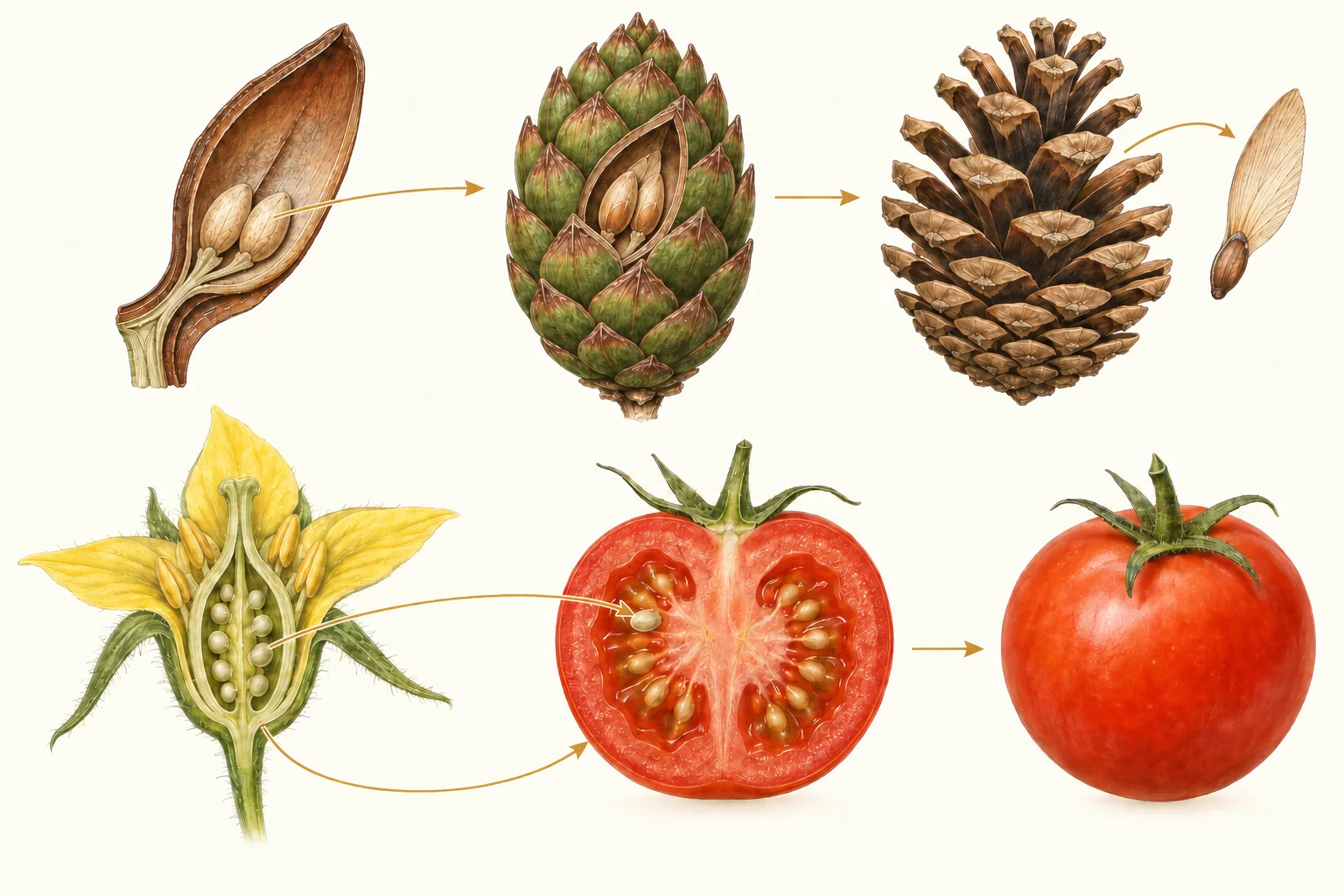
In pines, a female cone has a central axis surrounded by many scales. Each fertile scale typically bears two ovules near its base on the inner, or upper, surface. During pollination, pollen reaches the region near an ovule’s opening, called the micropyle. After successful fertilization, an ovule can continue developing into a seed.
In many familiar pines, cone scales stay closed while seeds develop, then open as the mature cone dries and releases seeds. Some pine species delay opening. So “naked” does not mean “exposed to the air from beginning to end.” It means that the ovules are not enclosed by an angiosperm ovary.
Angiosperms: the ovules are inside an ovary
In flowering plants, the female reproductive structure is a carpel or a group of carpels forming a pistil. Its main parts are the stigma, style, and ovary. Ovules sit inside the ovary. Pollen usually lands on the stigma, then a pollen tube grows through the style toward an ovule in the ovary.
After fertilization, an ovule can develop into a seed, while the ovary usually contributes to the formation of a fruit. Some fruits also include tissues from other floral parts, so a fruit is not always made from the ovary wall alone. See the main parts of a flower for the positions of the stigma, style, ovary, and ovules.
For the next step, see How Does an Ovule Become a Seed?. To compare the mature structures, see What Is the Difference Between a Fruit and a Seed?.
The comparison in one table
| Comparison | Gymnosperms | Angiosperms, or flowering plants |
|---|---|---|
| Common female reproductive structure | Pines and many other conifers bear cones; other gymnosperms may have very different structures | A flower containing carpels or a pistil, including an ovary |
| Where the ovules are | Not inside an ovary; in pines, two ovules usually lie near the base of the inner surface of a fertile scale | Inside an ovary formed by one or more carpels |
| A common pollination location | In pines, near the micropyles of ovules within a female cone | On the stigma, followed by pollen-tube growth toward the ovary |
| Shared result after fertilization | The ovule develops into a seed | The ovule develops into a seed |
| Ovary and fruit | No angiosperm ovary, so no fruit develops from an ovary | The ovary usually contributes to a fruit that encloses or carries seeds |
| What the outside may look like | Woody cones, winged seeds, fleshy seed appendages, or other varied forms | Fleshy or dry fruits; not every fruit resembles an everyday sweet fruit |
This table uses pine as an easy example, but pine does not represent every gymnosperm. Cycads, ginkgo, and other gymnosperms can have female reproductive structures that look very different from a woody pine cone. Angiosperm fruits also vary widely.
“Naked” does not mean unprotected
Gymnosperm ovules have an integument, which develops into the seed coat after fertilization. Mature seeds have a seed coat; some also have a wing or other attached structures. “Naked” means that the ovule is not enclosed by an ovary, not that the embryo has no outer layer.
In pines, cone scales can close while seeds develop, providing them with physical cover. This is another reason not to read “naked” as “unprotected.” To look more closely at the embryo, seed coat, and stored tissues, see What Are the Parts of a Seed?.
Why isn’t a pine cone a fruit?
In botany, a fruit is usually a mature ovary and may include other associated floral tissues. A fruit often encloses or carries seeds, but “it surrounds a seed” is not the only test. Its developmental origin matters: did it develop from an ovary or related flower tissues?
A typical woody pine cone has no ovary enclosing the ovules. It is a female seed cone made of an axis and many scales. In pines, ovules on the inner surfaces of fertile scales can develop into seeds after fertilization; the scales are not a fruit wall, or pericarp. The cone can hold, protect, and release seeds without being a fruit.
Pines can also produce smaller male, or pollen, cones whose function is to produce pollen. When people say “pine cone,” they usually mean the larger female seed cone, but not every cone on a pine has the same role. A cone is a reproductive structure, not a synonym for fruit.
Not all gymnosperms look like pines
Modern gymnosperms include conifers as well as cycads, ginkgo, and gnetophytes. Their reproductive structures can look very different. Pine is one familiar example, not a model for the whole group.
Some gymnosperms also have structures that look fruit-like. Juniper can produce a fleshy female cone with a berry-like appearance, and yew seeds can have a fleshy outer structure called an aril. These examples show why appearance and botanical origin are not the same thing. They do not have an angiosperm ovary simply because they look round, colorful, or fleshy.
For the same reason, do not generalize from the number of scales or seeds in one pine cone to every gymnosperm. Different groups have different reproductive structures.
Angiosperm fruits are not always fleshy
The reverse confusion is also common: flowering plants do produce fruits, but a fruit does not have to be soft, sweet, or juicy. Pods, capsules, winged fruits, and caryopses are examples of dry or specialized fruits.
To decide whether a structure is a botanical fruit, first ask whether it developed from an ovary and related flower tissues. Then examine its mature form: Is it fleshy or dry? Does it split open? Does it enclose or carry seeds? For more fruit categories, see What Are the Different Types of Fruit?.
A seed and a fruit are different structures. The seed develops from an ovule and contains the embryo; the fruit develops from the ovary and sometimes other flower tissues, and may surround or carry seeds. How Do Seeds Spread? explains how mature seeds move away from the parent plant.
What can you observe at school, in a park, or in a garden?
If you find an open pine cone, examine the inner surface of a scale near its base. You may see a paired seed scar even if the seeds have already dispersed. A woody structure that opens and once held seeds is not necessarily a fruit.
You can also compare a cone with a dry or fleshy fruit from a flowering plant. Instead of judging by appearance, ask which structure developed from an ovary.
If you compare male and female pine cones, remember that a smaller pollen cone and a larger seed cone can have different sizes, shapes, and periods of appearance. A photograph of a mature female cone shows only one structure and one stage of pine reproduction.
When a flowering plant finishes blooming, you may observe a swelling structure at the base of the flower. That can be a clue that later development is occurring, but appearance alone cannot prove that every ovule was fertilized or that every seed will mature.
Common mix-ups
- ✕ Gymnosperm seeds have no protection. ✓ “Naked” means that the ovules or seeds are not enclosed in an angiosperm ovary and fruit. Seeds can still have seed coats, wings, or other structures.
- ✕ A pine cone is the pine tree’s fruit. ✓ A typical pine cone is a female seed cone. In pines, ovules on the inner surface of fertile scales can develop into seeds; the cone does not develop from an ovary.
- ✕ Cone scales are fruit walls. ✓ Cone scales and the pericarp of a flowering-plant fruit have different origins.
- ✕ Seeing a seed means you are seeing a fruit. ✓ A seed develops from an ovule after fertilization. A fruit develops from an ovary and possibly related floral tissues.
- ✕ All gymnosperms grow typical woody pine cones. ✓ Gymnosperms include several groups with diverse reproductive structures. Pine is only the most familiar example.
- ✕ All flowering-plant fruits are sweet, soft, and juicy. ✓ Many botanical fruits are dry or have specialized forms.
- ✕ Pollination means fertilization is complete. ✓ Pollination is pollen reaching the appropriate location. Fertilization requires the later fusion of male and female gametes.
Frequently asked questions
Is a pine cone a fruit?
No. The woody pine cone people usually mean is a pine’s female, or seed, cone. It does not develop from an ovary, and its scales are not a fruit wall. The scales can still carry, protect, and release seeds.
Are an ovule and a seed the same thing?
No. An ovule is the female reproductive structure before fertilization. After successful fertilization and further development, the ovule can become a seed. The seed then contains an embryo, a seed coat, and some form of stored or nutritive tissue.
Are gymnosperm seeds completely naked and unprotected?
No. “Naked” means that the ovules are not enclosed by an ovary. Gymnosperm ovules have an integument that contributes to the seed coat after fertilization; some mature seeds also have wings, fleshy appendages, or other associated structures.
Do all gymnosperms grow pine cones?
No. Conifers such as pines, firs, and cypresses are familiar cone-bearing gymnosperms, but cycads, ginkgo, gnetophytes, and other gymnosperms have different reproductive structures. Even among conifers, not every cone has the same function.
Do all seed plants produce fruits?
No. Gymnosperms produce seeds but do not have ovaries, so they do not form fruits from ovaries. Angiosperms do produce fruits, but those fruits may be dry rather than fleshy.
Do pines have male cones as well as female cones?
Pines produce pollen cones and seed cones. The smaller male cones produce pollen, while the female cones bear ovules that can develop into seeds. The everyday term “pine cone” usually refers to the larger female cone.
Why do some gymnosperm structures look like berries or fruits?
Some gymnosperms produce fleshy cones or fleshy structures attached to seeds. Juniper’s berry-like structure is a fleshy female cone, and a yew seed may be surrounded by a fleshy aril. Their appearance does not change their developmental origin.
Does pollination mean fertilization has happened?
No. Pollination means that pollen has reached an appropriate female structure. A pollen tube and later gamete fusion are still needed before fertilization can occur. Pollen that is visible on a surface is not, by itself, proof of successful fertilization.
Related terms
- Gymnosperm: A seed-plant group in which the ovules are not enclosed in an angiosperm-style ovary.
- Angiosperm: A flowering-plant group in which the ovules are enclosed in an ovary.
- Flowering plant: A plain-language term for an angiosperm.
- Cone or strobilus: A reproductive structure made from an axis and associated scales, bracts, or sporophylls; it is not a synonym for fruit.
- Female, seed, or ovulate cone: A cone that bears ovules, which can develop into seeds after fertilization.
- Male or pollen cone: A cone that produces pollen.
- Ovule: A female reproductive structure that can develop into a seed after fertilization.
- Seed: A mature reproductive structure that usually contains an embryo, protective tissues, and stored or nutritive tissue.
- Ovary: The basal part of a carpel or pistil that encloses angiosperm ovules.
- Carpel or pistil: The female part of a flower that includes the stigma, style, and ovary, either as one carpel or several fused carpels.
- Integument: Tissue surrounding an ovule that is involved in seed-coat formation.
- Seed coat: The protective outer layer of a seed; it is not the same as a fruit wall.
- Fruit: In angiosperms, a mature ovary and possibly associated floral tissues, often surrounding or carrying seeds.
- Pericarp: The fruit wall, usually developed mainly from the ovary wall; it is not a cone scale.
- Pollination: The transfer of pollen to an appropriate female structure.
- Fertilization: The fusion of male and female gametes after the earlier steps of reproduction.
Related reading
Evidence
References
These sources were used to check the plant-science concepts and gardening context in this article.
View sources and further reading (14)
- openstax.org — 26 2 gymnosperms
- openstax.org — 26 2 gymnosperms
- openstax.org — 26 3 angiosperms
- openstax.org — 32 1 reproductive development and structure
- openstax.org — 32 2 pollination and fertilization
- fao.org — AD232E02.htm
- arboretum.harvard.edu — 2013 70 4 beyond pine cones an introduction to gymnosperms.pdf
- kew.org — what is a seed
- srs.fs.usda.gov — gtr so106.pdf
- srs.fs.usda.gov — gtr se013.pdf
- naturalhistory2.si.edu — genusdescr.cfm
- open.lib.umn.edu — 8 1 fruit morphology
- labs.plb.ucdavis.edu — flranat.html
- nzplants.auckland.ac.nz — pine life cycle.html