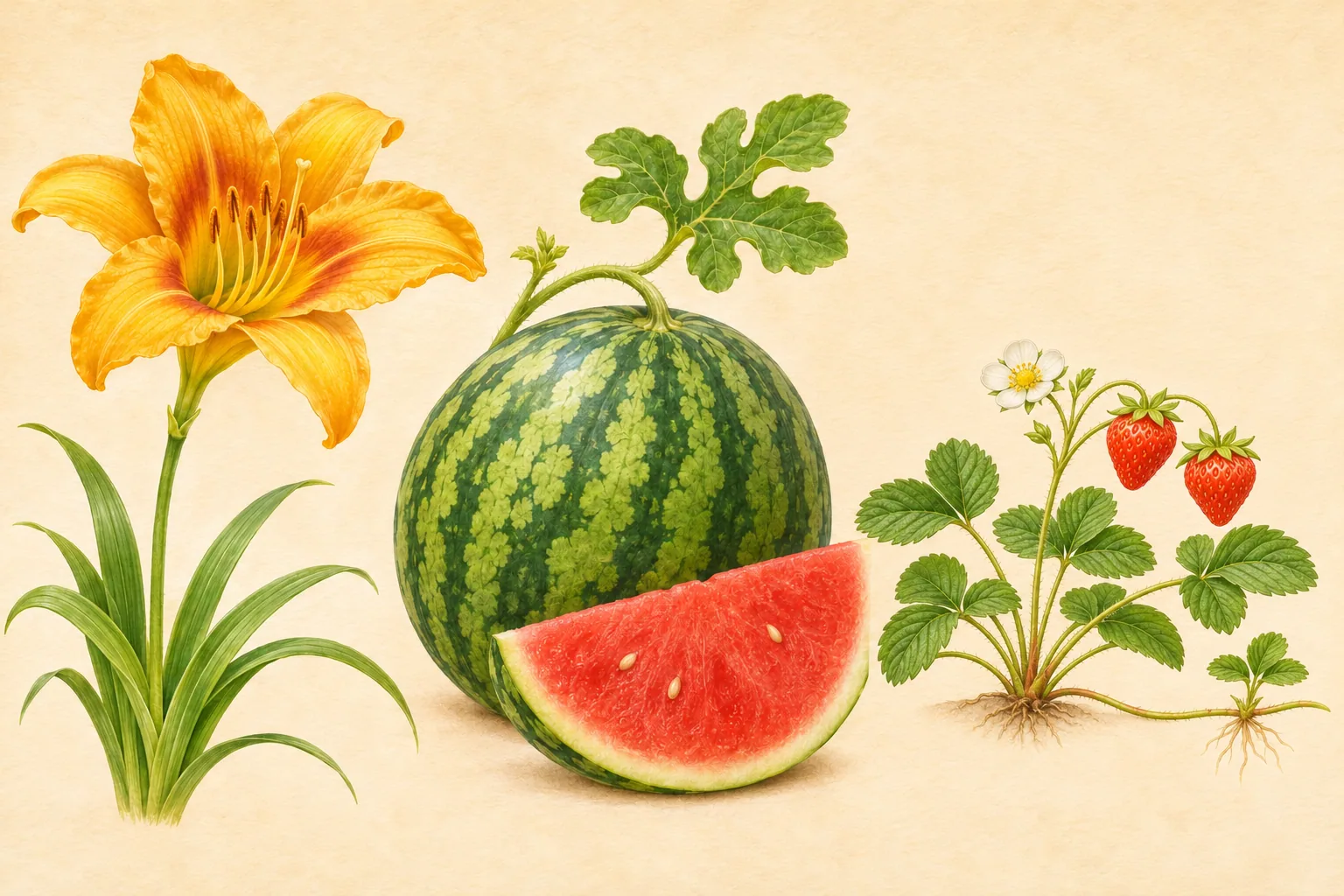
Examples of polyploid plants in horticulture include tetraploid daylilies, triploid seedless watermelons, and octoploid cultivated strawberries. Each illustrates a different question. Daylilies let us compare documented ploidy and cultivar traits; watermelons connect ploidy with seed formation; strawberries show how several chromosome sets can already be part of a crop’s inherited background.
These examples do not share a simple label such as “larger flowers,” “larger fruit,” or “completely sterile.” To connect chromosomes with a horticultural observation, first identify the plant or cultivar, then check what its records actually establish.
Chromosome sets and chromosome counts are different numbers
Ploidy describes the number of complete chromosome sets. The symbol x represents the basic chromosome number in one set, so 2x, 3x, and 4x indicate two, three, and four sets. The total number in a somatic cell is commonly recorded as 2n. Think of somatic cells here as ordinary cells in tissues such as leaves or root tips.
Watermelon has 11 chromosomes per basic set: a triploid has 2n = 3x = 33. Cultivated strawberry has seven per set: its octoploid number is 2n = 8x = 56. Different species do not necessarily have the same number of chromosomes in one set. For the full introduction to sets and how polyploidy can arise, see What Is Polyploidy?.
| Plant or material | Ploidy and somatic chromosome number | What does this example illustrate? |
|---|---|---|
| Diploid and tetraploid daylily cultivars | 2n = 2x = 22 and 2n = 4x = 44 | Different ploidies within a horticultural group; cultivar traits cannot all be attributed to ploidy |
| Common triploid seedless watermelons | 2n = 3x = 33 | Reduced fertility and the distinction between seed formation and fruit development |
| Cultivated strawberry, Fragaria × ananassa | 2n = 8x = 56 | An allopolyploid background; not every strawberry species has the same ploidy |
These numbers help identify the material. They are not a ranking of size or quality, or a list covering every cultivar in each group.
Daylilies: diploid and tetraploid cultivars in the same garden group
Daylilies belong to the genus Hemerocallis, which includes both diploid and tetraploid horticultural cultivars. The American Daylily Society lists ‘Stella de Oro’ as diploid and ‘Strawberry Candy’ as tetraploid. With a basic chromosome number of 11, those ploidies correspond to 22 and 44 chromosomes.
The registration records also describe traits. The recorded bloom size of ‘Stella de Oro’ is 2.75 inches, about 7 cm; that of ‘Strawberry Candy’ is 4.25 inches, about 10.8 cm. We can say that these two cultivars differ in both flower diameter and ploidy. However, this comparison alone does not yet establish that the second cultivar’s larger flowers are entirely the result of having twice as many chromosome sets.
They are different cultivars with different genetic backgrounds. This is not an experiment that divides the same starting material into two groups and changes only ploidy. Flower color, form, season, and plant traits may have been selected together during breeding. Parent plants, hybrids, and traits explains why that distinction matters.
Tetraploid daylilies have been important breeding material, as the University of Arkansas horticultural account describes. For an observer, the useful order is still to check cultivar identity and documented ploidy, then record traits such as flower diameter. A large flower alone cannot tell us that the plant has 44 chromosomes.
Seedless watermelons: the seed comes from one generation, the seedless fruit from the next plant
“If the watermelon is seedless, where does a new plant come from?” The answer becomes clearer when we separate two reproductive events.
In the usual production of triploid watermelon seed, a tetraploid seed parent is crossed with a diploid pollen parent. The seed parent has 44 chromosomes in its somatic cells. Following normal chromosome reduction and subsequent development, its egg cell carries 22; the diploid parent supplies a sperm cell carrying 11. Fertilization produces an embryo with 33 chromosomes, or three sets. That triploid embryo is enclosed in a seed and can germinate into a triploid plant.
When this plant later flowers, its reproductive situation is different. Three chromosome sets are difficult to distribute regularly during meiosis. Few functional reproductive cells develop, so most ovules do not become normally developed, mature seeds. In plants, meiosis first produces spores; further development gives rise to the structures that produce sperm or egg cells. A pollen grain is not itself a sperm cell.
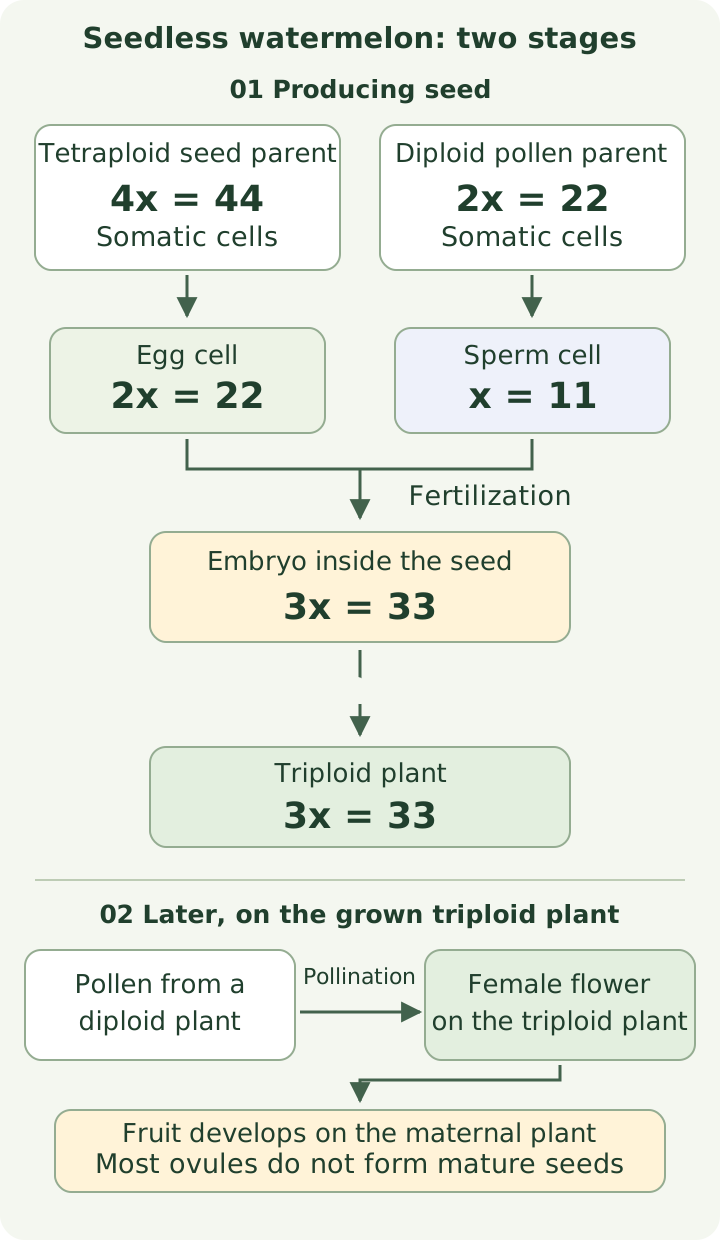
Triploid seedless watermelons generally still need pollen from a fertile plant to initiate normal fruit development. Pollination, fertilization, and the formation of a mature seed are distinct events. What happens after pollen lands on a stigma and how an ovule becomes a seed provide the foundation for understanding this example.
“Seedless” does not mean that every fruit lacks all seedlike structures. Alabama Cooperative Extension describes soft, incompletely developed seed coats and occasional hard seeds in these watermelons, with outcomes depending on cultivar and environment. Being triploid does not by itself establish that every reproductive cell must fail. Nor should every seedless fruit be assumed to come from a triploid plant.
Strawberries: eight sets can be a crop’s inherited background
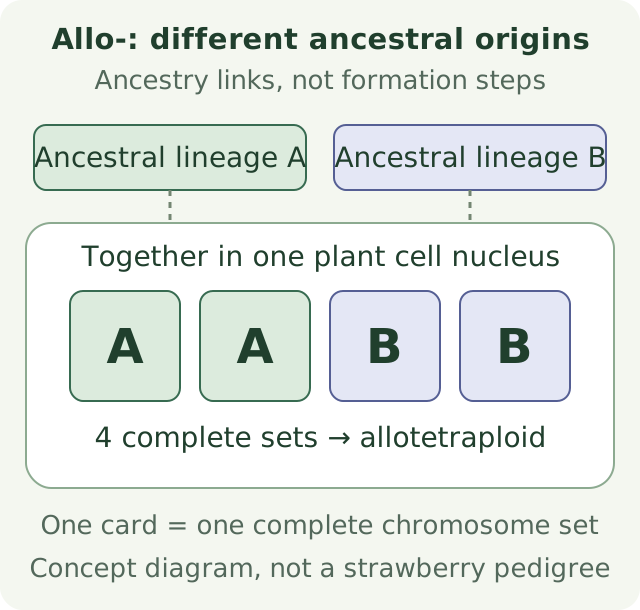
The usual cultivated strawberry, Fragaria × ananassa, is an allo-octoploid, with a somatic chromosome number of 2n = 8x = 56. The name describes both how many sets it has and their ancestral origins.
Octoploid describes the number of sets. Strawberry has a basic set of seven chromosomes, or x = 7; eight sets add up to 56 chromosomes. We are counting complete chromosome sets, rather than saying that each chromosome contains eight copies of its DNA.
Allo- describes ancestral origins. Genomes from different ancestral plant lineages combined earlier in evolution, leaving chromosome sets with different origins. The eight sets should therefore not be imagined as eight identical photocopies of one set of DNA, or as one set donated by each of eight different species.
A genomic study published in The Plant Cell in 2024 compared wild, heirloom, and modern cultivated material, documenting this group’s ploidy and breeding history.
This history differs from the watermelon example. Cultivated strawberry arose through hybridization between the wild octoploids F. virginiana and F. chiloensis. It did not become octoploid simply by crossing two diploid strawberry plants. Its polyploid background has an earlier evolutionary history, while the more recent horticultural hybridization involved parents that already carried that background.
Octoploidy does not make a strawberry fruit four times larger than another strawberry, or predict all the traits of a cultivar. Comparisons between modern cultivated strawberries and a wild species can differ in ploidy, species background, and generations of selection at the same time. Their entire difference cannot be assigned to set number.
The common name “strawberry” also covers different species, so it should not always be labeled octoploid. To connect this genetic background with actual organs, see What Is a Strawberry Plant?, including its flowers, runners, small surface fruits, and enlarged receptacle.
How can ploidy records help a horticultural observation?
When a record says “tetraploid” or “octoploid,” consider three things:
- Does the material match? Is the record about a species, a named cultivar, or the material in one experiment? Without a clear cultivar identity, another plant’s ploidy record may not apply.
- What supports the ploidy assignment? Cultivar records, chromosome counts, and properly calibrated flow cytometry provide a stronger basis than large flowers or thick leaves. Flow cytometry measures nuclear DNA content and needs an appropriate reference; a reading is not a direct chromosome count.
- Which trait is being observed? Flower diameter, plant height, pollen performance, and seed maturity are separate observations. Knowing ploidy does not turn one of those traits into a guarantee of the others.
Difficulty forming seeds does not necessarily prevent a plant from continuing. Plants also have vegetative propagation pathways that do not involve fertilization, as explained in sexual and asexual reproduction. Which pathways a plant can use depends on its structure and biology, not ploidy alone.
Common points of confusion
- ✕A tetraploid daylily must have flowers twice the diameter of a diploid’s.
- ✓Tetraploid describes chromosome sets. Flower diameter also depends on cultivar background, selection, and environment; there is no such conversion rule.
- ✕Seedless watermelons cannot form seeds, so seed for growing them cannot exist.
- ✓Seed for a triploid plant comes from a cross between the parental generation. The fruit that the triploid plant later bears is where the seedless trait is mainly expressed.
- ✕An octoploid strawberry has eight completely identical copies of its DNA.
- ✓Cultivated strawberry is an allopolyploid with different ancestral contributions. Its chromosome sets should not be treated as identical.
- ✕Any plant with seedless fruit must be triploid.
- ✓A lack of mature seeds can have different causes. The material and its ploidy evidence still need to be identified.
Frequently Asked Questions
What are some examples of polyploid plants in horticulture?
Tetraploid daylily cultivars, triploid seedless watermelons, and octoploid cultivated strawberries are examples. Keep the scope clear: not all daylilies are tetraploid, and not every strawberry species is octoploid.
Do ‘Stella de Oro’ and ‘Strawberry Candy’ have the same ploidy?
No. The American Daylily Society lists them as diploid and tetraploid, respectively. Their recorded flower sizes also differ, but they are different cultivars, so that difference cannot be treated as the isolated effect of chromosome doubling.
Do seedless watermelons still need pollination?
Common triploid seedless watermelons generally need functional pollen to promote fruit development. Fruit development and the formation of mature seeds are distinguishable processes; seedlessness does not mean that pollination is entirely bypassed.
Is every tissue in a seed containing a triploid watermelon embryo also triploid?
No. Here, triploid describes the embryo inside the seed. The seed coat develops from maternal tissue, while endosperm formation involves a separate fertilization event. It would be incorrect to label every tissue in the seed 3x.
Must octoploid strawberries have fruit four times larger than diploid strawberries?
No. Chromosome-set number and organ size do not follow a fixed ratio. Different strawberry species and cultivars also have different genetic backgrounds and selection histories. Fruit traits need to be evaluated for the actual material, rather than inferred from 8x versus 2x.
Can large flowers, thick leaves, or few seeds reveal a plant’s ploidy?
These are clues to investigate. Confirmation needs traceable cultivar or research records, or analyses such as chromosome counting and DNA-content measurements. Appearance alone cannot establish a particular ploidy.
Related Terms
- Ploidy: The number of complete chromosome sets.
- Basic chromosome number (x): The number used as the one-set baseline; it varies among plant groups.
- Fertility: The capacity to form functional reproductive cells, participate in reproduction, and produce offspring.
- Allopolyploid: A polyploid with chromosome sets from different ancestral origins.
- Cultivar registration: A record of a named horticultural cultivar and its associated information. It does not mean that controlled experiments have established the cause of every trait.
Read next
Evidence and attribution
Sources and image rights
These sources were used to check the plant-science concepts and gardening context in this article.
View sources and further reading (13)
- daylilies.org — stella de oro
- daylilies.org — strawberry candy
- uaex.uada.edu — tetraploid daylily.aspx
- cucurbitbreeding.wordpress.ncsu.edu — seedless watermelon breeding
- aces.edu — seedless watermelons why are seeds costly and why do they produce seeds sometimes
- academic.oup.com — 7479895
- daylilies.org — chromosome
- mcilab.cals.ncsu.edu — m11 ranney.pdf
- pubmed.ncbi.nlm.nih.gov — 24415480
- openstax.org — 32 2 pollination and fertilization
- plants.ces.ncsu.edu — hemerocallis
- plants.ces.ncsu.edu — citrullus lanatus
- plants.ces.ncsu.edu — fragaria x ananassa
Image sources and rights
- Plant Note · project-generated — Created in SVG and served in its original format.
- Plant Note · project-generated — Created in SVG and served in its original format.