
Taking a Small Piece of a Plant into a Controlled Environment
Plant tissue culture can be understood as growing a very small part of a plant in a sterile, controlled environment on a culture medium. The starting material may be a cell, tissue, organ, embryo, or small piece of a shoot or stem. Any material removed from a plant for culture is called an explant.
When the goal is to produce many new plants, the process is often called micropropagation. This does not mean growing a miniature plant. It means using a small amount of starting material to produce many shoots, roots, and young plants in culture vessels.
Tissue culture is the broader group of methods. Micropropagation is one common application within it. The terms are related, but they are not exact synonyms.
Why Can a Small Explant Sometimes Grow into a Plant?
Many plant cells retain the genetic information needed to form a whole plant. Under suitable culture-medium, plant-growth-regulator, light, and environmental conditions, cells may divide again, change their growth pattern, and form shoots, roots, or a small plant. This capacity is often discussed through the concept of cellular totipotency.
Totipotency does not mean that every leaf placed in a vessel will become a complete plant. Regeneration depends on the species, the source and condition of the explant, the culture conditions, and the method being used. Some materials readily form new shoots; others may form only a cell mass or stop growing.
What Stages Commonly Appear in a Culture Vessel?
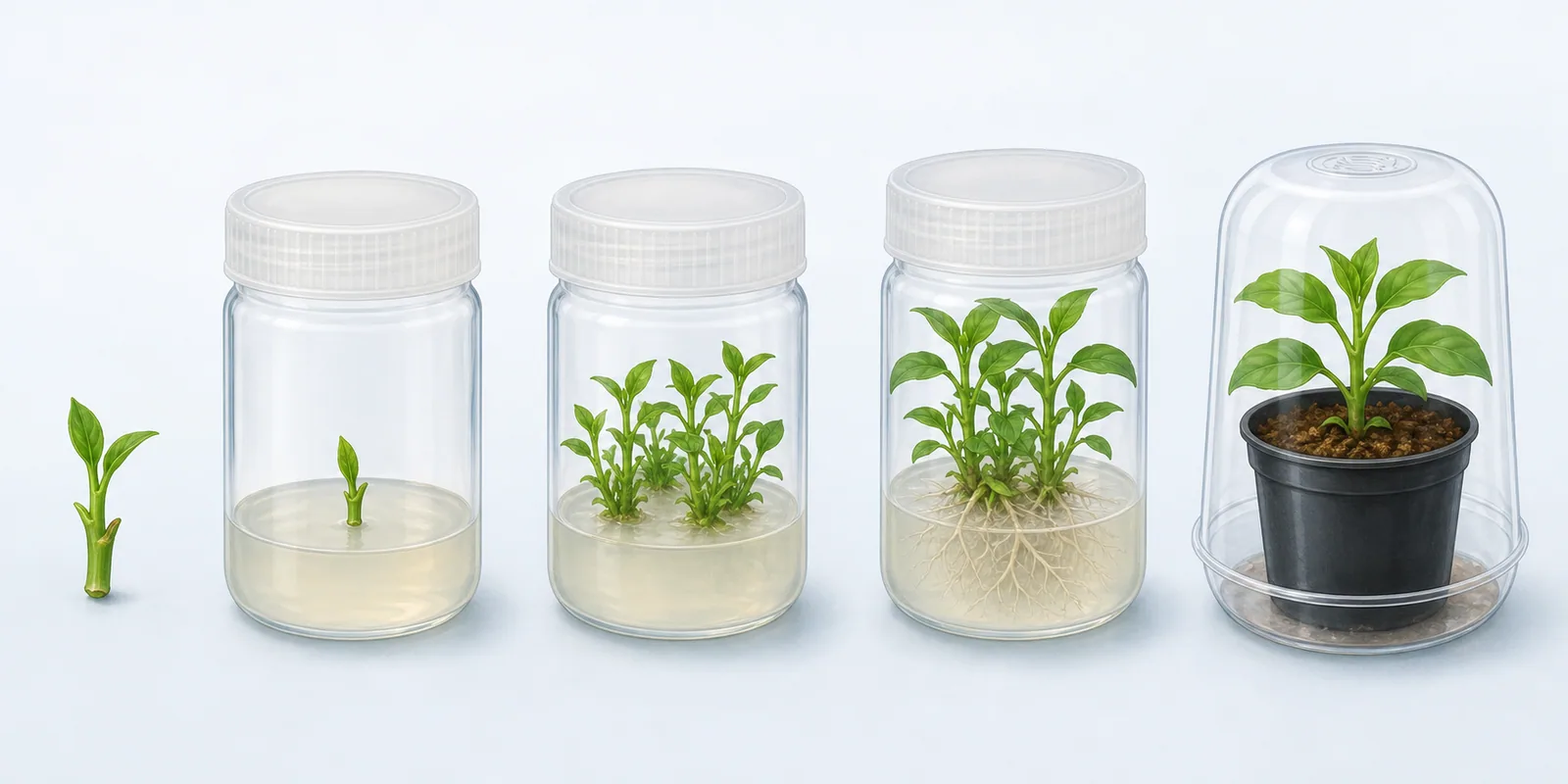
A common micropropagation pathway can be introduced through four broad stages:
- Establishing a clean culture: A suitable explant is taken from a healthy source plant and introduced into a culture environment that can be maintained without contamination.
- Multiplying shoots or plant material: The explant produces more shoots or small plant pieces, allowing a small starting sample to yield more culture material.
- Forming roots: A shoot develops roots and becomes a more complete young plantlet. Some methods root plants in the vessel; others complete rooting later.
- Acclimatization: Plantlets in culture have adapted to high humidity and controlled conditions. After leaving the vessel, they must gradually adjust to ordinary media, air humidity, and light.
Opening the lid is not the end. It begins another stage of growth and observation.
This four-stage map is an introduction, not a universal recipe. The order and timing may change with the species, material, and purpose.
Callus Does Not Appear Every Time
Callus is a mass of cells that has not yet developed a clear arrangement of organs. It may look like a small lump of tissue on the surface of the medium. Callus is not a root, and it is not already a plantlet. It is an intermediate state in some regeneration routes.
- Direct organogenesis: Shoots or roots form directly near the explant’s existing growing tissue, without a clearly visible callus stage.
- Indirect organogenesis: The explant first produces callus, and the callus later differentiates into shoots or roots.
- Somatic embryogenesis: A non-reproductive plant cell forms an embryo-like structure that can develop into a plantlet. A somatic embryo is not the fertilization-derived embryo inside a seed; it is an embryo-like structure regenerated from somatic cells.
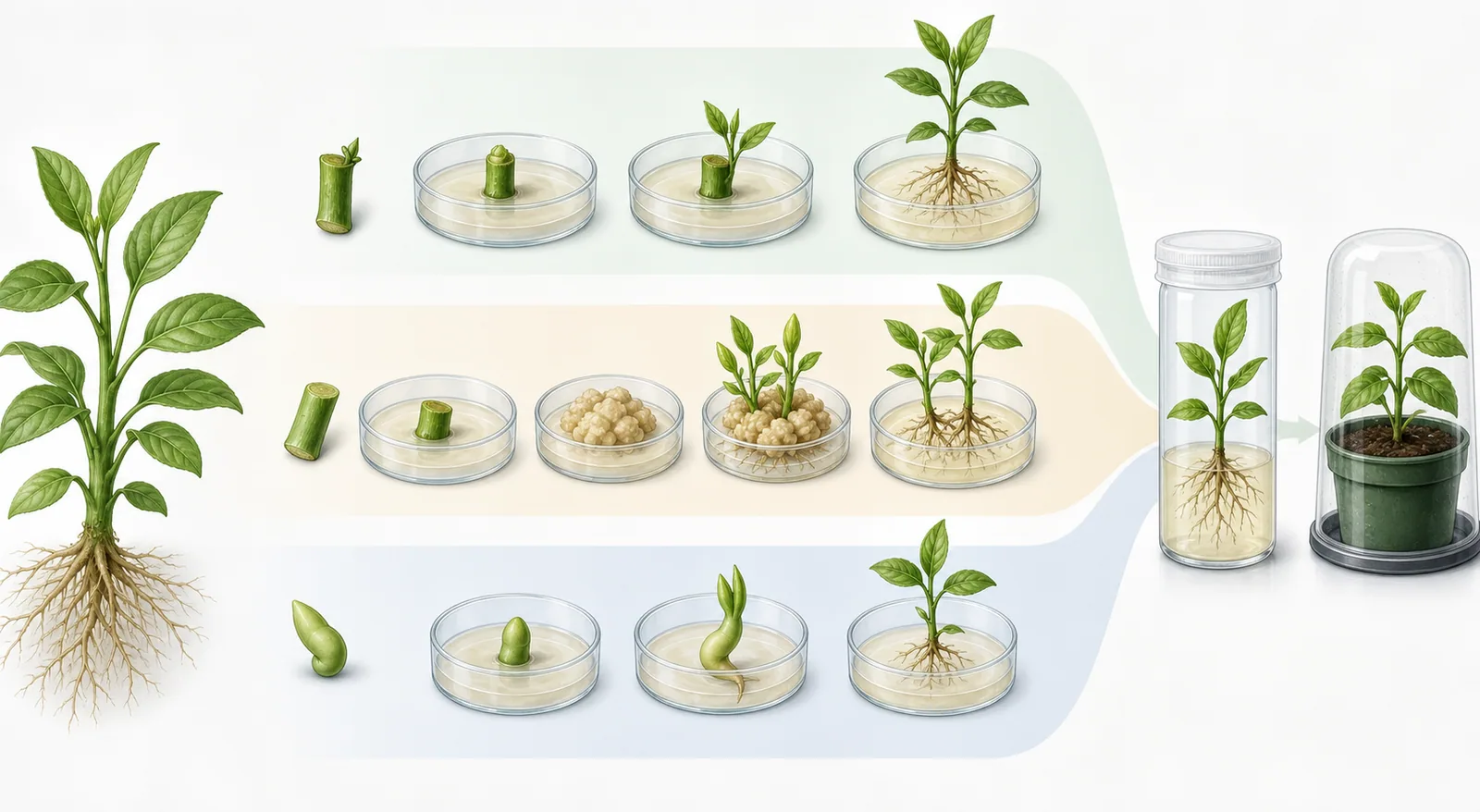
Therefore, “tissue culture” does not mean that callus must appear first. Nor can every method be reduced to “put a cutting in a bottle.”
How Is It Related to Cuttings and Plant Division?
Cuttings, plant division, and micropropagation can all be understood within the broader context of asexual or vegetative reproduction. They use a plant’s own cells, tissues, or organs to form new plants rather than beginning with pollination, fertilization, and a seed.
A cutting usually uses a recognizable piece of stem, leaf, or root in water, growing medium, or another horticultural setting. Plant division separates a clump or small plant that already has roots and growing points. Tissue culture can begin with much smaller material in a culture vessel and medium.
Micropropagation often aims to produce many young plants genetically close to the source plant. However, “close” does not mean “guaranteed to be exactly identical.” The culture process may produce somaclonal variation, and later environmental conditions may also contribute to differences.
Why Do Plantlets Need Acclimatization?
Plants in culture usually experience high humidity and more controlled light and temperature. Their roots develop in a specialized medium. Once a plantlet leaves the vessel, the air, humidity, light, and growing medium are different.
Acclimatization is the physiological transition from culture conditions toward ordinary growing conditions. Root formation and acclimatization are different stages. A rooted plantlet is not automatically ready to grow steadily in every outside environment.
Common Points of Confusion
- ✕ Tissue culture is the same as micropropagation.
- ✓ Tissue culture is the broader group of methods; micropropagation is a common application focused on multiplying new plants.
- ✕ Callus is a mass of roots.
- ✓ Callus is a mass of cells without clearly formed organs. It may later enter a shoot, root, or other regeneration route.
- ✕ Any leaf or stem can become a complete plant through tissue culture.
- ✓ Regeneration depends on the species, source material, and culture conditions.
- ✕ Roots in the vessel mean the process is finished.
- ✓ Root formation is often followed by acclimatization.
- ✕ Tissue culture is genetic modification.
- ✓ Tissue culture is a culture and regeneration technique. Genetic transformation and gene editing are separate technologies that may be combined with it.
Frequently Asked Questions
Is tissue culture a form of asexual reproduction?
When micropropagation regenerates plantlets from plant cells or tissues, it is usually understood as asexual or vegetative propagation. However, tissue culture can also be used with embryos, pollen, and other materials. The classification depends on the material and purpose.
Does tissue culture always require callus first?
No. Some materials form shoots or roots directly. Other pathways first form callus and then produce organs. Somatic embryogenesis is another regeneration route.
What Is an Explant?
An explant is material removed from a plant and introduced into a culture system. Examples include a shoot tip, node, part of a leaf, a root segment, or another tissue.
Is Tissue Culture the Same as Taking a Cutting?
Both use plant material to produce a new plant, but their scale and environment differ. Cuttings commonly use a stem, leaf, or root in an ordinary horticultural setting. Tissue culture uses a sterile, controlled vessel to regenerate and multiply smaller starting material.
Why Do Cultured Plantlets Need Acclimatization?
Humidity, light, temperature, and medium conditions inside a vessel differ from those in a pot. A plantlet must gradually adjust after leaving the vessel.
Can a Home Gardener Do Tissue Culture at Home?
Maintaining a clean culture environment, preparing a suitable medium, controlling contamination, and acclimatizing plantlets generally require specialized equipment, materials, and experience. This article explains the science rather than providing a home protocol or recipe.
Is Tissue Culture Genetic Modification?
No. Tissue culture is a technique for culturing and regenerating plant material. Genetic modification, gene editing, and other breeding methods are different technologies that may be used alongside tissue culture.
Related Terms
- Tissue culture: Growing plant cells, tissues, organs, or other material in a controlled, usually sterile environment.
- Micropropagation: An application of tissue culture that rapidly multiplies new plants.
- Explant: A cell, tissue, organ, or small piece removed from a plant and introduced into a culture system.
- Callus: A mass of cells that has not developed a clear arrangement of organs.
- Organogenesis: The regeneration process through which plant organs such as roots or shoots form.
- Somatic embryogenesis: A regeneration route in which non-reproductive cells form embryo-like structures that can develop into plants.
- Somaclonal variation: Genetic or observable differences that may arise during culture.
- Acclimatization: The transition in which plantlets gradually adjust to ordinary growing conditions.
Keep Reading
Evidence
References
These sources were used to check the plant-science concepts and gardening context in this article.