
Phloem pressure-flow model
SugarWater flowTurgor
Mechanism: the Münch pressure-flow hypothesis. The three steps focus on processes operating together.
Model conditions
The end compartments and level pathway form an abstract pressure-flow system. The compartments remain filled with sap; subtle swelling indicates increased water content. Pathway length and joins stay fixed. Sap arrives at the sink while water also moves out, so its total water content need not decrease. Surrounding water potential and pathway resistance are fixed. Sugar is supplied continuously; unloading depends on sugar available at the sink. Local water-potential differences drive water exchange, while the pressure difference between the ends drives sap along the pathway. Loading, unloading and water exchange operate together from the start; step pauses allow time to read. Swelling, tracers and speed show trends. The model omits separate pathway inventories, branches, gravity and viscosity changes. Loading and unloading mechanisms vary among species and organs.
Plants do not keep all the sugar they make in their leaves, and they do not divide it evenly among every part of the plant. A mature leaf that exports more sugars than it uses is often a source. Growing roots, shoot tips, young leaves, flowers, fruits, and seeds may act as sinks: places that receive sugars to support growth, metabolism, or storage. The phloem carries these sugars and other organic compounds between plant organs.
One way to picture this is to imagine mature leaves as places that make and send out supplies, while growing parts are receiving points. The comparison is only a guide to direction. Plants have no fixed allocation chart: which tissues act as sources or sinks can change with age, development, and season.
How do sugars travel from a leaf to other parts of the plant?
Photosynthesis uses light energy, carbon dioxide, and water to make sugars and other organic compounds. A leaf can use some of what it makes nearby. Some soluble sugars can also enter the phloem, one of the plant’s transport tissues, and travel to other organs. Sucrose is a common sugar transported over long distances, although the sugars transported can vary among plant groups.
In plant physiology, a source is a tissue that exports sugars and other photosynthetic products overall; a sink is a tissue that takes them in overall and uses or stores them. These are roles, not permanent labels for particular organs. A mature leaf with a surplus of photosynthetic products is often a source. A young leaf that has not yet expanded fully may use more than it produces, so it often receives sugars from other leaves. Growing roots, shoot tips, flowers, fruits, and seeds can also be sinks. For more on what roots and fruits do, see What Do Roots Do? and What Is the Function of a Fruit?.
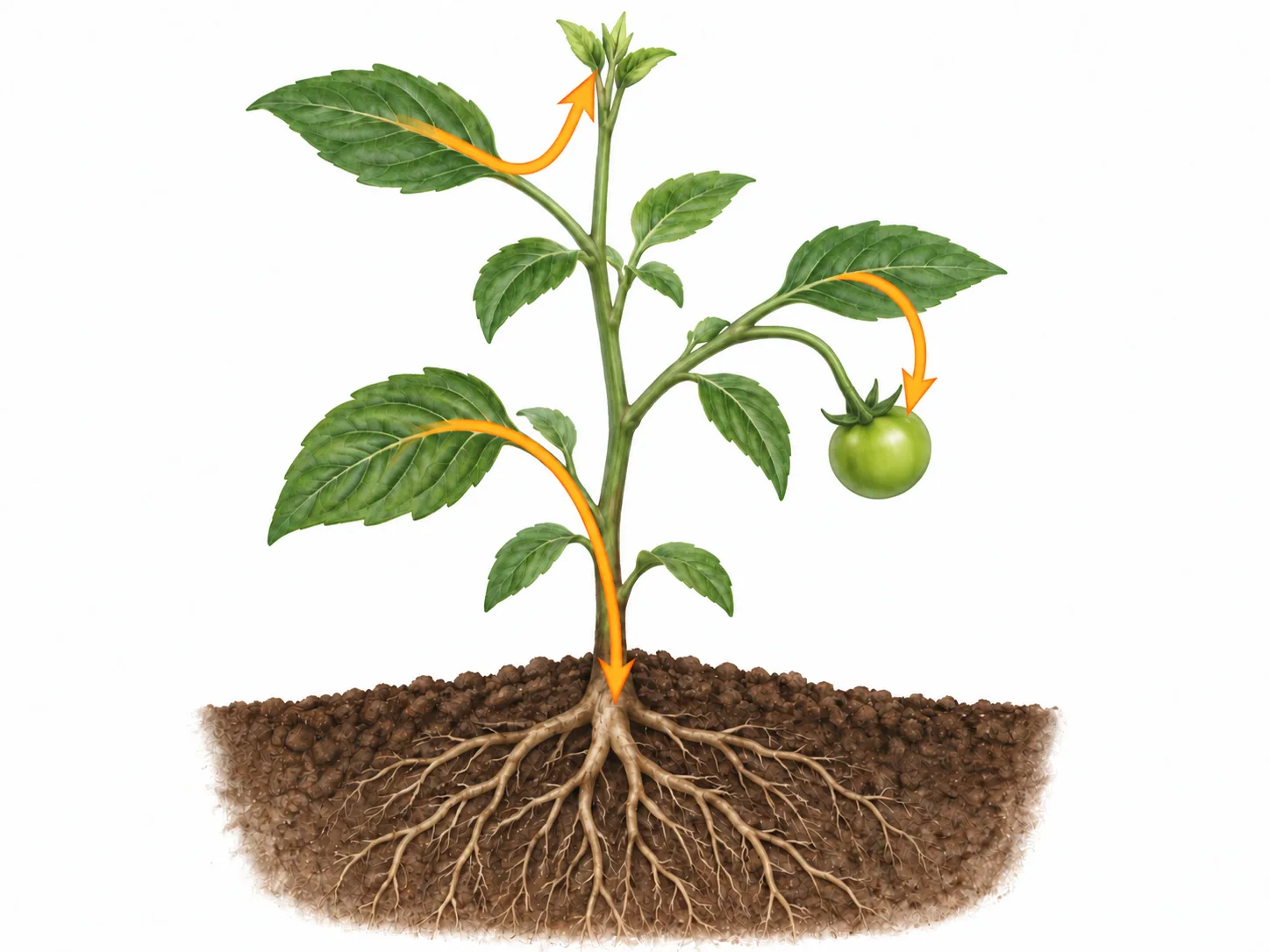
How does the phloem move sugar over long distances?
The model below connects a source and a sink along one pathway. Watch how sugar, water and pressure at the two ends work together to maintain transport.
The pressure-flow model is a common way to explain long-distance transport through the phloem. At a source, sugars enter the conducting phloem, including its sieve tubes. This raises the local concentration of dissolved substances and lowers water potential. Water potential describes the tendency of water to move: water flows from higher to lower water potential. Water enters the phloem from nearby tissues, including the xylem, by osmosis, raising pressure at the source end.
At a sink, sugars leave the phloem. Cells may use them in respiration and growth, or convert them into starch and other storage materials. Unloading changes local water potential; water moving out into surrounding tissues helps maintain relatively lower turgor at the sink. The pressure difference drives a bulk flow of sugar-containing phloem sap from source toward sink.
This model describes the overall movement of sap through sieve tubes. The details of sugar loading into the phloem and unloading from it vary among plant species and organs. Some steps involve transport proteins and metabolic energy; loading is not carried out in exactly the same way by every plant. The model also does not mean that an ATP-powered pump pushes each sugar molecule along the entire route. Xylem mainly transports water, while phloem distributes sugars and other organic products. The two tissues work together, but their roles and transport mechanisms differ. See How Are Xylem and Phloem Different? for a comparison.
Sources and sinks can change as a plant grows
A newly unfolding leaf can photosynthesize, but while it is small and still needs more sugar than it makes, it often acts as a sink. Once it matures and produces more than it uses, it may become a source.
Roots are not always sinks, either. Growing roots commonly receive sugars. In some plants, storage roots, tubers, or bulbs accumulate carbohydrates. Later, stored material can be converted into transportable sugars and sent to support new shoot growth. A storage organ can therefore act as a sink while reserves build up and later act as a source when those reserves are mobilized.
The mix of sinks can also change over a plant’s life. During vegetative growth, young leaves and root tips need resources to build new tissue. After flowering, developing fruits and seeds may become important sinks. Learn more about changing needs across the stages of a plant’s life cycle.
Several sinks can receive photosynthetic products at the same time. A developing fruit does not automatically take every available sugar away from a new shoot. The amount each organ receives depends on factors such as its demand, size, activity, developmental stage, and connection to the source. Their relative shares are not a fixed percentage that applies to every plant.
What happens to sugar after it reaches an organ?
Sugar is more than a fuel. Plant cells can break it down through cellular respiration to obtain energy for cell activities. They can also use its carbon to build cell walls and other organic materials. When sugar is not needed immediately, some may be converted into starch or another storage form for later use.
So the amount of sugar a leaf makes and the amount that each organ receives are related, but they are not the same question. Phloem transport helps a plant direct carbon toward parts that are growing, carrying out metabolism, or building reserves. To review how sugars form during photosynthesis, read What Is Photosynthesis?. For what happens when cells use sugars, see Do Plants Respire?.
Common confusions
- ✕ Sugar is made in leaves, so it stays there.
- ✓ Mature leaves can export sugars to other organs. Young leaves, root tips, and fruits may receive them.
- ✕ Phloem only moves sugar downward.
- ✓ Phloem carries sugars from sources to sinks. A sink may be above, below, or beside a source, so the direction depends on where they are and how they are connected.
- ✕ Roots are always sinks, and leaves are always sources.
- ✓ The role of a root, leaf, or storage organ can change with age, season, and stage of growth.
- ✕ Sugar is used only to make energy.
- ✓ Cells can use sugar in respiration, use its carbon to build new tissue, or convert it into starch for storage.
Frequently asked questions
Does sugar diffuse all the way from a leaf to a root?
Long-distance phloem transport is mainly a pressure-driven bulk flow of sap, carrying dissolved sugars with it. Diffusion can contribute to local loading, unloading or exchange between cells. These local processes operate at a different scale from long-distance pressure flow.
Do plants transport glucose in the phloem?
Many plants use sucrose as an important long-distance transport sugar, but the soluble sugars used are not identical in every plant. Plants also contain glucose and fructose, while starch is an insoluble storage carbohydrate. Their presence in a plant does not mean they are all transported through the phloem in the same form.
Does phloem sugar always move downward?
No. Phloem carries photosynthetic products from sources to sinks. A young shoot above a source may receive sugars moving upward, while roots or fruits in other positions may receive sugars moving downward or sideways. The direction depends on the source, the sink, and their connections—not simply on which organ is higher or lower.
Can a young leaf make sugar?
Yes. A young leaf can photosynthesize as it unfolds. But while it is immature and does not make enough to meet its own needs, it often receives sugar from mature leaves. After it matures, it may become a source if it has a surplus of photosynthetic products.
Why do plants send sugar to roots?
Roots need sugars for cellular respiration, maintenance, and growth. Some plants also convert sugars into starch or other stored forms. A root may be a sink during one stage, while a storage organ may later release reserves to support a new shoot or another part of the plant.
Are fruits always a plant’s main sugar sink?
Developing fruits are often important sinks, but there is no fixed ranking that applies to every plant or season. The relative demand of roots, young leaves, seeds, storage stems, and fruits can change with the species and its stage of development.
Key terms
- Source: A tissue that, at a particular time, exports more sugars and other organic products than it imports. Mature leaves are common sources; storage organs can also become sources when they release reserves.
- Sink: A tissue that, at a particular time, imports more sugars and other organic products than it exports, using them for growth, metabolism, or storage. Young leaves, root tips, and developing fruits are common examples.
- Phloem: The plant tissue that transports sugars and other organic compounds. It includes conducting cells and cells that support transport.
- Sieve tube: A conducting pathway in flowering-plant phloem, formed by sieve-tube elements joined end to end. Sugar-containing sap passes through pores between these cells.
- Water potential: A physical quantity describing water’s tendency to move. Water moves from higher to lower water potential; both dissolved substances and pressure affect it.
- Turgor pressure: The pressure of a cell’s water-containing contents against its cell wall. In the pressure-flow model, a difference in turgor pressure between source and sink drives phloem sap flow.
Evidence
References
These sources were used to check the plant-science concepts and gardening context in this article.
View sources and further reading (9)
- openstax.org — 30 2 stems
- bio.libretexts.org — 8.02: The Flower and the Fruit
- openstax.org — 30 5 transport of water and solutes in plants
- openstax.org — 8 3 using light energy to make organic molecules
- annualreviews.org — annurev arplant 070721 083240
- frontiersin.org — full
- frontiersin.org — full
- elifesciences.org — 15341
- pmc.ncbi.nlm.nih.gov — PMC2729037