
White, yellow, silver, or red areas on a leaf do not automatically mean disease. Some patterns recur across leaves; others are localized changes noticed in later observations. They can look similar.
First note when you noticed the pattern, whether it repeats on other leaves, and whether its boundaries or tissue change over time. Color and a single photograph describe appearance, but they do not identify a cause on their own.

Variegation describes an appearance, not one mechanism
Gardeners use leaf variegation for recurring areas of different color on a leaf or plant. It describes an appearance, not one mechanism. Patterns may involve pigments, chloroplasts, cell lineages, or leaf structure, and their shapes can be regular or irregular.
Some specific patterns are established early in leaf development, but that does not mean every variegated leaf shows its full pattern as it unfolds. Record when you first notice a pattern and compare it with other new or mature leaves rather than treating timing alone as a definition.
Chlorophyll is the green pigment closely involved in photosynthesis, so it often makes leaves look green. Carotenoids are a group of pigments commonly associated with yellow and orange tones. Anthocyanins can make plant tissues look red, purple, or reddish purple. When the type, amount, or distribution of these pigments differs from one part of a leaf to another, the result can be stripes, patches, or areas of different intensity. For an introduction to the relationship between green leaves and chlorophyll, see What is chlorophyll?. To place leaf color back into the process plants use to make sugars and other organic compounds, continue with What is photosynthesis?.
White or cream-colored areas often contain less chlorophyll, or may reflect differences in chloroplast development. The greener areas are therefore usually the main photosynthetic regions. But that does not mean every white patch is “dead mesophyll,” and color alone cannot tell you where a pattern came from. Variegated plants also differ in how stable their patterns are: some new leaves repeat a similar design, while others gradually become greener. For that related observation route, see Why do variegated plants turn green?.
Some silver markings come from reflected light
When a leaf looks silver or as if it has been dusted with metallic powder, it is easy to assume that the area simply has no chlorophyll. In some plants, however, a pale or silvery appearance is related to the epidermis, the arrangement of mesophyll tissue, spaces between cells, or the way the leaf surface reflects light. Looking white or silver does not necessarily mean that the tissue contains no chlorophyll at all.
Research on some begonias, for example, has found that particular structural variegation zones can still contain chloroplasts and retain photosynthetic ability. That is evidence from particular plants, not a rule for every silver-leaved plant. To understand how the outermost leaf layer protects internal tissues and helps regulate gases and water, see What does the plant epidermis do?. For the leaf’s broader roles in capturing light and exchanging gases, see What do leaves do?.
If the silvery appearance changes in strength when you change the leaf’s angle, reflection may be part of what you see. It is an observation clue, not a test that identifies the pattern’s mechanism.
Read localized changes by their timing, boundaries, and tissue condition
“Leaf spot” describes a localized spot or lesion-like change; colors, shapes, and boundaries vary. Some spots expand or merge, while other changes follow a different course. A color or a single view does not point to one cause.
These changes may be associated with pathogens, insects, light or temperature shifts, nutrient or chemical factors, or mechanical injury. Recording when you first noticed a change, where it occurs, its size and boundary, and the condition of the tissue helps describe what is happening; different causes can look similar.
Variegation, leaf spots, and mosaic patterns are not interchangeable
These words can describe similar-looking leaves, but they do not mean the same thing:
- Variegation describes recurring areas of different color on a leaf or plant. Some patterns may be visible as a leaf unfolds, but timing alone does not define variegation. Patterns may relate to cultivar traits, genetics, pigments, chloroplasts, or tissue structure; variegation is not the name of one disease.
- Leaf spot describes a localized spot or lesion-like change on a leaf. Its colors, shapes, boundaries, and progress can vary; the term itself does not name one cause.
- Mosaic or mosaic pattern describes a patchwork of contrasting colors. Some viruses can cause mosaic symptoms, but similar patterns can have other sources; the visual term alone does not confirm a virus.
This distinction matters because the same word “spot” may be used casually for any colored patch, while the time of appearance and whether the tissue is damaged often tell you more than the color name.
Four questions for reading a leaf pattern
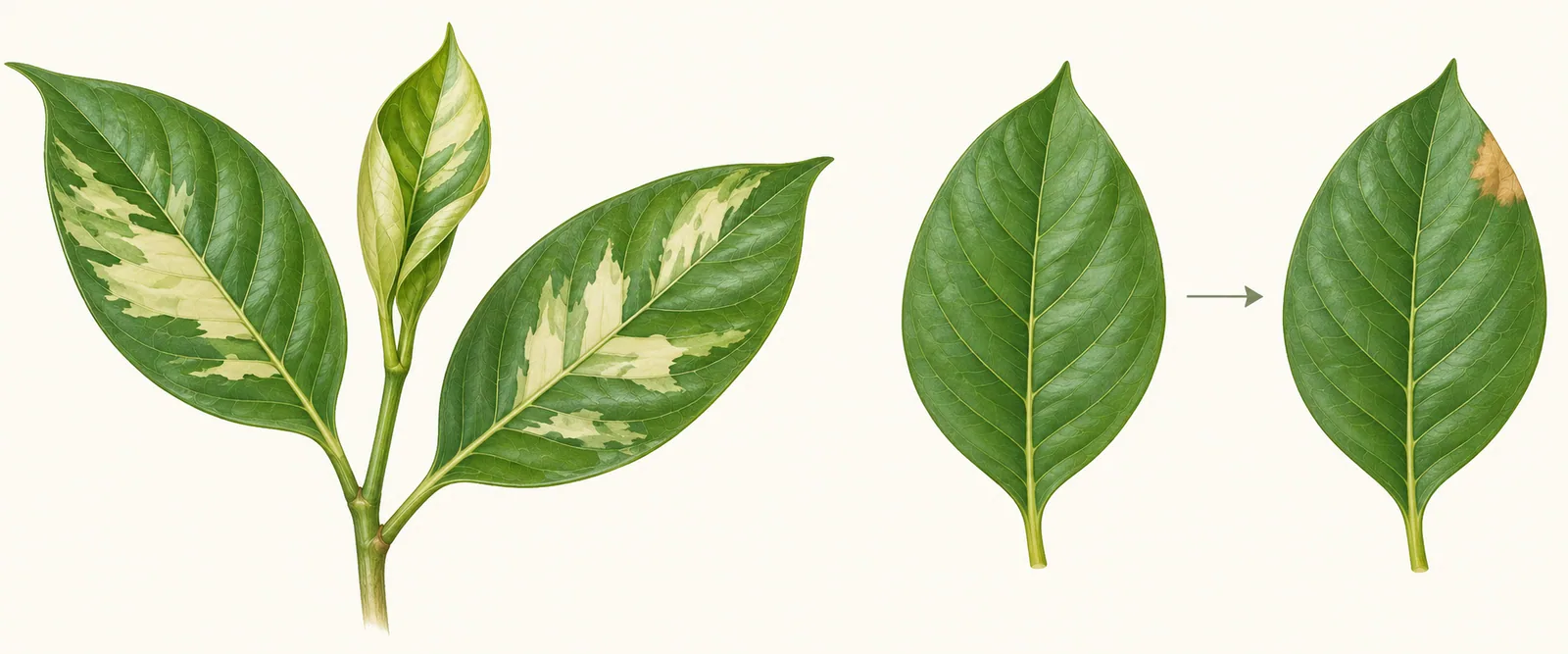
When you observe a patterned leaf, describe it in this order instead of rushing to name it:
- When did you first notice it? Was it visible as a young leaf unfolded, or did you record it later?
- Does it repeat on other leaves? How many leaves show a similar pattern, and where are they on the plant?
- Have the boundaries or area changed? Compare observations over time to see whether a color area has expanded, shrunk, or merged.
- Has the tissue changed too? Beyond color, is the area thinner, dry, collapsed, or different in texture?
Dated photographs of new leaves, mature leaves, and localized areas can show whether a similar pattern repeats, whether a boundary changes, and whether tissue condition changes too. If several leaves or the whole plant change at the same time, record nearby environmental changes as well. These notes describe what happened; they do not establish a cause on their own.
Common mix-ups
-
✕ A leaf with patterns is always diseased.
-
✓ Similar patterns repeated across several leaves can be recorded as a possible variegation or developmental feature; if a localized area changes during later observations, record that change and the tissue condition too.
-
✕ A white area is always dead tissue.
-
✓ White or cream areas may relate to lower chlorophyll, different chloroplast development, or reflected light. Look for simultaneous drying, collapse, thinning, or spreading before treating the area as later tissue damage.
-
✕ A silver marking always means there is no chlorophyll.
-
✓ Some structural silver patterns can still contain chloroplasts. That is a finding from particular plants, not a conclusion that applies to every silver marking.
-
✕ Yellow and green patches always mean a virus.
-
✓ Viruses are one possible cause of mosaic-like patterns, but inherited variegation, cool temperatures, insects, chemical factors, and other environmental changes can look similar. Appearance alone cannot confirm a virus.
-
✕ A red patch is just another kind of leaf spot.
-
✓ Red or purple areas may relate to anthocyanins, cultivar traits, leaf age, or environmental responses. Compare when the color appeared and whether the tissue is damaged. See Why do some plant leaves turn red?.
Frequently Asked Questions
Do patterned leaves always mean the plant is sick?
No. Similar color areas that recur across several leaves can be recorded as a possible variegation or developmental pattern. If a localized area changes during later observations, note its timing, position, boundary, and tissue condition. Color alone does not point to a cause.
Are white or cream-colored areas dead?
Not necessarily. They may contain less chlorophyll, reflect differences in chloroplast development, or look pale because of the way the tissue reflects light. If the same area also dries, collapses, becomes thin, or keeps spreading, that is evidence that the leaf may have undergone later tissue damage. Color alone is not enough.
Does a silver pattern mean the leaf has no chlorophyll?
Not necessarily. Some silver appearances come from cell arrangement, spaces within the leaf, or epidermal and surface features that change how light is reflected. Research on particular plants has even found chloroplasts in some structural variegation zones. The mechanism varies among plants, so “no chlorophyll” is not a universal explanation.
Does a yellow-and-green pattern mean a virus?
You cannot make that conclusion directly. Viruses can cause mosaic patterns, but inherited variegation, cool temperatures, insects, chemical factors, and other environmental changes can create similar yellow-green visuals. A reliable assessment generally needs more than one photograph and may require professional examination.
Why does the same plant have patterned leaves and greener leaves?
Leaf age, the time and place of development, the growing point or bud, tissue origin, pigment distribution, and environmental exposure can all differ between leaves. Some variegated plants naturally vary in the proportion of patterned tissue. If a series of new shoots produces fully green leaves, record the shoots and growing conditions; the change does not guarantee that the original pattern will return.
How are brown spots different from variegation?
Variegation describes recurring areas of different color on a leaf or plant; leaf spot describes a localized spot or lesion-like change. Their appearance can overlap. Compare when you first noticed it, how it is distributed, its boundaries, and the tissue condition rather than relying on one color.
Can a red or purple patch be called variegation?
Not from color alone. Red or purple may be a pigment zone related to anthocyanins, a normal cultivar trait, a difference in leaf age, or an environmental response. It may also be part of a later change if the tissue is damaged or the patch is spreading. Why do some plant leaves turn red? explains the color clues in more detail.
Can a photograph identify why a leaf has a pattern?
A photograph records color, shape, and distribution at one moment. Adding dates and comparing new leaves, other leaves, and the localized area over time provides more context than one close-up; the images still do not identify a cause by themselves.
Related terms
- Leaf variegation: Recurring areas of different colors on a leaf or plant; the causes can include genetics, pigments, chloroplasts, tissue layers, and leaf structure.
- Leaf spot: A term for a localized spot or lesion-like change on a leaf; its appearance and progress vary, and the term does not name one cause.
- Mosaic pattern: A patchwork appearance made of contrasting colors; it does not, by itself, confirm a virus or other cause.
- Chlorophyll: A green pigment closely involved in photosynthesis and often responsible for the green appearance of leaves.
- Carotenoids: Plant pigments commonly associated with yellow and orange colors.
- Anthocyanins: Water-soluble pigments that can give plant tissues red, purple, or reddish-purple colors.
- Chloroplast: A structure inside many plant cells that is closely involved in photosynthesis.
Read Next
Evidence
References
These sources were used to check the plant-science concepts and gardening context in this article.
View sources and further reading (10)
- open.lib.umn.edu — 11 2 light and photosynthesis
- harvardforest.fas.harvard.edu — leaf pigments
- onlinelibrary.wiley.com — j.1365 3040.2006.01630.x
- pmc.ncbi.nlm.nih.gov — PMC3336944
- sciencedirect.com — S0367253020302024
- frontiersin.org — full
- extension.umn.edu — leaf spot diseases of trees and shrubs
- pubs.ext.vt.edu — 426 714.html
- yardandgarden.extension.iastate.edu — tips and tricks identifying and tracking plant problems
- ipm.cahnr.uconn.edu — some virus diseases of greenhouse crops