
When New Variegated Leaves Turn Green, Ask Where the Variegation Came From
A variegated plant turning greener does not necessarily mean the plant has a problem, and low light is not the only possible reason.
In plain language, variegation happens when different colored areas appear on the same leaf or plant. The green areas usually contain more chlorophyll, the pigment that helps plants capture light for photosynthesis. Pale white, cream, yellow, or silver areas often have less visible chlorophyll or work differently from the green tissue.
So when light is weak, when an all-green shoot appears, or when the variegated tissue itself is not very stable, the new growth may look greener than before. In some plants, one part of the plant may keep its variegated leaves while another shoot becomes fully green.
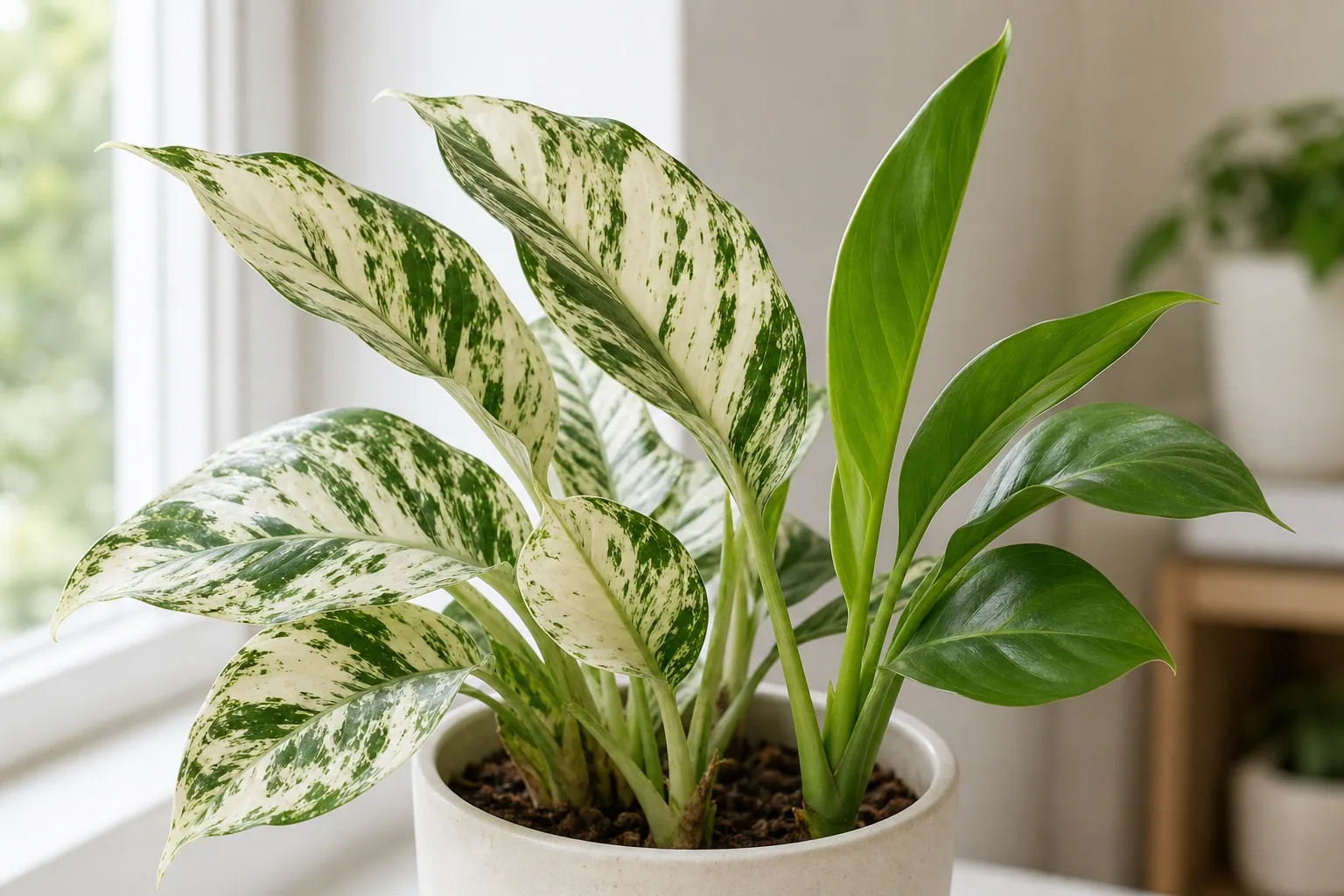
Variegation Is Not Simply a Leaf “Fading”
Variegation means that a leaf or plant shows areas of different colors, such as green, white, cream, yellow, silver, or reddish tones. Gardeners may describe new growth with fewer markings as a “loss of variegation.” “Reversion” is a more specific horticultural term often used when a cultivated trait shifts back toward a less-variegated or more typical form. These terms overlap in casual use, but they are not exact synonyms.
But not all variegation comes from the same cause.
Some variegation comes from differences between cells or tissue layers. Some comes from genetic patterns, pigment differences, leaf structure, or, in a few cases, plant viruses that create mosaic-like markings. That means two plants can both look variegated while behaving very differently over time.
This matters because some kinds of variegation are fairly stable, while others can change from shoot to shoot. One plant may keep a steady pattern for years. Another may suddenly produce a green branch, or a very pale branch with little green tissue. When you see a variegated plant turning green, avoid treating it as one simple care mistake.
Green Areas Usually Have More Chlorophyll
Many leaves look green because they contain chlorophyll. Chlorophyll absorbs red and blue-violet light strongly, while more green light is reflected or passes through the leaf. That is why many leaves appear green to our eyes.
In many variegated plants, white, cream, or pale yellow areas have less chlorophyll than the green areas. These pale areas are still part of the leaf, and they may matter for appearance, structure, or other pigments. But in terms of photosynthesis, they usually do less work than the green tissue.
That gives all-green shoots a simple advantage: they often have more green surface area available for capturing light and making sugars. On some variegated plants, a fully green shoot can grow faster and stronger than the variegated parts. Over time, it may make the whole plant look greener.
Low Light Is Common, But It Is Not the Only Answer
For indoor variegated plants, low light is one of the first things worth checking. A plant kept in a dim corner may produce greener leaves, weaker patterns, changes in foliage color, longer stems, or smaller new leaves; the color response varies by plant and situation. University of Minnesota Extension guidance on indoor plant lighting also lists white-and-green variegated plants turning fully green as one possible sign of too little light.
The basic idea is easy to understand: when pale areas contain less chlorophyll, a variegated plant may have less green surface area for most of its photosynthesis than an all-green plant. Under limited light, tissue with more chlorophyll may have an advantage. Greener new growth can therefore appear alongside low light and other growth conditions, but this wording alone cannot identify the cause.
But this does not mean every green leaf is proof of low light. A fully green shoot may also come from unstable variegated tissue. Some cultivars are naturally more likely to change on new shoots. In other cases, the branch origin, meristem layers, plant age, and environmental changes may all play a role.
Low light is a useful clue. It is not the whole explanation.
Some Variegation Involves Chimeras
Some variegated plants are chimeras. In simple terms, a chimera is a plant where different cell layers or tissues are not genetically identical. Some tissue may produce chlorophyll normally, while other tissue may produce little or show a different color expression. When leaves develop from those tissues, the result can be white-green, yellow-green, or uneven color patterns.
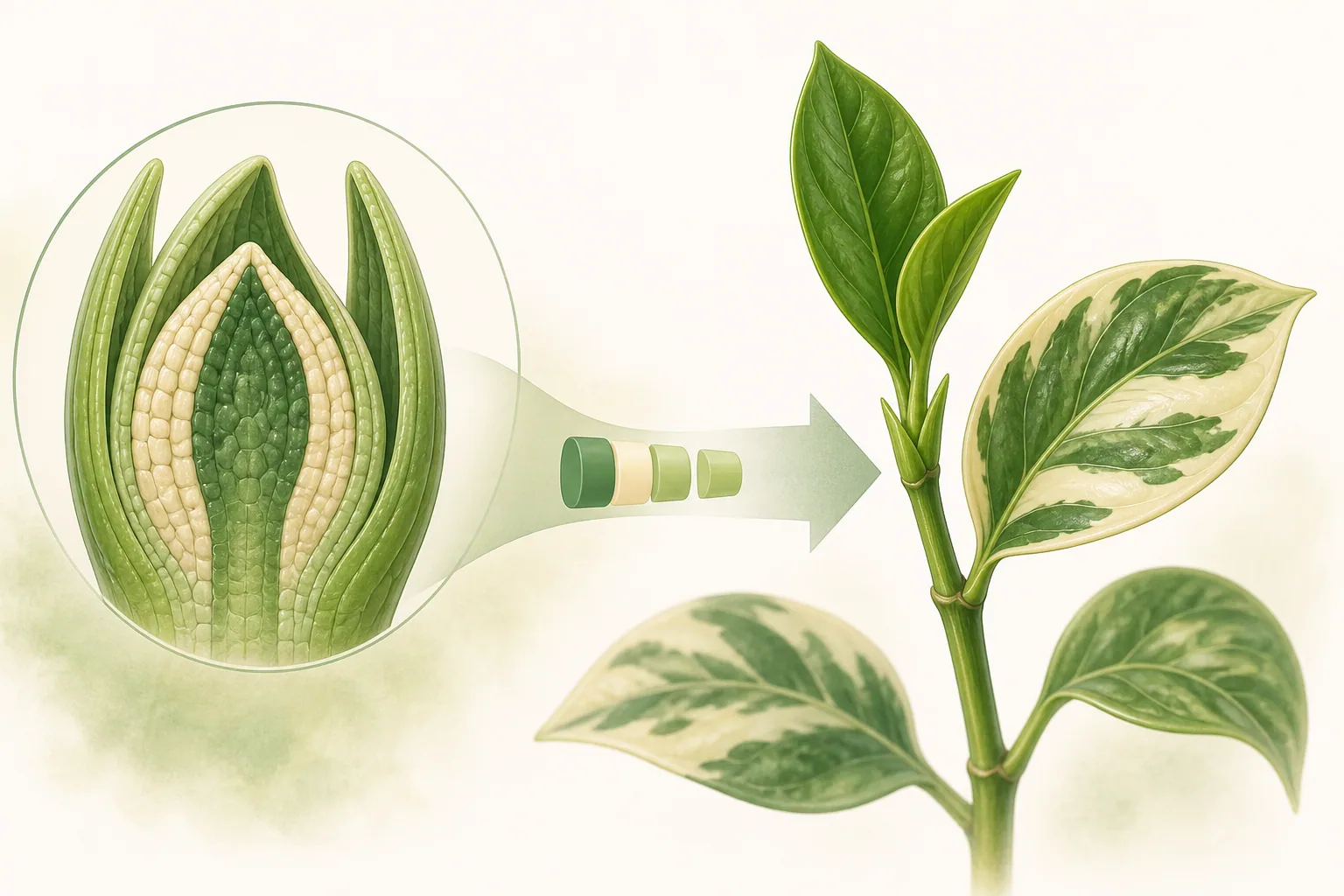
This kind of variegation can be beautiful, but it can also be unstable. If a new bud or shoot develops mostly from green tissue, that shoot may become fully green. If a shoot develops with very little green tissue, it may be weaker because it has less photosynthetic area.
Still, it would be misleading to say that all variegated plants are chimeras. Chimera-based variegation is one important source of variegation, but not the only one. When a variegated plant turns green, look at both the growing conditions and the stability of the variegation itself.
Look at New Leaves, New Shoots, and Where the Change Appears
Do not judge the whole plant from one leaf. Start with three observations.

- Are several new leaves becoming greener in a row? One greener-than-usual leaf is different from a whole run of fully green new leaves.
- Is the change concentrated on one shoot? If one branch or one growing point keeps producing all-green leaves, that shoot may have shifted toward all-green growth.
- Are there other low-light clues? Look for longer spaces between leaves, leaning toward light, changes in foliage color that vary by plant and situation, smaller new leaves, or older leaves dropping more easily.
A little variation between leaves is normal for many variegated plants. The stronger warning sign is a whole new shoot becoming fully green and growing more vigorously than the variegated parts.
Common Mix-Ups
- ✕ A variegated plant turning green always means low light.
- ✓ Low light is common, but tissue stability, branch origin, plant type, and growth pattern can also matter.
- ✕ White parts of a variegated leaf are completely useless.
- ✓ Pale areas usually have less chlorophyll and lower photosynthetic ability, but they are still part of the leaf and may matter for appearance, structure, or other pigments.
- ✕ All variegated plants are chimeras.
- ✓ Chimeras are one important source of variegation, but variegation can also involve genetic patterns, pigments, leaf structure, transposons, or pathogens.
- ✕ Fully green leaves are always healthier.
- ✓ Fully green leaves usually have more chlorophyll and stronger photosynthetic potential, but plant health still depends on roots, light, water, growing conditions, and overall growth.
- ✕ Once a variegated plant turns green, one simple action will always bring the pattern back.
- ✓ Different plants and different kinds of variegation behave differently. A return of the pattern cannot be guaranteed; record new leaves, new shoots, and light conditions to see whether the change continues.
FAQ
Do variegated plants turn green because they are trying to survive?
That is a useful plain-language way to picture it, but plants are not making conscious choices. More precisely, green tissue usually contains more chlorophyll and can often do more photosynthesis. In some situations, all-green shoots have a growth advantage, so the plant appears to grow in a greener direction.
Is low light always the reason variegated plants turn green?
No. Low light is one common reason, especially if the plant is also becoming leggy, leaning toward a window, producing smaller new leaves, or showing a change in foliage color; that color response varies by plant and situation. But unstable variegated tissue, a new all-green shoot, cultivar behavior, and other environmental changes can also be involved.
Can white parts of a leaf photosynthesize at all?
White or cream-colored areas usually have less chlorophyll, so they often photosynthesize less than green areas. But variegation has many causes, so it is risky to apply one sentence to every plant. The main point is that green areas are usually the main photosynthetic areas.
Why can one plant have both variegated leaves and fully green leaves?
Different shoots, buds, or tissue layers can behave differently. If one new shoot begins producing fully green leaves, that part may become more noticeable over time, especially if it grows faster than the variegated parts.
Will the variegation come back by itself?
Sometimes the amount of variegation naturally rises and falls from leaf to leaf. But if an entire shoot has produced fully green leaves for a while, the same shoot may not reliably return to a variegated pattern. Different plants vary a lot, so it is better to record the new leaves, new shoots, and light conditions than to expect a guaranteed result.
Is a whiter variegated plant better?
Not necessarily. White or pale areas usually have less chlorophyll. If a leaf has almost no green area, it may contribute less to photosynthesis, and the plant may grow more slowly. Ornamental value and growth strength are not the same thing.
Are yellow, white, silver, and red variegation caused by the same thing?
No. White areas often make people think of reduced chlorophyll, but silver, yellow, and red patterns can have different causes. All of these patterns cannot be explained by reduced chlorophyll alone.
Related Terms
- Variegation: The appearance of different colored areas, such as green, white, yellow, silver, or red, on a leaf or plant.
- Loss of variegation: A general gardening description for new growth becoming less patterned or more green.
- Chlorophyll: An important pigment that helps plants absorb light energy and often makes leaves look green.
- Photosynthesis: The process plants use to turn light energy into sugars and other organic compounds.
- Chimera: A plant or plant part made of cell layers or tissues that are not all genetically identical; some variegation is related to this.
- Meristem: A plant growth region where new leaves, stems, or shoots can develop.
- Growth vigor: The relative strength and speed of plant growth.
- Reversion: A horticultural term often used when a cultivated trait, such as variegation, shifts back toward a less variegated or more typical form.
Read Next
Evidence
References
These sources were used to check the plant-science concepts and gardening context in this article.