You may notice that the leaves of ornamental ferns often develop dry edges. This commonly happens because the leaves are losing water faster, or the root system is not replacing it quickly enough. Low humidity, higher temperatures, moving air, strong light or heat, potting mix that stayed dry for too long, and a root zone that stayed wet and oxygen-poor can all create similar-looking symptoms. Fern species differ widely in their tolerance of dry conditions.
The appearance alone cannot identify one single cause. Read it together with the fern type, the age of the affected leaf, the potting mix, and any recent change in the plant’s environment.

First, what is a fern leaf?
The whole leaf of a fern is called a frond—in other words, a fern leaf. Many fronds have a broad, divided blade with smaller sections arranged along a central axis.
The lower stalk that connects the rhizome to the blade is called the stipe. Once it enters the blade, it continues as the central rachis. The leaflet-like divisions arranged along the rachis are called pinnae. In some ferns, each pinna divides again into even smaller sections called pinnules.
This means that “dry edges” can describe several different locations:
- the outside margin of the entire frond;
- the margins or tips of individual pinnae;
- the edges or tips of smaller pinnules.
Identifying the location makes later observations more useful. For readability, this article sometimes uses “fern leaf” and “frond” interchangeably.
How are dry edges connected to water supply?
After roots absorb water, it moves through xylem in the roots and rhizome, then enters the stipe and travels through the rachis and branching veins of the pinnae. Within the blade, some water evaporates from moist tissues and, in most ferns, usually leaves through openings called stomata as water vapor. This process is called transpiration. A few fern lineages have very different leaf surfaces and water relations, so this is a general teaching route rather than one anatomy shared by every fern.
You can follow how water moves from roots into leaves and how water vapor leaves a leaf in more detail.
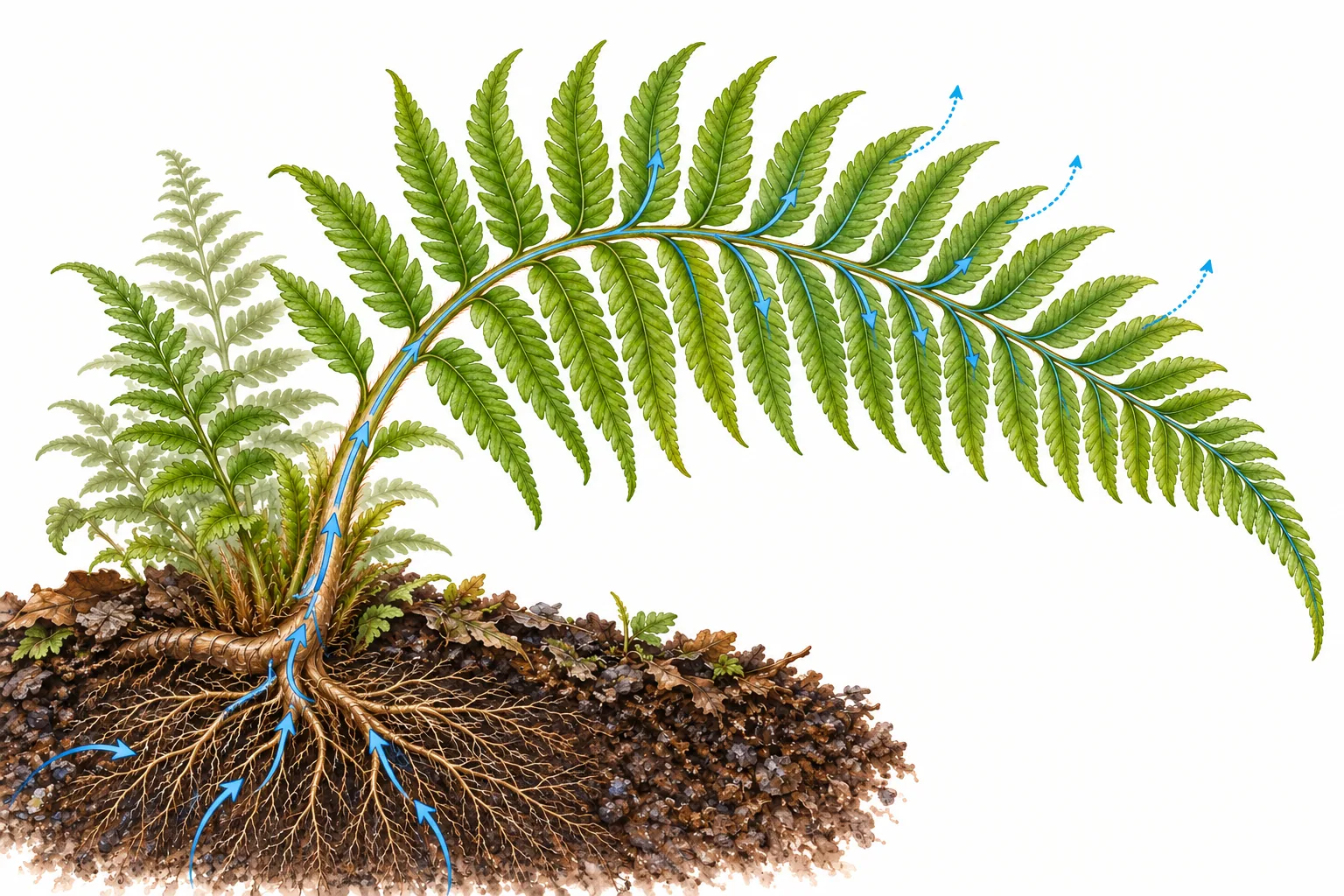
When water leaves a frond faster than the root zone can replace it, the leaf can experience water stress. Higher temperatures, strong light, moving air, and low humidity can all increase the external demand for water loss. Stomata also regulate water exchange, so actual transpiration does not rise by a fixed amount in response to one condition alone.
General leaf-scorch mechanisms often explain early tip or margin browning as tissue farther from major veins dehydrating sooner. For ferns, this remains a useful direction for understanding the pattern, not a fixed rule that applies identically to every species.
Ferns occupy humid forest floors, tree canopies, rocks, and seasonally dry habitats. Frond thickness, degree of division, and water regulation can differ accordingly. A dry margin is evidence that conditions changed somewhere in the water balance, not a universal diagnosis shared by all ferns.
Dry air is one possibility—not the whole diagnosis
Air conditioning, heating, fans, open windows, and other drafts can change the air around a plant. Relative humidity tells us how close the air is to saturation at a given temperature. Vapor pressure deficit (VPD) combines temperature and humidity into a better description of the atmosphere’s evaporative demand. VPD generally rises as temperature rises or relative humidity falls, but leaf temperature, stomata, root supply, and species still regulate the fern’s actual transpiration.
A relatively still, humid layer of air also clings to the leaf surface. This leaf boundary layer adds resistance to vapor movement. Persistent airflow usually thins the layer and makes it easier for vapor to move away, but water stress can also cause stomata to narrow. Wind speed therefore cannot be converted directly into one fixed water-loss rate. For more context, see how airflow changes the microclimate around a leaf.
Under these conditions, pinna tips or margins may look dull, tan, papery, or crisp. Those words describe the appearance; they do not identify the cause by themselves.
A brown margin should not automatically be translated into “mist the fern constantly.” Brief misting is at most a local, short-lived action; one misting does not show that the humidity of the whole room has changed steadily, and keeping leaves wet is not a universal solution. It is usually more useful to observe the plant’s location, airflow, light, temperature, and potting-mix moisture together.
For a broader explanation of the plant–air relationship, see How Does Humidity Affect Plants?.
Why can a fern develop dry edges when the potting mix is wet?
Water in the pot does not necessarily mean that the roots can use it effectively. If the growing medium stays saturated, water can fill the air spaces around the roots. Less available oxygen can interfere with root respiration and normal water uptake.
A stressed root system may be associated with limp fronds, dropped leaflets, or dry margins. The plant can look as though it needs more water even though the root zone is already wet.
One way to picture this is as weaker function at the supply end: dry air may increase the external demand for water loss, while a wet, oxygen-poor root zone may slow water replacement. Both pressures can occur at the same time.
That is why fern browning should be considered alongside Why Do Potted Plants Develop Root Rot? and What Does Potting-Mix Aeration Mean?, rather than treated as a simple choice between watering more or watering less.
How to observe before deciding on a cause
Before interpreting every brown mark as dried tissue, check the underside of the frond. Small rusty-brown dots arranged in regular patterns may be sori, the spore-producing structures of ferns. Their position and pattern are useful identification clues, and they should not automatically be treated as damage from drying.
When you notice brown margins or dry tips, ask:
- Where is the browning? Is it limited to the tips of a few pinnae, or is the outside of the whole frond drying inward? Are new and older fronds affected in the same way?
- How quickly is it changing? A gradual change over several weeks and extensive browning within a few days do not necessarily call for the same observation priorities.
- What changed in the air or light? Was the plant moved near an air conditioner, heater, fan, window, or balcony? Is browning concentrated on the windward or warmer side? Did the light or temperature change at the same time?
- What is happening in the root zone? Is the surface dry while the middle of the pot is still wet? Did the entire pot become unusually light? Have drainage or aeration changed?
- Are there other clues? Look for dropped leaflets, yellowing of inner leaves, smaller new fronds, incomplete unfurling, limp growth, or collapse of an entire frond.
If browning is concentrated near a window, heat source, or draft, Indoor and Outdoor Light: What Is the Difference? may help explain how the location changes the plant’s microenvironment. If the leaves are also curling, see Why Do Plant Leaves Curl?.
Taken together, location, timing, and whole-plant changes provide more useful evidence than one brown edge alone.
Common Confusions
-
✕ Dry, brown edges always mean the fern needs more water.
-
✓ Soil that stayed dry can speed up water loss, but low humidity, dry moving air, higher temperatures, strong light or heat, and root-zone water-uptake problems can create similar symptoms.
-
✕ If the potting mix is still wet, the fern cannot be under water stress.
-
✓ Waterlogged, oxygen-poor roots may not supply the fronds normally. A wet pot does not guarantee that water is reaching the leaves effectively.
-
✕ Dry edges mean you should keep misting the fern.
-
✓ Misting may not steadily change the humidity of the whole environment. Observe the plant’s position, airflow, root zone, and new frond growth together.
-
✕ All ferns need exactly the same humidity and watering rhythm.
-
✓ Fern species, frond texture, degree of division, and native growing conditions differ. Their tolerance of dry conditions can differ as well.
-
✕ Regular rusty-brown dots on the underside are automatically dead, dried tissue.
-
✓ Regular brown dots may be sori. Check their location and pattern before interpreting them as drying.
Frequently Asked Questions
Do dry edges mean I waited too long to water my fern?
Not necessarily. A potting mix that stayed dry for too long is one possible cause, but low humidity, dry air, higher temperatures, strong light, or restricted water uptake by the roots can also produce brown margins or dry tips.
Check the potting mix, the plant’s location, recent environmental changes, and the condition of both new and older fronds instead of deciding how much to water from one dry edge alone.
Why do fern tips or margins often turn brown first?
In general plant-water stress, tissue farther from major veins may dehydrate earlier, so leaf tips and margins can show papery or brown tissue first. When water leaves the frond quickly and root-zone supply cannot keep up, this pattern may become more visible.
This is a useful general mechanism, not a single rule for every fern. Frond structure, species, age, and growing conditions all affect how symptoms appear.
Can a fern develop dry edges even when the potting mix is wet?
Yes. If the growing medium stays saturated, it may contain less usable air around the roots. Root stress can interfere with normal water uptake, so the fronds may still show limp growth, dropped leaflets, or dry margins.
In this situation, consider drainage, aeration, root-zone moisture, and the dryness of the surrounding air together rather than simply adding more water.
Will moving a fern to a bathroom or misting it necessarily improve dry edges?
No. A more humid room may change the plant’s immediate microenvironment, but it still needs suitable light and a root zone that is not kept constantly wet. Brief misting is short-lived and should not be treated as proof that the room’s humidity has changed steadily.
Observe the plant’s air movement, light, potting mix, and new frond growth over time instead of assuming that a bathroom or misting will solve every case.
Are regularly arranged brown dots on the underside dried tissue?
Not necessarily. Brown or rusty dots arranged in a regular pattern on the underside may be sori, the spore-producing structures of a fern. Check their position and arrangement before treating them as the same thing as dry, brown tissue along a pinna margin.
Is browning on a new frond different from browning on an older frond?
It can be. A new frond that is unfurling may respond differently to a recent change in temperature, humidity, light, or root-zone conditions than an older frond that is aging or carrying damage from an earlier period of stress.
If new fronds repeatedly develop dry edges, become smaller, or fail to unfurl fully, record recent changes in location, temperature, humidity, watering, drainage, and root-zone moisture.
Can brown, crispy fern tissue turn green again?
Once tissue has become dry and brown, it generally does not return to its original appearance. More useful clues are whether later new fronds remain stable, whether the brown area keeps expanding, and whether the plant also develops dropped leaflets or limp growth.
Tracking the pattern over time can be more informative than reacting to one damaged margin.
Related Terms
- Frond: The whole leaf of a fern.
- Pinna: One of the smaller leaflet-like divisions arranged along a fern frond; the plural is pinnae.
- Pinnule: A smaller division of a pinna in some ferns.
- Rachis: The central axis of the frond blade that carries the pinnae.
- Stipe: The stalk below the blade that connects the rhizome to the frond; it continues into the blade as the rachis.
- Transpiration: The release of water vapor from a plant, mainly through stomata in its leaves.
- Relative humidity: The amount of water vapor in the air compared with the maximum amount the air could hold at that temperature.
- Vapor pressure deficit (VPD): The difference between how much water vapor the air holds and how much it could hold at saturation; it depends on both temperature and relative humidity.
- Leaf boundary layer: The relatively still layer of air next to a leaf surface; airflow usually makes it thinner.
- Root-zone oxygen stress: A condition in which saturated growing medium leaves too little air around the roots.
- Sori: Groups of fern spore-producing structures, often visible as regular rusty-brown dots on the underside of a frond.
Read Next
Evidence
References
These sources were used to check the plant-science concepts and gardening context in this article.
View sources and further reading (18)
- lancaster.unl.edu — success houseplants humidity
- extension.unh.edu — do ferns make good houseplants
- homegarden.cahnr.uconn.edu — growing indoor ferns
- ag.purdue.edu — ho 141 w.html
- ucanr.edu — et evapotranspiration and plant water use
- hort.extension.wisc.edu — northern maidenhair fern adiantum pedatum
- botanicgardens.uw.edu — pacific connections mobile field guide.pdf
- extension.colostate.edu — leaf scorch
- usgs.gov — evapotranspiration and water cycle
- pubs.ext.vt.edu — spes 749.html
- yardandgarden.extension.iastate.edu — growing ferns iowa
- uwgb.edu — fern intro01.htm
- profiles.si.edu — sro 135918
- openstax.org — 30 5 transport of water and solutes in plants
- extension.arizona.edu — what air telling you understanding vapor pressure deficit and why it matters yuma
- ext.vt.edu — spes 750.html
- ucanr.edu — maximize photosynthesis moving air
- frontiersin.org — full