
Backcrossing means crossing two parents first, then crossing selected offspring back to one designated parent. The parent used repeatedly is usually called the recurrent parent. The other parent, which contributes a target trait or allele, is called the donor parent.
Breeders may use this strategy when one line already has most of the characteristics they want but lacks one particular trait, while another parent contributes that trait but differs in other ways. The aim is to bring the target trait into the first line’s genetic background—not to mix every difference between the two parents or guarantee a perfect replacement for the original variety.
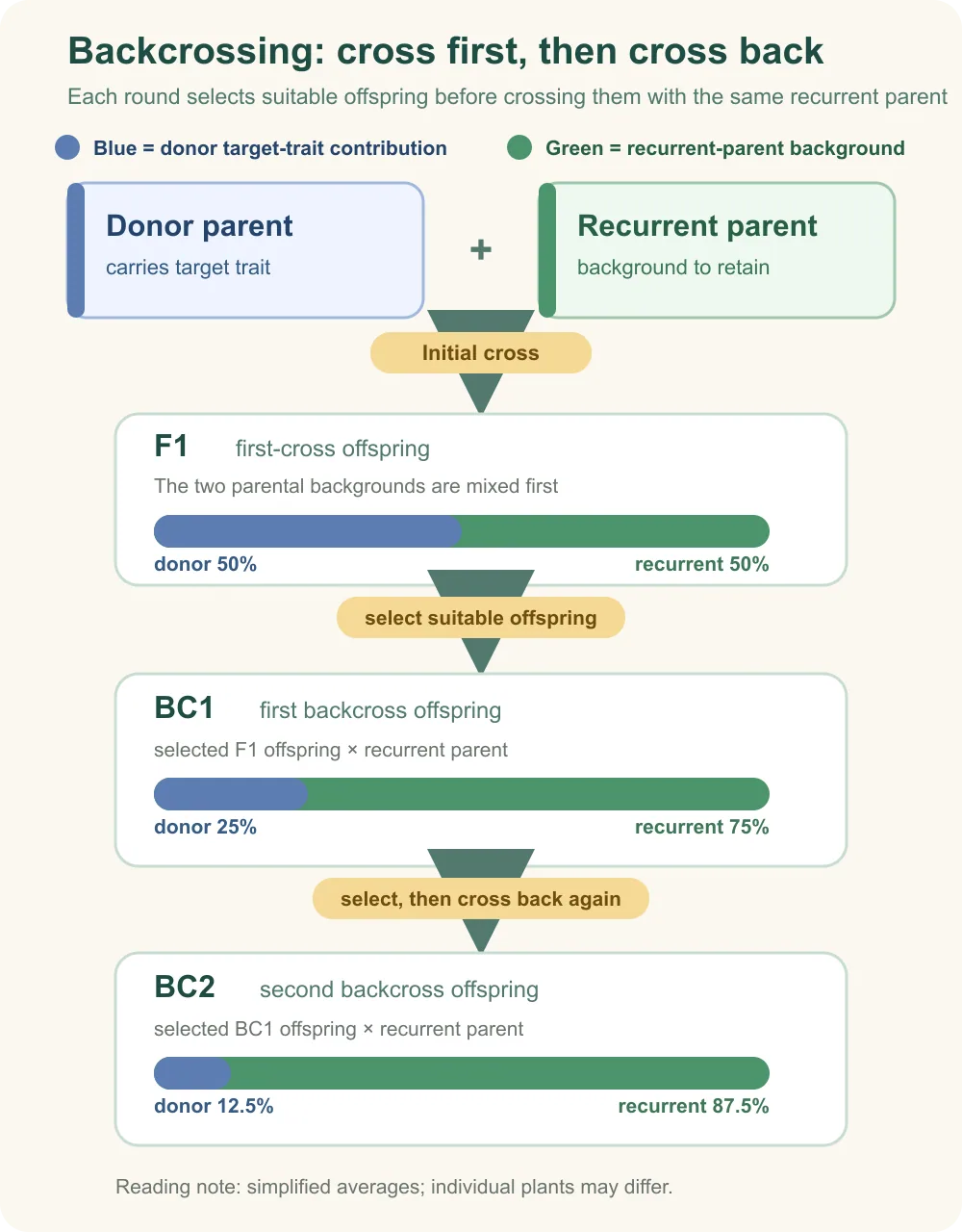
Donor parent and recurrent parent
The donor parent contributes a target trait or allele. An allele is one version of a gene at a particular position. The target might involve plant form, maturity, flower color, quality, or another inherited difference being studied. Calling a line a donor does not mean it is worse in every other way.
The recurrent parent is used again in later crosses. It usually already has most of the characteristics the breeder wants to keep, such as a useful plant form, adaptation, or overall horticultural performance. In breeding records, a “parent” may be a variety, line, or group of related breeding material—not necessarily one potted plant. If those names are unfamiliar, Parent Plants, Hybrids, and Traits: How Are They Connected? provides the broader starting point. The differences among a species, variety, cultivar, and strain are explained in Species, Variety, Cultivar, and Strain: What Do Plant Names Mean?.
How is backcrossing different from crossing or self-pollination?
These terms all involve sexual reproduction, but the partners and the purpose differ:
- A regular cross mates two designated parents. Their offspring combine genetic material from both, and breeders may select among the resulting plants. What Is Plant Breeding? Selection vs Breeding in Plain Language introduces that broader relationship between crossing and selection.
- Self-pollination uses pollen and ovules from the same plant. In a breeding program, it may be used to produce a later generation from a hybrid; it does not mean that offspring are crossed back to a different parent. For the distinction between self-pollination and cross-pollination, see What is the difference between self-pollination and cross-pollination?.
- Backcrossing takes selected hybrid offspring and crosses them with a designated parent. It is still sexual reproduction, with genetic recombination; it is not cloning, cuttings, or division.
So “back” does not mean repeating the original cross between the same two plants without selection. It means bringing qualifying offspring back to one chosen parent. A breeding program may use controlled pollination to make that cross, but this article explains the concept rather than providing a home-breeding procedure. For the broader purpose of controlled pollination, see Why Is Hand Pollination Used?.
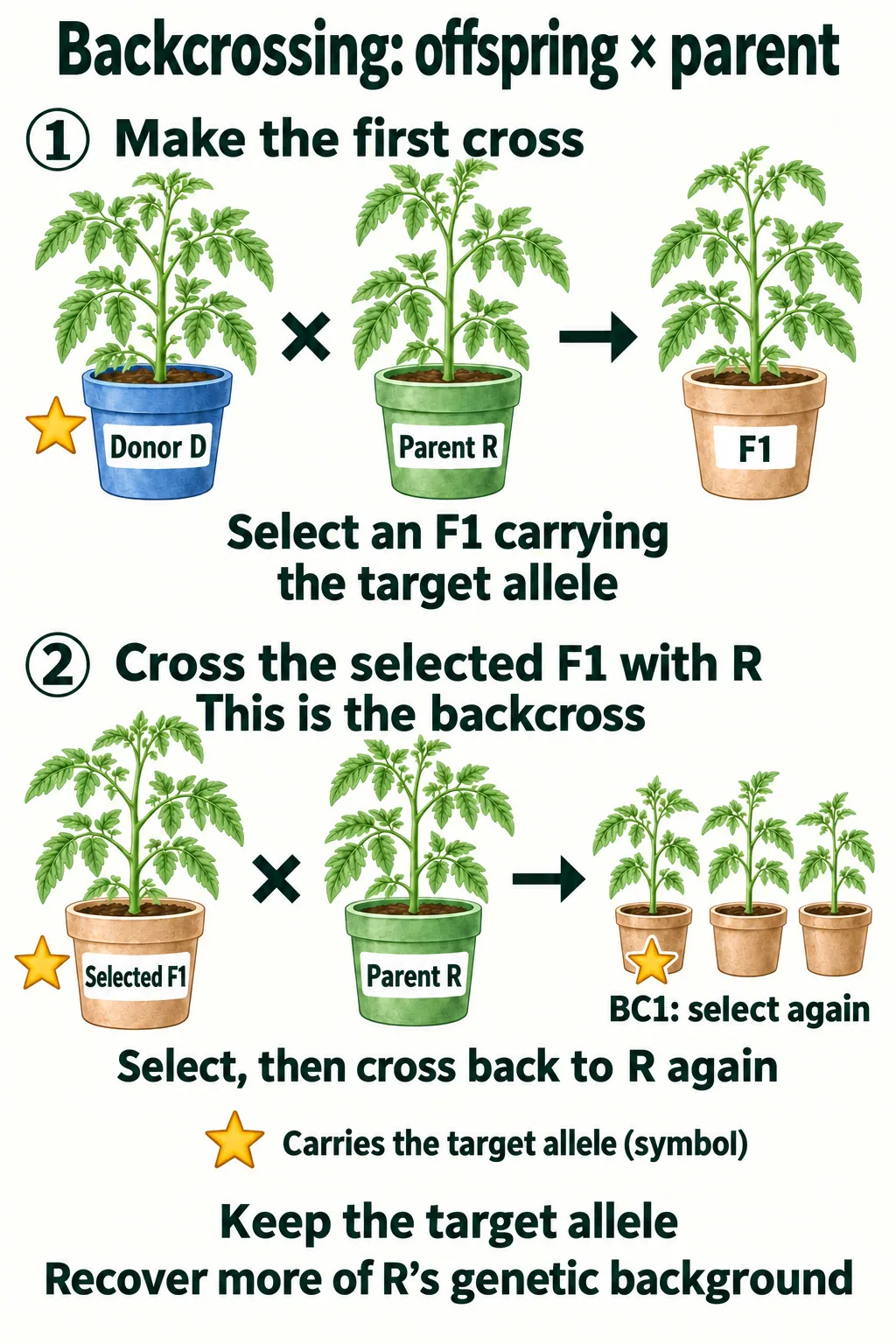
Why cross back to the recurrent parent?
Imagine a line R whose plant form and fruit performance fit the breeding goal but which lacks a target trait. Another parent, D, has that trait but also differs from R in several ways the breeder does not want to carry forward. The first cross between D and R produces F1 offspring with genetic material from both parents.
The breeder can then select an F1 plant that still carries the target trait and cross it with R. This is the first backcross. The resulting BC1 offspring receive another contribution from R. From that group, the breeder selects again and crosses the chosen material with R to produce BC2. Repeating this direction aims to move the average genetic background closer to R without losing the target trait contributed by D.
The movement of a target genetic region into another genetic background through crossing and repeated backcrossing is often called introgression. The word describes what genetic material is being moved; it does not mean that the result is a guaranteed copy of the recurrent parent.
In a simplified model—assuming homozygous parents, no special linkage, and no selection bias—the expected average contribution from the recurrent parent is approximately:
- F1: 50% recurrent-parent background and 50% donor-parent background.
- BC1: 75% recurrent-parent background and 25% donor-parent background.
- BC2: 87.5% recurrent-parent background and 12.5% donor-parent background.
- BC3: 93.75% recurrent-parent background and 6.25% donor-parent background.
These values show the direction of the process; they are not a test report for every plant. Chromosomes recombine, individuals differ, and a donor segment near the target gene may be inherited along with it. When an unwanted neighboring donor segment comes along with the target region, the situation is called linkage drag.
Backcross simulator: what happens over rounds of crossing back to R?
Using tomato as an example, follow the blue donor stretches through crossing over, selection, and linkage drag.
Donor parent D (blue) carries the target allele ★ on both sets of chromosomes. Recurrent parent R (green) has the genetic background the breeder wants to keep. F1 gets one set of chromosomes from each, so half its background comes from R. Only four chromosome pairs are drawn.
Reduced motion is on: choosing a step shows its final frame.
About this model and the evidence
This is a teaching simulation built on backcross genetics, not data from a real tomato breeding program.
- Expected averages
With homozygous parents and no selection, the expected average share from the recurrent parent after t backcrosses is 1 − (1/2)^(t+1): F1 50%, BC1 75%, BC2 87.5%, BC3 93.75%, BC4 about 96.9%.
- Chromosomes and crossovers
Tomato has 12 chromosome pairs; four are drawn here. In normal tomato meiosis, homologous chromosomes usually have at least one crossover, which helps them separate correctly. After DNA replication, a pair contains four chromatids (the copied strands). One crossover involves only two of them, so the copy entering a gamete may not have taken part. The drawing leaves out replication and the full four-chromatid process. The four gametes on the right are separate examples, not the four products of a single meiosis. The model follows only the copy passed on, allowing zero to three color-switch points drawn according to chromosome length and spread evenly. This is not the number of crossovers in the entire pair. Studies of tomato show crossovers concentrating in euchromatin (the looser, gene-rich regions), rarely occurring near the centromere (the chromosome’s constriction), and tending to keep apart along a chromosome; none of that is simulated. With so few chromosomes, differences between plants, and the weight of the ★ chromosome in the total, look larger than in a real tomato, and the late lead from background selection looks smaller.
- Selection
Eight plants per generation is only the batch size on screen. Foreground selection keeps only ★ carriers; background selection then picks the carrier with the highest share from R. The animation shows the true share directly; real breeding can only estimate it, with DNA markers or by comparing traits. With foreground selection alone, carrying ★ means carrying the blue stretch beside it, so the chosen plant often sits a little below the no-selection average. If none of the eight carries ★ (about 1 chance in 256), the simulation draws that generation again.
- Linkage drag
Blue stretches on the other chromosomes halve, on average, with each generation. The blue beside ★ can be trimmed only by crossovers that happen to fall close by, so it shrinks far more slowly. For a chromosome of about 100 cM (centimorgans, the unit of genetic map length) under foreground selection alone, roughly four tenths of its length around ★ is still blue on average after the fourth backcross, and about a third after the sixth. In tomato, the wild-relative stretch kept beside one introduced disease-resistance gene has been measured at anywhere from about 4 cM to more than 50 cM.
- Not shown
After backcrossing, breeders usually self-pollinate or otherwise fix the target allele and compare the material in different environments. Those steps are covered in the article, not in the simulation.
What do F1, F2, BC1, and BC1F1 mean?
The letters and numbers in a breeding record describe how a group of plants was produced. They are not quality grades:
- F1 is the first filial generation—the offspring from the first cross between two parents. “Filial” means offspring generation.
- F2 is produced by self-pollinating F1 plants or crossing F1 plants with one another. In many simplified examples, F2 shows more genetic segregation and trait combinations, but it is not automatically “better” than F1.
- BC1 is the first backcross generation: offspring produced after hybrid material is crossed with the designated parent for the first time.
- BC2 is the second backcross generation, usually produced when selected BC1 material is crossed again with the same recurrent parent.
- BC1F1 is a more detailed label for the first filial generation after the first backcross. Labels such as
BC1F2orBC2F2:4depend on the crop and the pedigree system used by a research program.
For a beginner, the key point is that BC1 means “first backcross,” not a product ranking. The exact naming convention can vary among crops and breeding programs.
Why is selection needed in every round?
Backcrossing does not mean moving every offspring into the next cross without checking them. Each round usually involves at least two selection goals:
- Foreground selection checks that a plant still carries the target trait or target allele.
- Background selection looks for plants whose overall genetic background, plant form, or other important traits are closer to the recurrent parent.
Some traits can be observed directly. Others require waiting until a particular developmental stage, testing progeny, or using DNA markers to help identify the relevant region. These tools can make selection more efficient, but a marker does not automatically replace field or horticultural evaluation. After the backcross cycles, breeders may still use self-pollination or another fixation method, followed by testing in more than one environment, to see whether the material actually meets the breeding goal.
Backcrossing is not an exact copy machine
Repeatedly using the recurrent parent can move the expected average genetic background closer to it. It does not mean that a fixed number of backcrosses will make every offspring identical to the original variety. Several factors matter:
- Backcross offspring still segregate and recombine, so individuals are not all the same.
- Linkage drag can keep unwanted donor DNA near the target region.
- If the goal involves many traits, or traits influenced by many genes and the environment, backcrossing may not be the simplest strategy.
- Compatibility between parents, inheritance of the target trait, and the selection method all affect the program.
Backcrossing is therefore best viewed as a way to address one or a few specific gaps while moving material toward an established genetic background. It is not a guarantee that a plant will become “better,” and appearance alone cannot confirm that introgression has succeeded.
Common confusions
- ✕ Backcrossing means repeating the original cross between the same two parents.
- ✓ It means crossing selected hybrid offspring with one designated parent.
- ✕ BC1 means a higher-quality generation than F1.
- ✓ BC1 only records that the material has gone through one backcross.
- ✕ BC1’s 75% means every plant has exactly 75% recurrent-parent background.
- ✓ It is an expected average in a simplified model; individuals differ because of recombination and selection.
- ✕ Backcrossing removes every other donor gene automatically.
- ✓ Linkage drag can keep neighboring donor segments, so selection and testing are still needed.
- ✕ Backcrossing is the same as self-pollination, cuttings, or cloning.
- ✓ It is a sexual breeding strategy that reshuffles genetic material.
- ✕ Backcrossing is another name for genetic engineering.
- ✓ Backcrossing describes a crossing and selection strategy; the source of the donor material is a separate question.
Frequently Asked Questions
Does a backcross have to use the exact original parent plant?
Not necessarily. In breeding records, the recurrent parent may be a variety, line, or group of related material rather than the first individual plant used in the original cross. What matters is how the breeding program defines and maintains that recurrent background.
Is F2 better than F1?
No. F2 is simply a later generation, often with more segregation and variation. That variation can create more choices for selection, but it can also produce unwanted combinations. A generation label does not determine quality.
How many backcrosses are needed?
There is no universal number for all plants. The answer depends on how similar the donor and recurrent parents are, how the target trait is inherited, which selection tools are available, how much linkage drag must be reduced, and what testing is required afterward. Expected percentages explain the direction of the process; they do not set the schedule for every breeding program.
Why self-pollinate after backcrossing?
Backcrossing mainly moves the overall background toward the recurrent parent. Self-pollination or another fixation method may then help establish the target allele in the form needed for the next evaluation. The exact approach depends on the crop and the trait.
Is the donor parent a worse plant?
Not necessarily. A donor may be valuable for one target trait, while the recurrent parent better fits a different set of breeding goals. “Donor” and “recurrent” describe roles in a program, not a good-versus-bad rating.
Is backcrossing the same as genetic engineering?
No. Backcrossing describes a crossing and selection strategy. Donor material may come from natural variation, mutation, a related plant, or another breeding source. Whether genetic engineering was used is a separate technical question that cannot be answered from the word “backcross” alone.
Related terms
- Backcross / backcrossing: a backcross is a cross between hybrid offspring and a designated parent; backcrossing can also describe the repeated strategy as a whole.
- Donor parent: the parent that contributes a target trait or allele.
- Recurrent parent: the parent used repeatedly in later crosses, whose genetic background the breeder wants to retain.
- Genetic background: the overall genetic composition of a line or plant, not a single trait.
- Introgression: moving a target genetic region into another genetic background through crossing and repeated backcrossing.
- Linkage drag: unwanted donor segments inherited along with a target region because they are genetically linked.
- Marker-assisted selection (MAS): using DNA markers to help identify material carrying a target region or a desired background.
Evidence and attribution
Sources and image rights
These sources were used to check the plant-science concepts and gardening context in this article.
View sources and further reading (16)
- openstax.org — 11 1 the process of meiosis
- iastate.pressbooks.pub — backcrossing
- iastate.pressbooks.pub — pedigree naming systems and symbols
- iastate.pressbooks.pub — marker assisted backcrossing
- passel2.unl.edu — 3
- passel2.unl.edu — glossary
- ams.usda.gov — Induced Mutagenesis.pdf
- ars.usda.gov — publication
- plants.ces.ncsu.edu — solanum lycopersicum
- pmc.ncbi.nlm.nih.gov — PMC1204794
- pmc.ncbi.nlm.nih.gov — PMC1569518
- doi.org — pp.16.01530
- doi.org — BF00305828
- pmc.ncbi.nlm.nih.gov — PMC3378239
- pmc.ncbi.nlm.nih.gov — PMC1206766
- pmc.ncbi.nlm.nih.gov — PMC8000504
Image sources and rights
- Plant Note project-made image · Created by Plant Note; no third-party image license applies — The project-made SVG was adapted as WebP for delivery.