Repotting droop is often a temporary mismatch between roots and leaves
When a plant droops after repotting, it does not automatically mean the plant is dying. It also does not always mean the plant is simply thirsty. A useful first explanation is this: the root zone has just been rearranged, while the leaves are still losing water.
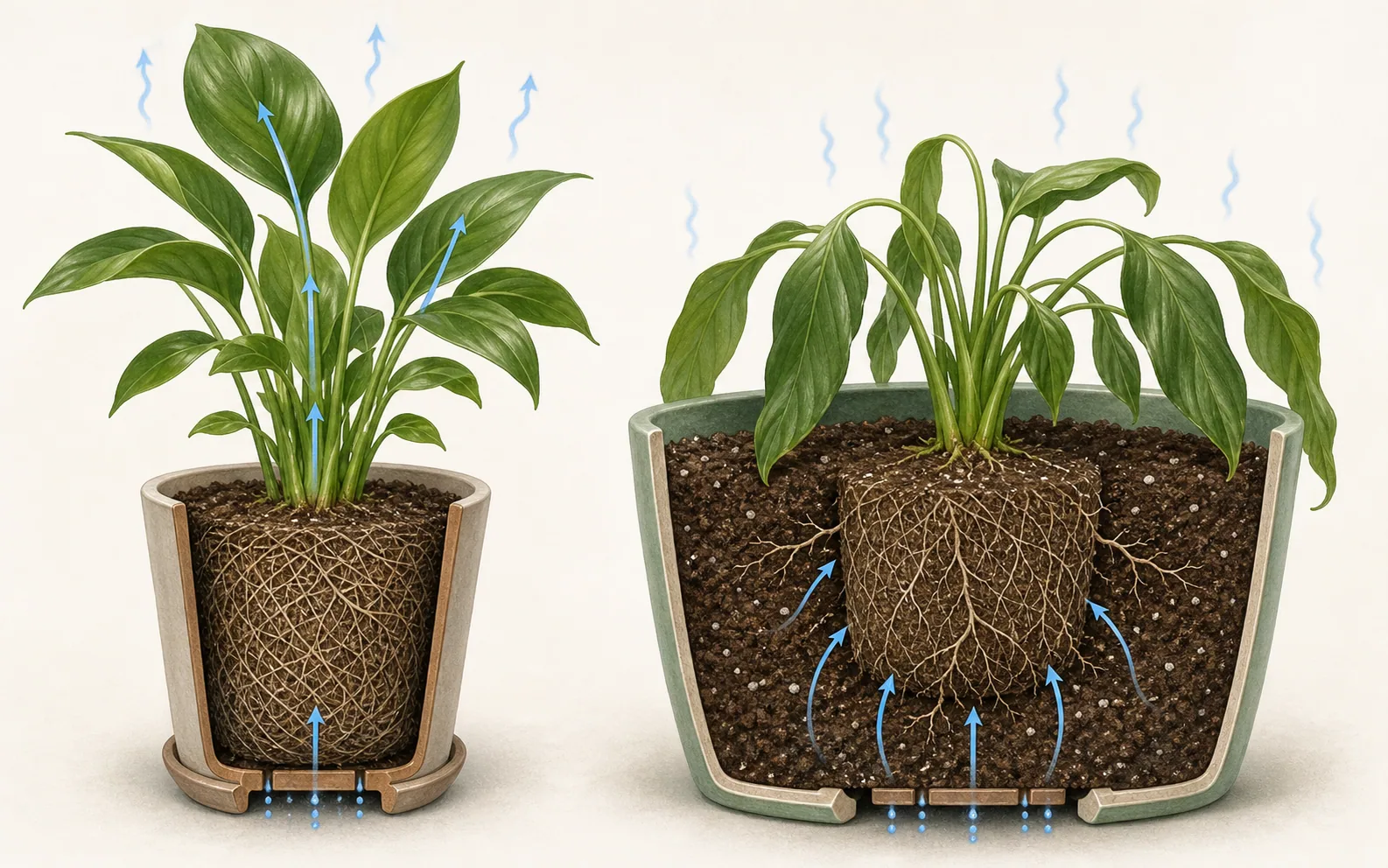
Before repotting, fine roots are already in close contact with the old potting mix. During repotting, the root ball is lifted out, loosened, and surrounded by a new mix. Root-to-mix contact, air spaces, moisture movement, and drying speed can all change. Meanwhile, leaves keep losing water through transpiration, the movement of water vapor from the plant into the air. If the roots cannot keep up for a while, leaves may lose firmness and look limp.
Repotting changes the whole root zone
Repotting is not just moving a plant into a nicer container. For the plant, the real change is in the root zone: the root ball, potting mix, container space, moisture pattern, and air movement around the roots.
If a plant was pot-bound, roots may have circled along the pot wall. To help roots grow outward again, the outer root ball may be loosened during repotting. That can be useful, but it can also disturb some fine roots. The more the fine roots are disturbed, the more easily short-term water uptake can drop.
The new mix also has to make contact with the old root ball. If there are gaps between the root ball and fresh mix, water may not move smoothly into the active root area. If the new mix holds more water than the old mix, the pot may also stay moist longer than expected. These changes make the first period after repotting less predictable.
It can look like thirst, but more water is not always the answer
Wilting makes people think of thirst because leaf firmness depends on water and turgor pressure. Turgor pressure is the water pressure that helps plant cells stay firm. When water supply cannot keep up, leaves may droop.
The tricky part after repotting is that water may be present near the roots, but the plant may not be able to use it well yet. Roots may have been tugged, fine roots may be damaged, the root ball may not be well connected to the new mix, or the potting mix may stay so wet that root oxygen becomes limited.
That is why leaves and pot clues need to be read together. If the pot is light and the deeper mix is dry, dryness may matter. If the pot is still heavy, the deeper mix is moist, or water remains in the saucer, the droop should not be reduced to “add more water.”
Fresh mix, pot size, and the room environment also matter
After repotting, the moisture rhythm often changes. The old root ball may be dense, while the fresh mix around it may be loose. The surface can look dry while the inner root ball is still moist, or the fresh mix can be wet while the older root ball has not rewetted evenly.
Pot size also changes the reading. A pot that is too small can limit roots and mix volume. A pot that is much larger than the root system can leave outer areas of mix moist for a long time. If repotting also comes with brighter light, dry air, warm conditions, air-conditioning, or a new location, leaf water loss and environmental stress can rise at the same time.
So “wilting after repotting” can have several overlapping causes. Sometimes the root ball was disturbed. Sometimes old and new mix dry at different speeds. Sometimes the leaves lose water faster because the plant was moved. Sometimes the pot stays too wet and roots work less well. It is an observation problem, not a one-sentence diagnosis.
Why can leaves droop even when the pot has water?
Whether a leaf stays firm depends on whether the water the roots send up can keep up with the water the leaves lose. Pick a situation and compare what happens in the pot, in the leaf and in one leaf cell when supply falls behind loss.
Pick a situation:
There is water in the pot, but some fine roots broke or were disturbed in repotting and the root ball is not yet in close contact with the new mix, so the roots take up water more slowly. A long oxygen shortage around the roots can slow uptake too.
Relative rates (illustration) · the line marks the usual rateAbout even: cell water holds steady
Roots take up water from the potting mix and send it through the xylem in the stem to the leaves, while the leaves lose water to the air through transpiration. When the two roughly match, the large central vacuole in each leaf cell stays full and pushes outward while the cell wall pushes back. That pressure is called turgor, and it holds the leaf up.
In short: a leaf stays firm while supply keeps up with loss. A drying mix, struggling roots and fast water loss can all leave supply behind. Inside the leaf the result is the same—turgor falls and the leaf wilts—so read the potting mix, the roots and the surroundings together.
About this model
This is a qualitative model of a generic soft-leaved herb, not a particular species, and nothing on screen is a measured value. In measurements, leaves near zero turgor usually still hold about 77–89% of their water, and their cell layers thin by only about 10–20%; the cell here shrinks within that range, with a dashed line marking its original size. Showing one cell is a simplification, since different cells in a leaf shrink by different amounts. Thick, leathery leaves are held up mainly by cell walls and fibers and may barely droop as they lose water.
The three situations are simplified; in a real pot several causes often overlap, such as fine roots disturbed in repotting followed by a hot spell. The bars compare rates, not amounts of water: normally roots take up water about as fast as leaves lose it. When supply runs slower than loss for a while, water stored in stems and leaves makes up the difference, so the leaves hold less water, and recovery needs supply to run ahead of loss for a time. When roots run short of oxygen, their cells turn more acidic and some of the water channels in their membranes (aquaporins) close, so water enters the roots less easily; this can partly reverse once air returns. Some plants narrow their stomata early when their roots lack oxygen and may not wilt, and their leaf stalks may bend down because of ethylene (epinasty), which is not a loss of turgor; neither sign identifies the cause on its own. After repotting, recovery depends mainly on new roots growing into the new mix.
When a leaf loses water to the air, each cell’s membrane stays against its wall and the whole cell shrinks slightly. The textbook picture of a membrane pulling away from the wall, called plasmolysis, mostly comes from soaking cells in a strong solution. Only if water loss continues well past zero turgor do cell walls start to buckle inward, which is beyond what this demonstration shows.
Low-risk clues to check first
A useful way to read a post-repotting plant is to bring attention back to the root zone and the environment, not only the leaves.
- Pot weight: after watering, does the pot gradually become lighter, or does it stay heavy for many days?
- Deeper mix: even if the surface looks dry, is the mix near the root zone still moist?
- Leaf rhythm: is the plant limp all day, or does it droop more during the day and recover somewhat at night or early morning?
- New growth and older leaves: is the whole plant suddenly limp, or are only a few older leaves yellowing or dropping?
- Environmental change: did the plant also move to a different light level, air vent, dry room, or sun exposure after repotting?
These clues do not guarantee one answer, but they keep the problem from being oversimplified. A repotted plant has to rebuild contact between roots and mix, and it also has to settle into a new moisture rhythm.
Common Mix-Ups
- ✕ If a plant wilts after repotting, the repotting failed.
- ✓ Wilting can be a short-term adjustment, or it can be a clue about root-zone moisture and environmental stress.
- ✕ Drooping leaves always mean the plant needs more water right away.
- ✓ A plant can droop when roots are disturbed or when the root zone is too wet and low in oxygen.
- ✕ A larger pot always helps a plant recover faster.
- ✓ Pot size needs to match root size, mix volume, drainage, and aeration; too much unused mix can stay wet.
- ✕ Leaf drop after repotting automatically means root rot.
- ✓ Leaf drop, wilting, and yellowing can come from several causes. Root rot is only one possible issue to check.
Frequently Asked Questions
Is wilting after repotting normal?
It can happen, especially when the root ball was loosened, fine roots were disturbed, or the plant also moved into a new environment. But “can happen” does not mean “always harmless.” The better approach is to read root-zone moisture, pot weight, and environmental changes together.
Why is my plant drooping after repotting even though I watered it?
Leaf firmness depends not only on water being in the pot, but also on roots being able to take it up. If root contact is poor, fine roots were disturbed, or the mix is too wet and low in oxygen, water uptake can lag even when the pot is moist.
Does wilting after repotting mean root rot?
Not necessarily. Root rot involves damaged, decaying, or nonfunctional roots. Post-repotting wilt may instead come from short-term root-zone disturbance, changed moisture patterns, or environmental stress. If the pot stays wet for a long time, roots darken or soften, and the plant keeps declining, root health becomes more important to check.
Can I keep the same watering schedule after repotting?
It is better not to rely only on the old schedule. Repotting can change mix volume, pot size, root contact, and drying speed. The old rhythm can be background information, but pot weight, deeper mix moisture, and plant condition need to be checked again.
Why do some plants handle repotting well while others droop badly?
Plant type, root structure, how much the roots were disturbed, season, light, temperature, airflow, and potting mix can all matter. Some plants rebuild fine roots quickly; others are more sensitive to root disturbance. One plant’s reaction should not be treated as a rule for all houseplants.
Should I fertilize right away to help a repotted plant recover?
This article does not give a fertilizing prescription. From a plant-science point of view, the first issue after repotting is often root contact, water supply, and environmental adjustment, not simply a lack of fertilizer. If roots are not yet working steadily, treating the issue as a fertilizer problem can be misleading.
Related Terms
- Repotting: moving a plant from one container to another, often changing the potting mix and root-zone conditions.
- Transplant shock: a stress response after a plant is moved or repotted and its roots or environment change.
- Root ball: the combined mass of roots and potting mix around the plant.
- Fine roots: smaller roots that often do much of the water and mineral uptake work.
- Transpiration: water vapor loss from leaves and other plant surfaces into the air.
- Turgor pressure: water pressure inside plant cells that helps leaves and stems stay firm.
Read Next
Evidence
References
These sources were used to check the plant-science concepts and gardening context in this article.
View sources and further reading (17)
- extension.illinois.edu — 2018 03 19 tips repotting houseplants
- hgic.clemson.edu — indoor plants watering
- purduelandscapereport.org — common abiotic problems of ornamentals transplant shock
- cals.cornell.edu — avoid transplant shock
- pubs.ext.vt.edu — spes 749.html
- openstax.org — 30 5 transport of water and solutes in plants
- extension.umd.edu — potting and repotting indoor plants
- open.lib.umn.edu — 11 1 plants and water
- hort.extension.wisc.edu — reasons why plants wilt
- gardeningsg.nparks.gov.sg — transplanting shock
- extension.psu.edu — repotting houseplants
- extension.umd.edu — overwatered indoor plants
- pmc.ncbi.nlm.nih.gov — PMC2689965
- pmc.ncbi.nlm.nih.gov — PMC1065914
- pmc.ncbi.nlm.nih.gov — PMC3982740
- doi.org — ajb.1300158
- pmc.ncbi.nlm.nih.gov — PMC12131956