
Gravitropism in five steps: from statoliths to a bend
Lay a seedling on its side and watch statocytes, auxin and cell walls turn the root down and the shoot up, step by step.
Gravity-sensing cells are called statocytes: the column of cells in the center of the root cap (columella cells) and, in the young shoots of many plants, cells of the endodermis around the vascular tissue. Dense, starch-filled amyloplasts settle to the new lower side and act as statoliths. Current research suggests they bring LAZY (LZY) proteins to the lower cell membrane; LZY then helps gather PIN3, a protein that moves auxin out of cells, on that side. In roots, the cap senses gravity but the bend forms farther back, in the elongation zone.
Reduced motion is on: choosing a step shows its final frame.
About this model and the evidence
This is a qualitative teaching model based mainly on seedling studies such as Arabidopsis, not a measured simulation. In the first four steps, roots and shoots are drawn separately on their side with the tip to the right for comparison; step five shows one seedling on its side. In real plants the steps overlap. Transport routes, particle counts, curve shapes, pH colors and timing are simplified and are not measured values.
- Starch–statolith hypothesis and LAZY proteins
Root-cap columella cells and shoot endodermal cells contain amyloplasts that can settle. Starch matters but is not strictly required. Since 2023, two independent teams have reported evidence that amyloplasts bring LAZY (LZY) proteins to the lower cell membrane, where LZY then helps guide PIN3 to that side. This is the strongest current model, though details remain open and direct imaging evidence is thinner for the shoot endodermis than for roots.
- Cholodny–Went model and the root’s reverse fountain
A directional cue changes auxin transport, so auxin becomes uneven across the organ and the two sides elongate at different rates. After tilting, PIN3 and PIN7 in root-cap columella cells move to the lower side within minutes. In the shoot endodermis, PIN3 also moves to the lower side, then later shifts back so the shoot does not overshoot.
- Concentration–response curves
In 1937 Thimann compared the effects of added auxin on roots, buds and stems: all three gave bell-shaped curves with different optima. Later reviews note that micromolar auxin (about 10⁻⁶ M) promotes stem elongation, while roots are inhibited above roughly 10⁻⁹ to 10⁻⁸ M. These curves come from added-auxin experiments and illustrate sensitivity; positions in the chart are not measured internal concentrations. Too much auxin inhibits stems as well.
- Acid growth and rapid root inhibition
Research shows that TMK proteins at the shoot cell surface can switch proton pumps on directly, while nuclear auxin signaling keeps the pumps active through SAUR proteins. How the two share the work during gravitropic bending is still being studied. Expansins have no wall-digesting enzyme activity; they work best around pH 4 and are thought to let tightly touching cellulose microfibrils slip. Acid does not dissolve the wall. In roots, a rapid response started by the AFB1 receptor lets Ca²⁺ in through the CNGC14 channel and causes net H⁺ influx, raising apoplast pH (alkalinization) and slowing elongation in under 30 seconds; an acidifying TMK1 route in roots pulls the other way.
Still open: researchers still describe why the same auxin promotes elongation in shoots but inhibits it in roots as an unsolved puzzle; differences in receptors and rapid signaling routes are the main leads. Measured apoplast pH varies widely with tissue and method, so the chart only shows the direction: more or less acidic.
Why do roots go down and shoots go up? What is gravitropism?
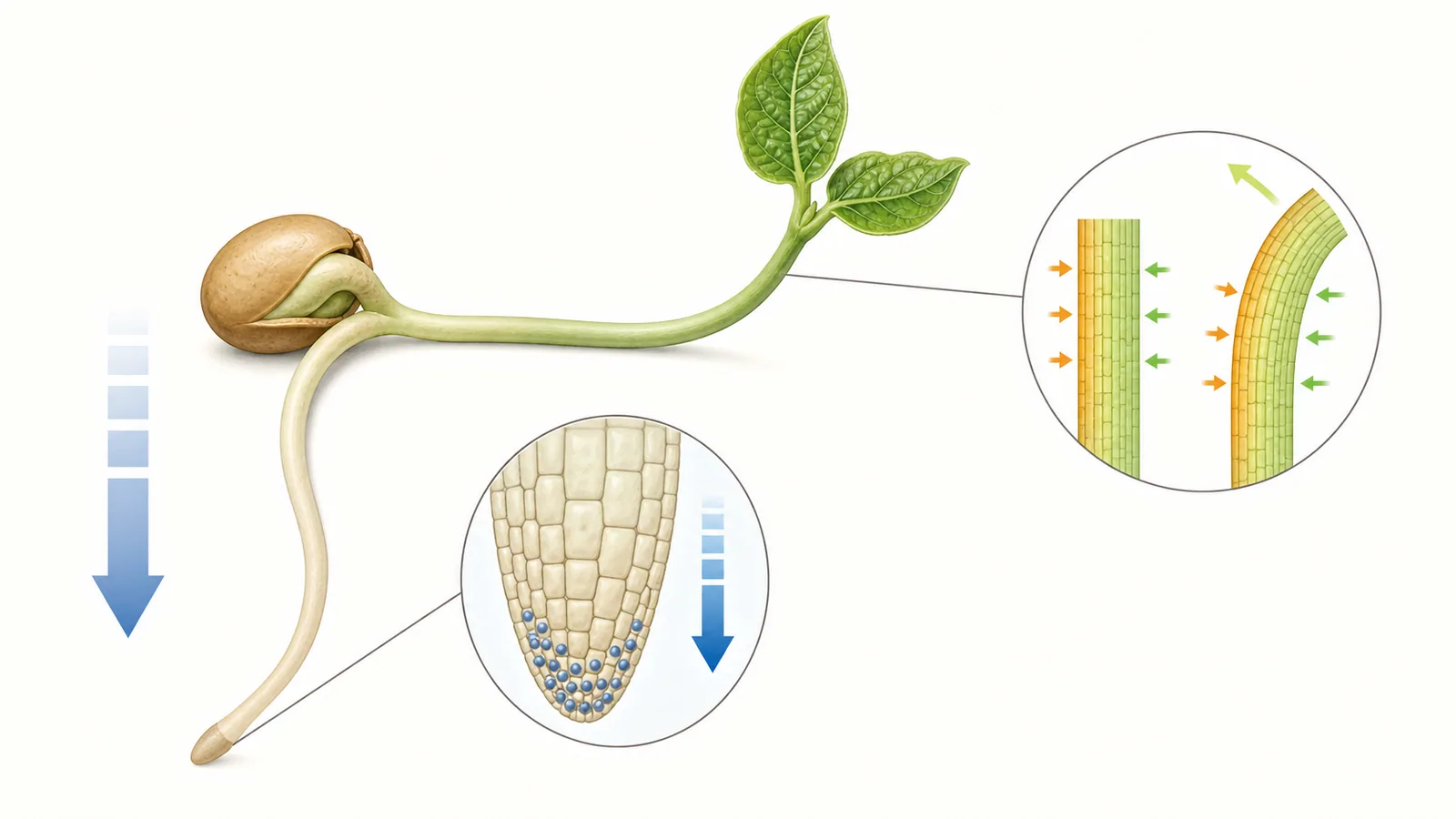
If a germinating seedling is turned sideways, the root often bends downward again and the shoot bends upward again. Growing tissues can respond to the direction of gravity, then shift their growth pattern through unequal growth on different sides of an organ.
This gravity-related growth response is called gravitropism. Roots often show positive gravitropism by growing with the direction of gravity, while shoot tips often show negative gravitropism by growing against the direction of gravity.
How can a plant tell which way is down?
Plants do not have animal balance organs. Their gravity response begins in specialized gravity-sensing cells called statocytes. In roots, these are the column of cells in the center of the root cap, known as columella cells. In the young shoots of many plants, such as dicot seedlings, they are cells of the endodermis, the cell layer that wraps around the vascular tissue. Statocytes contain dense, starch-filled amyloplasts. Because these settle with gravity and provide a direction cue, they are also called statoliths.
When a root or shoot is reoriented, the statoliths settle toward the new lower side of the cell. The plant is not “seeing” gravity. Instead, a change in position inside the cell is converted into signals. Current research suggests that amyloplasts bring LAZY (LZY) proteins to the lower cell membrane. LZY then helps gather PIN proteins, the carriers that move auxin out of cells, on that side, redirecting the flow of auxin.
Auxin is a plant hormone involved in cell elongation and directional growth. In gravitropism, the key point is not simply whether auxin is present. The key point is that auxin patterns and growth responses become uneven across the two sides of a root or shoot.
Why do roots bend downward?
Root bending downward is the everyday example of positive gravitropism. When a root is placed sideways, statoliths in the columella cells settle toward the new lower side. The root cap then sends more auxin to the lower side, and outer tissues carry it back to the elongation zone, the short region behind the tip where cells lengthen quickly. In roots, extra auxin often inhibits cell elongation.
So the lower side of the root elongates more slowly, while the upper side keeps growing at the same or a relatively faster rate. Because the upper side grows more, the root tip bends downward, back toward the direction of gravity. The root cap that senses gravity and the elongation zone that bends are in different places.
This distinction matters: gravity does not simply pull the root into a curved shape. Gravity provides directional information. The bend is produced by unequal growth in the growing region of the root.
Why do shoots bend upward?
Shoots, young stems, and seedling shoot tips often show negative gravitropism. They grow away from the direction of gravity. This helps the above-ground part of a seedling leave the soil or growing medium so future leaves can reach light.
Roots and shoots both need auxin, but the same extra auxin often pushes them in opposite directions. In many young shoots, auxin on one side promotes elongation: it makes proton pumps in the cell membrane move H⁺ out of the cells, and the more acidic wall stretches more easily. When the lower side of a sideways shoot elongates more, the shoot curves upward.
This can happen alongside phototropism, but it is not the same process. Phototropism responds to light direction. Gravitropism responds to gravity direction. A seedling can still orient its root downward and shoot upward in darkness, which makes gravitropism especially clear in young seedlings.
Why does the same auxin signal act differently in roots and shoots?
Statoliths only tell the cells which way is down. Roots and shoots bend in opposite directions because of two things that happen next: root cells are far more sensitive to auxin than shoot cells, and the space around the cell wall becomes more or less acidic, which affects how easily the wall can loosen. The demonstration below follows five steps, from statocytes to a whole seedling bending.
Why are roots more sensitive to auxin?
When auxin is added at different concentrations to roots, buds and stems, all three give a bell-shaped response: a little promotes growth and too much inhibits it. Their optimum concentrations, however, are very different. Reviews of this work note that micromolar auxin (about 10⁻⁶ M) promotes stem elongation, while roots are inhibited above roughly 10⁻⁹ to 10⁻⁸ M, a gap of several orders of magnitude. (M is a unit of concentration; in other words, one-hundredth to one-thousandth of the stem’s concentration is enough to inhibit roots.)
In Arabidopsis, a small mustard-family plant widely used in research, a root’s own auxin is already near its optimum, so a little more on the lower side turns “just right” into “too much”. The extra auxin on a shoot’s lower side is still in the promoting range. These curves come from experiments that added auxin, and they illustrate a difference in sensitivity. Why roots are so sensitive is still being studied; one known part is a rapid inhibition route in root cells started by AFB1, a receptor protein that recognizes auxin.
Why does an acidic cell wall make a cell grow faster?
A plant cell is like a water balloon inside a wall, with turgor pressure always pushing outward. The cell can only enlarge if the wall gives way. Cellulose microfibrils in the wall mostly wrap around the cell like the hoops of a barrel, so the cell lengthens along its long axis.
On the lower side of a young shoot, auxin makes proton pumps (H⁺-ATPases) in the cell membrane more active. They move H⁺ into the apoplast, the space outside the cell membrane that includes the cell wall. As this space becomes more acidic, proteins called expansins become active. They are thought to let tightly touching microfibrils slide apart a little. Turgor can then stretch the cell, and water flows in. Expansins do not cut the fibers, and the acid does not dissolve the wall.
The lower side of a root does the opposite. When auxin rises, a rapid AFB1 signal lets calcium ions and H⁺ flow into the cells. The apoplast becomes less acidic, expansins stay less active, the wall stays tight, and elongation slows within tens of seconds. “Less acidic” does not necessarily mean alkaline, and slower elongation does not mean shrinking.
Roots and shoots compared
| Root | Young shoot | |
|---|---|---|
| Where gravity is sensed | Columella cells in the center of the root cap | Endodermal cells around the vascular tissue (in dicot seedlings, for example) |
| How auxin reaches the lower side | PIN3 and PIN7 in the root cap send it downward; the outer cells of the root cap (lateral root cap) and the epidermis carry it back to the elongation zone | Endodermal PIN3 moves to the lower side of each cell and pushes auxin into the lower tissues |
| Sensitivity to auxin | Very high; a root’s own auxin is often already near the optimum | Much lower; extra auxin mostly promotes elongation |
| Apoplast on the lower side | Becomes less acidic | Becomes more acidic |
| Elongation on the lower side | Slows | Speeds up |
| Result | Upper side grows more, so it bends down (positive gravitropism) | Lower side grows more, so it bends up (negative gravitropism) |
This table compares only the gravity cue. Real plants also combine light, water, touch, physical resistance and their natural growth angle.
Side roots and side branches are not all vertical
If the lesson stops at “roots go down and stems go up,” it can create a new misunderstanding. Not every root or branch is supposed to be perfectly vertical.
Lateral roots often grow outward at angles as they explore the surrounding medium. Side branches may spread sideways rather than shoot straight upward. That does not mean they lack gravity responses. It means plants integrate gravity with light, water, physical support, organ age, and inherited growth habit.
Gravitropism is a useful base concept for plant orientation. It is not a rule that every organ must line up with a vertical axis.
What can gardeners observe?
Seedlings are the easiest place to see the idea. After a seed germinates, changing its orientation can lead to a root that curves downward and a shoot that curves upward again. This shows that early seedling growth is not random; gravity is one of the first direction cues a young plant can use.
Potted plants and cuttings can show related patterns too. After a plant is moved, tipped, or weighed down by growth, new growth may begin to reorient. But garden observations should not be explained by gravitropism alone. A plant leaning toward a window is often showing phototropism. Roots in a pot are also influenced by moisture, air, physical resistance, and available space.
A useful observation question is: “Which directional cues are present here: gravity, light, water, and support?” That places gravitropism back inside the plant’s overall growing environment.
Common mix-ups
- ✕ Roots grow downward because gravity physically pulls them into that shape.
- ✓ Gravity gives directional information; the curve comes mainly from unequal elongation in growing tissues.
- ✕ Gravity pulls auxin down to the lower side.
- ✓ PIN and other transport proteins pass auxin from cell to cell; gravity only makes the amyloplasts settle and gives the direction.
- ✕ If plants sense gravity, they must use animal-like balance organs.
- ✓ This is a cellular and hormonal growth response, focused on how a direction cue changes elongation.
- ✕ Gravitropism and phototropism are the same thing.
- ✓ Gravitropism responds to gravity direction; phototropism responds to light direction. Both can shape the same plant.
- ✕ Every root should point straight down and every stem should point straight up.
- ✓ Main roots, lateral roots, main stems, and branches have different growth angles and combine several environmental cues.
- ✕ Gravitropism explains every leaning plant or root pattern.
- ✓ It is one directional cue. Real plants are also shaped by light, water, root-zone conditions, support, and plant type.
Frequently Asked Questions
What is gravitropism?
Gravitropism is a plant growth response to the direction of gravity. Roots often show positive gravitropism by growing with gravity, while shoot tips often show negative gravitropism by growing against gravity.
Can plants really sense gravity?
Plants can sense gravity direction, but not in an animal-like way. In statocytes such as root-cap columella cells and shoot endodermal cells, dense starch-filled amyloplasts (statoliths) settle toward the lower side. That position change helps trigger signaling and growth responses.
Why do roots grow downward?
The root tip can sense gravity direction. When a root is turned sideways, auxin patterns and elongation change across the root. The upper side often elongates more, causing the root tip to bend downward.
Why do stems grow upward?
Young shoots and stems often show negative gravitropism. After being turned sideways, uneven elongation helps the shoot curve away from gravity. This helps the seedling lift leaves and shoots toward positions where light can be used later.
Why does the same auxin signal produce opposite bends in roots and shoots?
Root cells are several orders of magnitude more sensitive to auxin than shoot cells. After tilting, both get more auxin on the lower side. The lower side of a shoot is still in the promoting range: proton pumps acidify the apoplast and the wall loosens, so it grows faster. The lower side of a root goes past its optimum: a rapid AFB1 signal makes the apoplast less acidic, so elongation slows. As a result, shoots bend up and roots bend down. The molecular reason roots are so sensitive is still being studied.
Why does an acidic cell wall make a cell grow faster?
Acidity activates expansins in the cell wall. They are thought to let tightly touching cellulose microfibrils slide apart, so the wall stretches more easily. Turgor pressure inside the cell then pushes it longer, and water flows in. This explanation is called the acid growth hypothesis. Expansins do not break down the wall, and the acid does not dissolve it.
Which matters more, gravitropism or phototropism?
It depends on the situation. A seedling in darkness can still orient roots downward and shoots upward, showing the importance of gravity. In one-sided light, phototropism also affects shoot direction. Plants usually integrate several cues at once.
Are roots also affected by moisture direction?
Yes. Roots respond not only to gravity but also to moisture, oxygen, physical resistance, and local conditions. Hydrotropism and gravitropism can work together, so “roots always go down” is too simple for real root systems.
Why do side branches not all grow straight upward?
Side branches have their own growth angles. They are shaped by light, gravity, bud position, branch weight, and the plant’s natural form. Negative gravitropism does not mean every branch must become vertical.
Related Terms
- Tropism: a directional growth response to a stimulus such as light, gravity, water, or touch.
- Gravitropism: a growth response to gravity direction.
- Positive gravitropism: growth with the direction of gravity, often illustrated with roots.
- Negative gravitropism: growth against the direction of gravity, often illustrated with shoots.
- Statocyte: a gravity-sensing cell, such as a root-cap columella cell or a shoot endodermal cell.
- Amyloplast / statolith: a dense, starch-filled structure that settles inside statocytes and provides a gravity-direction cue.
- Root cap: protective tissue at the root tip; its central columella cells sense gravity for the root.
- Elongation zone: the region behind a root or shoot tip where cells lengthen quickly and bending happens.
- Auxin: a plant hormone involved in cell elongation and directional growth.
- PIN proteins: transport proteins that move auxin out of cells; where they sit on the membrane sets the direction of auxin flow.
- Apoplast: the space outside the cell membrane, including cell walls and the spaces between cells.
- Expansin: a protein that is more active in acidic conditions and lets the cell wall stretch.
- Acid growth hypothesis: the explanation that auxin acidifies the apoplast, loosening the wall and promoting cell elongation.
Read Next
Evidence
References
These sources were used to check the plant-science concepts and gardening context in this article.
View sources and further reading (22)
- openstax.org — 30 6 plant sensory systems and responses
- organismalbio.biosci.gatech.edu — plant hormones and sensory systems
- pmc.ncbi.nlm.nih.gov — PMC7601833
- frontiersin.org — full
- nationalacademies.org — 6
- nature.com — s41586 021 03976 4
- nature.com — s41586 021 04037 6
- doi.org — j.molp.2023.06.008
- pmc.ncbi.nlm.nih.gov — PMC10615846
- science.org — science.adh9978
- pubmed.ncbi.nlm.nih.gov — 21569134
- pmc.ncbi.nlm.nih.gov — PMC9121899
- pmc.ncbi.nlm.nih.gov — PMC2857164
- pmc.ncbi.nlm.nih.gov — PMC5474774
- pmc.ncbi.nlm.nih.gov — PMC5045290
- pmc.ncbi.nlm.nih.gov — PMC7733314
- osti.gov — 2580093 plant cell wall loosening expansins
- academic.oup.com — 7210523
- doi.org — j.cub.2016.08.067
- cell.com — S0960 9822(15)01287 7
- pmc.ncbi.nlm.nih.gov — PMC6104345
- doi.org — j.tplants.2021.11.006