
Auxin is not a “grow taller” fertilizer. It is a growth signal.
Auxin is a class of plant hormones. It does not simply switch on “grow bigger.” Instead, plants use auxin to help decide where cells should elongate, where roots should form, which bud should stay quiet for a while, and which direction a shoot or root should bend.
The key idea is simple: location, local concentration, and tissue sensitivity all shape auxin’s effect, along with the other hormones and environmental cues acting at the same time. That is why “more auxin always means faster growth” is not true.
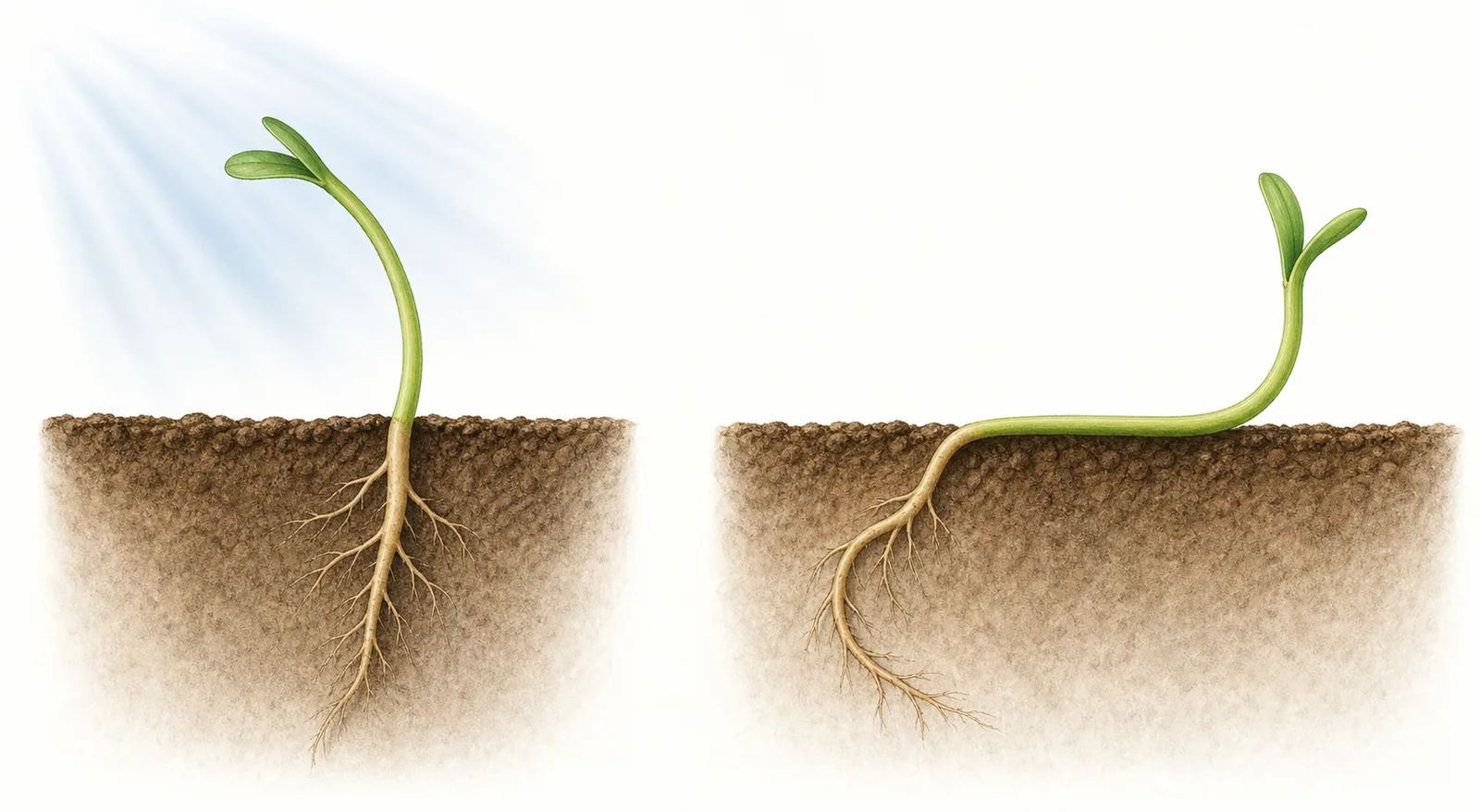
Picture a young seedling beside a window. Light comes from one side. The two sides of the shoot do not elongate at exactly the same rate, so the seedling bends toward the light. Auxin helps create that difference in growth between the two sides.
What auxin means, and why IAA is the classic example
Plant hormones are chemical signals used inside the plant body. They may act near the place where they are made, or they may move to other tissues through transport systems. Auxin is one of those hormone groups and is often discussed alongside cell elongation, organ formation, phototropism, gravitropism, shoot branching, and root development.
In many higher plants, indole-3-acetic acid, or IAA, is the best-known natural auxin. Auxin is often produced or accumulates in young shoot tips and young leaf primordia. From there, it can be redistributed through the plant by a mix of local production, breakdown, storage, and transport.
Do not picture this as a single pipe carrying one fixed amount everywhere. Auxin moves through the transport system and also through directional cell-to-cell transport using membrane carriers. This directional movement is often described as polar transport. What the plant responds to is usually not an average whole-plant number, but a local concentration pattern and the sensitivity of the receiving tissue.
Why seedlings bend toward light
Phototropism is the growth response to light direction. In many seedlings, one-sided light is detected by light receptors first. That changes how auxin is distributed across the shoot. The shaded side often gets more of the auxin that promotes shoot cell elongation, so that side grows faster. The shoot then bends toward the light source.
That means the plant is not turning itself toward light like a weather vane. It is bending because one side is elongating faster than the other. Phototropism is also not done by auxin alone; light receptors, internal signaling, transport proteins, and tissue sensitivity all take part.
That is why “auxin makes plants grow upward” is too simple. For a seedling, uneven auxin distribution can actually produce a sideways bend toward a cue in the environment.
The same auxin level can mean different things in shoots and roots
One of the easiest auxin misconceptions is to assume that one rule applies everywhere. In reality, shoots and roots differ in their sensitivity to auxin. Within certain ranges, a higher auxin level may promote shoot elongation but inhibit root elongation. If the concentration changes further, the response can change again.
| Plant part | A simple first idea | Important condition to keep in mind |
|---|---|---|
| Shoot | An appropriate auxin signal can promote elongation in some cells | Concentration, tissue age, light, and other signals all matter |
| Root | Roots are often more sensitive to auxin, and higher levels may inhibit elongation | The root tip, elongation zone, and lateral-root region do not respond the same way |
So when you see one source saying auxin can promote rooting and another saying higher auxin can inhibit root elongation, they are not necessarily contradicting each other. They may be describing different tissues, different concentrations, or different developmental stages.
This figure compares the same kind of signal in two local growth zones: the shoot elongation zone on the left and the root-tip region on the right. The shoot side pairs the signal zone with elongated cells and an upward arrow; the root side uses more compact cells and a shorter arrow to show a different tissue response. The point is not to apply one rule to both organs, but to consider signal location and tissue sensitivity together.

Why roots go down and shoots go up
Gravitropism is the growth response to gravity. In most plants, shoots show negative gravitropism and grow upward, while roots show positive gravitropism and grow downward.
If a seedling is laid on its side, gravity changes the auxin pattern on the two sides of each organ. In shoots, the lower side often responds in a way that promotes elongation, so the shoot curves upward. In roots, the lower side usually responds in a way that inhibits elongation, so the upper side grows relatively faster and the root curves downward.
This is the basic direction to remember, but roots and shoots differ in tissue structure, sensitivity, and auxin transport, so the “shoot rule” cannot simply be copied onto roots. The exact response also depends on species, developmental stage, and environment.
Apical dominance: why the shoot tip often grows first
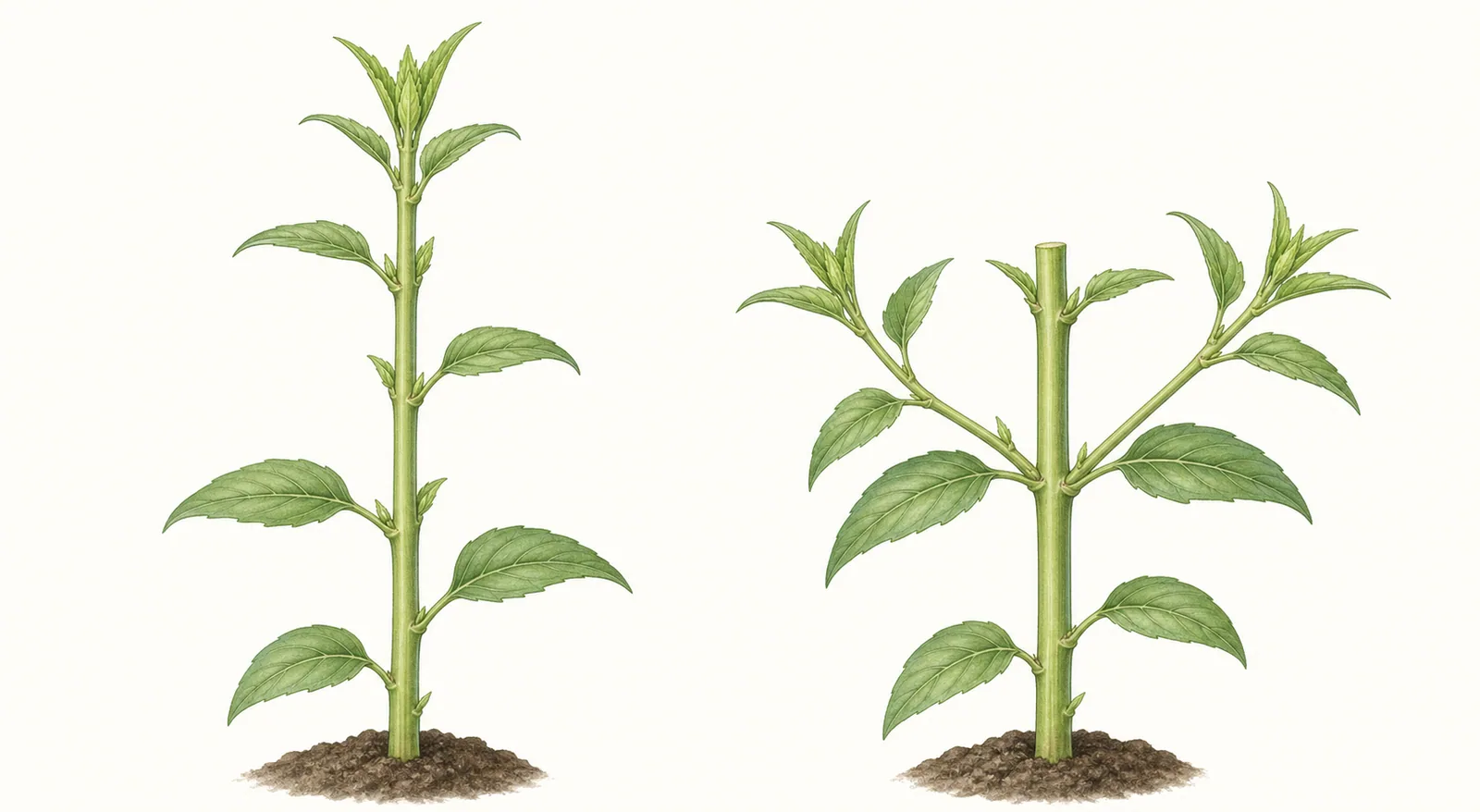
The shoot tip often grows before the side buds below it. This pattern is called apical dominance.
Auxin made in the shoot apex and young leaves can move downward through the stem and change the signaling state around nodes and buds. Auxin also interacts with cytokinin, strigolactone, and other signals so that side buds remain less active or grow more slowly for a time.
This does not mean auxin directly “presses down” on every side bud. Apical dominance is the result of several signals, transport routes, and the internal state of the bud itself. When the shoot tip is removed, that signal pattern changes, and side buds may begin to grow. Even then, the final result still depends on species, season, light, and the plant’s overall condition.
Why auxin matters for cutting propagation
Some plants can form new roots from stems, leaves, or other organs that are not originally roots. These new roots are called adventitious roots. Auxin is involved in their formation, which is why gardeners often discuss auxin and cutting propagation together.
But “auxin present” does not mean “roots must form.” Whether a cutting can produce new roots also depends on the plant species, the maturity of the cutting, wound response, carbohydrate supply, water balance, temperature, and the rooting environment. Added rooting material affects only part of the system; it cannot replace the plant’s own physiological condition.
Auxin is not fertilizer, and it is not a universal growth liquid
Fertilizers supply mineral nutrients such as nitrogen, phosphorus, and potassium. Those are materials plants need to build tissues and keep metabolism running. Auxin, by contrast, is a low-dose regulatory signal inside the plant. The roles are different.
Having enough minerals does not mean a plant will instantly grow taller, branch more, or root faster. Auxin signaling also cannot replace light, water, oxygen, carbohydrate supply, or the other conditions needed for growth. Treating auxin as “the more the better” ignores how different tissues respond differently and mixes promoting conditions with inhibiting ones.
Common points of confusion
- ✕ Auxin is just fertilizer that makes plants grow taller.
- ✓ Auxin is a chemical signal that helps regulate growth and development; fertilizer mainly supplies mineral nutrients.
- ✕ More auxin always makes both roots and shoots grow faster.
- ✓ Roots and shoots do not respond the same way, and the effect can change with concentration and tissue position.
- ✕ A plant bends toward light because the whole plant actively turns like a weather vane.
- ✓ One-sided light can create different auxin levels on the two sides of a shoot, and the shoot bends because cells elongate at different speeds.
- ✕ If you cut off the shoot tip, the plant is guaranteed to become bushier.
- ✓ Removing the shoot tip can reduce apical dominance and give side buds a chance to grow, but the result still depends on species, season, light, and plant condition.
- ✕ If a cutting roots, auxin must be the only reason.
- ✓ Rooting depends on auxin, tissue state, wound response, carbohydrates, water, temperature, and the rooting medium.
- ✕ Auxin is only about shoots and never matters in roots.
- ✓ Auxin also helps shape root development, including lateral roots and adventitious roots.
Frequently asked questions
Is auxin a plant hormone?
Yes. Auxin is a class of plant hormones. It is often linked with cell elongation, phototropism, gravitropism, organ formation, shoot branching, and root development. It is not fertilizer and not a single switch that only makes plants “grow.”
Where is auxin made in a plant?
Many plants produce or accumulate auxin in young shoot tips and young leaf primordia. Roots also have local production and regulation. Auxin distribution changes with development, transport, breakdown, and tissue sensitivity, so one fixed source cannot explain the whole plant.
Why does auxin make shoots bend toward light?
One-sided light changes how auxin is distributed across the shoot. The shaded side often gets more of the auxin that promotes elongation, so cells there grow faster. The shoot then curves toward the light source. The bend comes from different growth rates on the two sides, not from the whole plant actively rotating.
Can auxin help roots grow?
Auxin participates in root formation, lateral-root development, and root growth. But the effect depends on the root region, concentration, plant species, and environmental conditions. It may help adventitious root formation in some cases, but at higher levels it can also inhibit root elongation. It is not safe to reduce everything to “auxin makes roots.”
How is auxin related to apical dominance?
Auxin from the shoot tip moves downward and helps shape the signaling environment around side buds. Together with other hormones, it often keeps the tip growing ahead of the buds below it. If the tip is removed, the signal pattern changes and some side buds may begin to grow. That is a physiological response, not a guaranteed pruning effect for every plant.
Is rooting powder the same as auxin?
Gardening products described as rooting powders may contain synthetic substances that act like auxin in some ways, but products differ in composition and use. This article explains the biology of how auxin participates in adventitious root formation. It does not give product recommendations, concentrations, or instructions, and cutting results still depend on the plant and the environment.
Related terms
- Auxin: A class of plant hormones that helps regulate cell elongation, organ formation, tropisms, and bud/root development.
- Indole-3-acetic acid (IAA): The best-known natural auxin in many higher plants.
- Phototropism: Growth in response to the direction of light.
- Gravitropism: Growth in response to the direction of gravity.
- Apical dominance: The tendency of the shoot tip to suppress or delay side bud growth.
- Adventitious root: A new root that forms from a place that was not originally a root, such as a stem or leaf.
- Auxin transport: The process by which auxin changes its distribution through the plant via transport systems, cell-to-cell carriers, local production, and breakdown.
Keep going with
Evidence
References
These sources were used to check the plant-science concepts and gardening context in this article.
View sources and further reading (9)
- openstax.org — 30 6 plant sensory systems and responses
- bio.libretexts.org — 4.4.01: Auxin
- frontiersin.org — full
- frontiersin.org — full
- frontiersin.org — full
- pubmed.ncbi.nlm.nih.gov — 34312248
- pmc.ncbi.nlm.nih.gov — PMC2869515
- extension.oregonstate.edu — em 9902 how hormones growth regulators affect your plants
- extension.umn.edu — propagating monstera deliciosa