
Flowers usually smell because their floral tissues release a mixture of volatile organic compounds, or VOCs. These molecules can leave the flower, move through the surrounding air, and become an odor cue. In some plants, that cue helps a pollinator locate or recognize a flower. Floral scent is not the same thing as nectar or pollen, however, and a stronger smell does not guarantee successful pollination.
Floral scent is a mixture of airborne molecules
Floral scent is usually not one single substance. It is the result of different volatile molecules being released in different amounts and combinations. Because species, varieties, and individual flowers can produce different mixtures, a rose, a citrus blossom, an orchid, and another flower can each have a distinctive scent profile.
The term volatile means that a substance can readily enter the air. Organic compounds are carbon-based molecules, so volatile organic compounds are molecules that can leave plant tissues and move through the air. At a deeper level, floral scents can include groups such as terpenoids, benzenoids or phenylpropanoids, and fatty-acid derivatives. Readers do not need to memorize these chemical groups to understand the main idea: the scent we notice is often the combined result of many molecules.
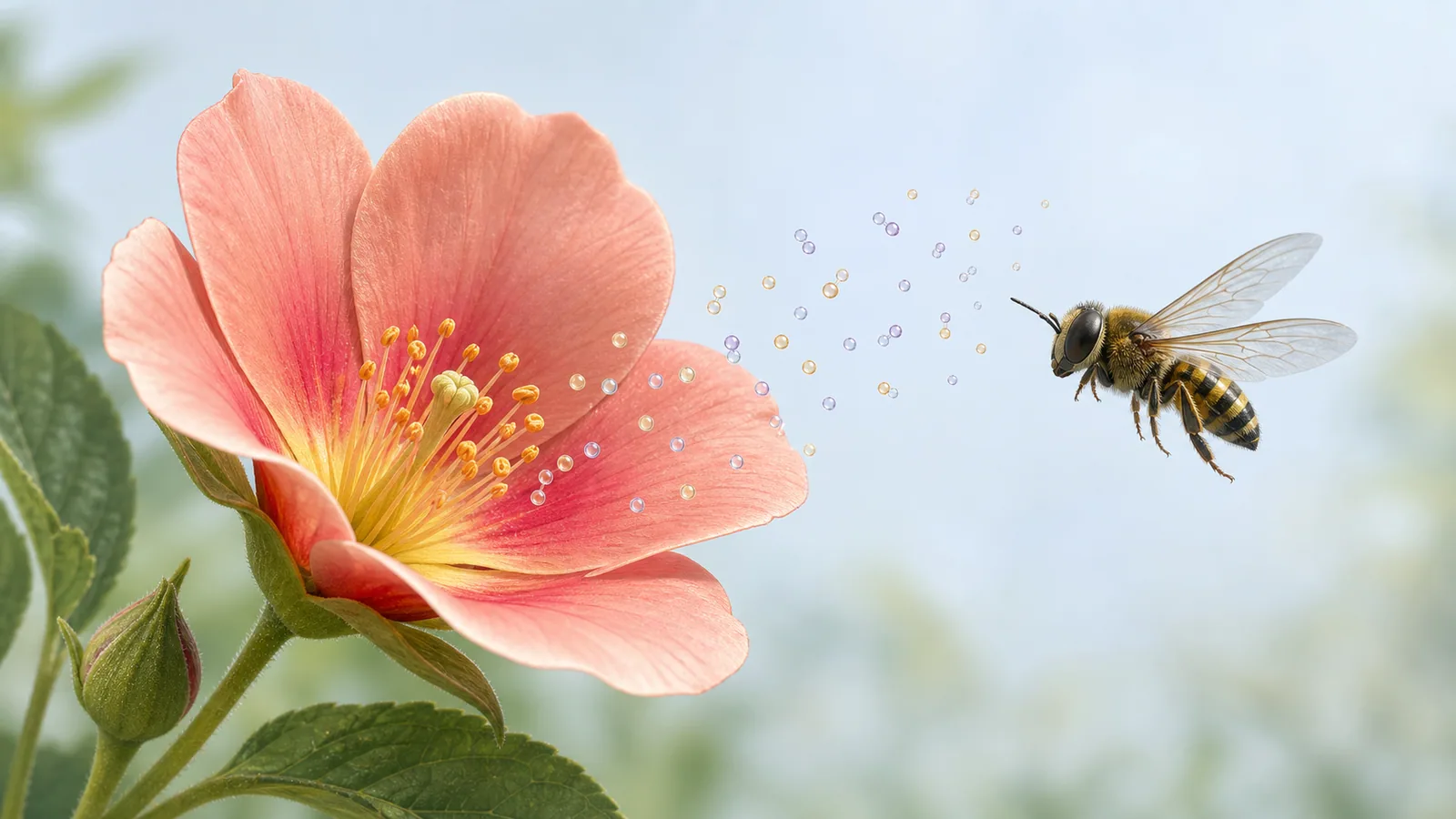
Petals are common sources, but they are not the only ones
Petals are common and often important sources of floral scent, but it is too simple to say that every flower makes all of its scent from its petals. Depending on the species, other floral tissues—including sepals, stamens, anthers, the pistil, the floral tube, or nectaries—may also contribute to the overall scent profile. Some plants have specialized cells or tissues associated with scent production or release; these are sometimes called osmophores.
The exact source can differ from one molecule to another. Finding out which tissue produces, stores, or releases a particular volatile usually requires chemical analysis or close biological observation. A person cannot determine the complete source just by smelling the flower. To build a basic map of where petals, stamens, and pistils are located, see What are the main parts of a flower?, What Do Petals Do?, and What is the difference between stamens and pistils?.
Floral scent is not nectar or pollen
Floral scent is an airborne chemical signal. Nectar is a resource that some flowers offer to visiting animals, while pollen is the reproductive material that can be carried between flowers. A pollinator may use scent to approach a flower and then encounter nectar or pollen once it arrives. During a visit, it may also contact anthers or a stigma and move pollen, but these are separate steps.
Nectar and pollen should not be treated as the source of all floral scent. They can have their own volatile compounds, and in some species they may contribute to the mixture detected around a flower. That does not make nectar or pollen identical to floral scent. The useful distinction is between the scent signal in the air and the floral resource or reproductive material that a visitor may find at the flower.
How can a pollinator detect scent?
Once volatile molecules leave floral tissues, air movement can carry and dilute them. Together, the molecules form a changing scent plume rather than a solid line or a visible cloud. A pollinator with an olfactory sensory system may detect that chemical pattern and use it as one clue when searching for a flower.
Scent is only one part of the interaction. Color, shape, opening time, flower position, nectar location, pollen, wind, and the pollinator’s own behavior can also matter. Different insects and other flower visitors may detect or respond to the same scent in different ways. For this reason, floral scent can be a cue for some pollinators, but it is not a promise that every pollinator will be attracted or that pollination will occur.
For a broader explanation of pollen movement between flowers, see What is pollination?. The distinction between a scent cue, a visit, contact with the right floral parts, and successful reproduction is important: smelling a flower and completing pollination are not the same event.
Why do some flowers have little or no noticeable scent?
Flowers do not all use the same combination of signals. Some plants rely more on wind or on visual and structural features, so they may not have a strong scent that humans can notice. Other flowers may release only small amounts of volatile compounds, or compounds that people do not detect easily. A scent that seems faint to a person is not automatically irrelevant to every animal, and a scent that seems pleasant to a person is not a requirement for a plant’s ecological interaction.
The way a flower is pollinated can help explain why scent is more obvious in some flowers than others, but it is not a simple rule for every species. Compare Wind-pollinated vs insect-pollinated flowers to see how different pollination systems are associated with different floral traits.
Why can the same flower smell different at different times?
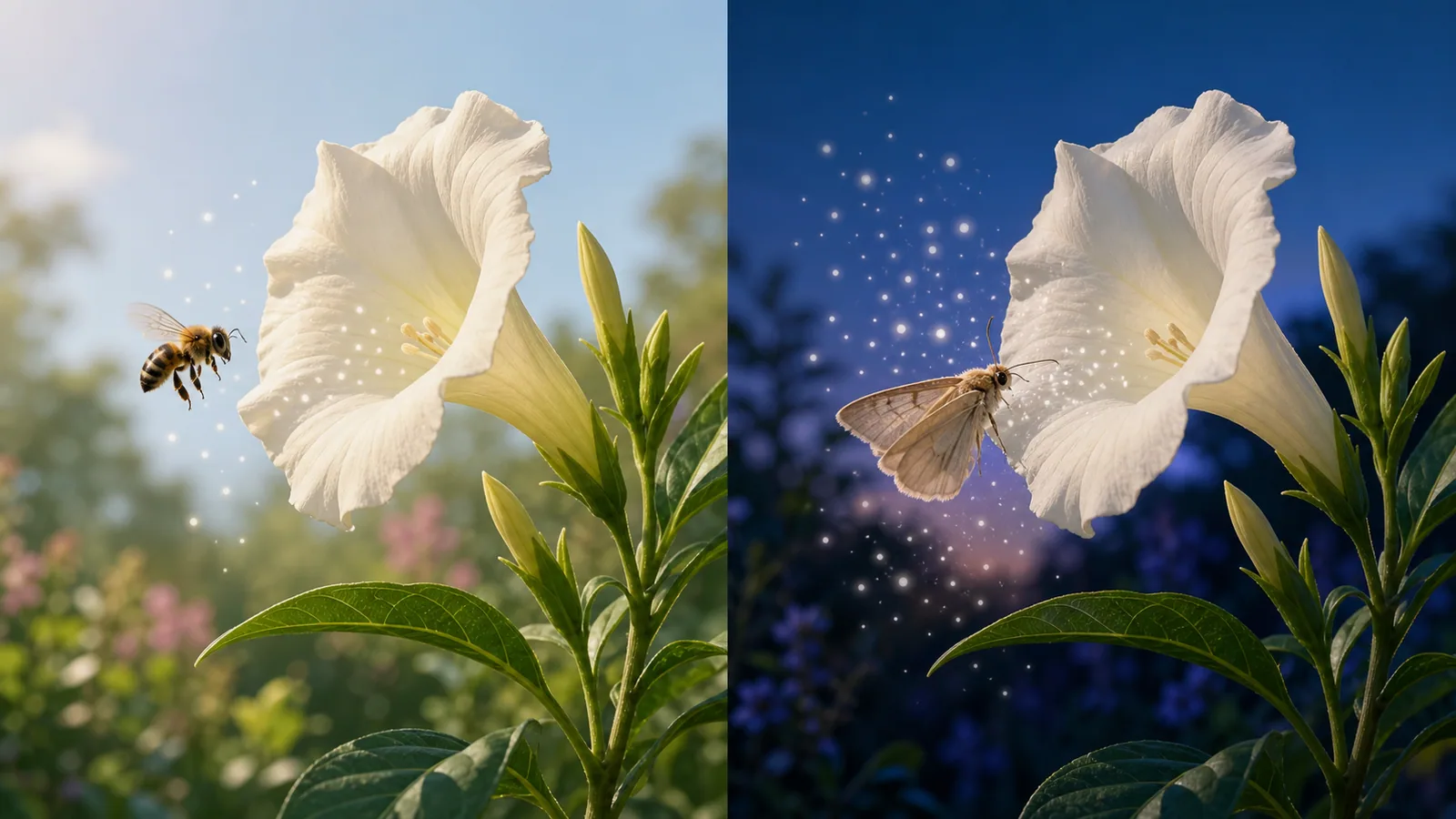
Some plants release more scent during particular parts of the day. In some species, this timing is connected to an internal daily rhythm and to the activity period of likely pollinators. A night-blooming plant may have a scent peak at night, for example. For these plants, matching scent release to visitor activity can be part of a pollination strategy—but it is a species-specific pattern, not a rule that all flowers become more fragrant after dark.
Scent can also change as a flower develops and opens. Flower age, developmental stage, light, temperature, humidity, wind, and time of day can affect the production, release, transport, or perception of volatile compounds. These factors do not all act in the same direction for every plant. Wind, for example, can carry molecules away and dilute the scent at the place where a person is standing, without proving that the flower has stopped producing or releasing scent.
A simple way to observe floral scent at home
If you have a flowering ornamental plant, observe how its scent changes without picking the flower or rubbing its petals. Choose a flower or a group of flowers in a similar condition, and check them in the morning, afternoon, and evening from roughly the same distance. You can note whether the flower is still a bud, newly open, fully open, or beginning to fade; whether the scent is noticeable; and how much wind or other environmental change is present.
This is a descriptive observation, not a diagnostic test. Not smelling a scent once does not prove that the plant has no scent. Distance, airflow, temperature, flower age, the amount and composition of VOCs, and individual differences in smell all affect what a person notices. Confirming the chemical composition of a scent requires laboratory analysis, such as gas chromatography, rather than a household observation alone.
Common misconceptions
- ✕ Floral scent is nectar or pollen.
- ✓ Floral scent usually refers to a mixture of VOCs released by floral tissues. Nectar and pollen are different floral resources or reproductive material, although they may have their own volatile compounds.
- ✕ Petals are the only source of every flower’s scent.
- ✓ Petals are common sources, but other floral tissues may contribute depending on the species and the compound.
- ✕ Every flower has a strong, pleasant smell.
- ✓ Some flowers have faint or hard-to-detect scents, and a scent’s appeal to humans is not the same as its ecological function.
- ✕ If a flower smells stronger at night, all flowers must release more scent at night.
- ✓ Some species have daily scent rhythms, while others follow different patterns. Night fragrance is an example, not a universal rule.
- ✕ A stronger scent means more nectar or guaranteed pollination.
- ✓ Scent is one possible cue among many. Scent strength alone cannot show how much nectar is present or whether pollination will succeed.
- ✕ If a person cannot smell a flower, the flower has no volatile compounds.
- ✓ Human perception depends on concentration, distance, airflow, timing, and individual sensitivity. A single human observation cannot identify every volatile compound a flower releases.
Frequently Asked Questions
Why do flowers smell?
Flowers usually smell because floral tissues release a mixture of volatile organic compounds into the air. In some plants, the resulting scent can work with color, shape, and other cues to help a pollinator find or recognize a flower. Not every flower has a noticeable scent, and scent can also be involved in other ecological interactions.
Is flower scent made from nectar?
Not exactly. Floral scent is mainly the airborne mixture of volatile compounds released by floral tissues. Nectar is a resource that some visiting animals collect. Nectar may have its own volatile compounds and may contribute to the odor around a particular flower, but nectar and floral scent are not the same concept.
Is flower scent the same as pollen?
No. Pollen is reproductive material and can also be a resource for some flower visitors. Some pollen may release volatile compounds, but pollen itself should not be treated as the definition or the only source of floral scent.
Why do some flowers smell stronger at night?
Some species have scent-release patterns that peak at night, possibly matching the activity of nocturnal flower visitors. Daily timing varies with the plant, flower stage, light, temperature, humidity, and other conditions. It is not a rule for all flowers.
Why can the same flower smell different in the morning and evening?
Daily rhythms, light, temperature, wind, humidity, flower age, and the timing of different volatile compounds can all affect how much scent is released or how strongly it is perceived. The direction and size of the change depend on the species and the conditions at that moment.
Why do some flowers have no noticeable scent?
Some flowers release very little scent, release compounds that humans detect poorly, or rely more on other signals such as color, shape, or wind. A lack of noticeable scent to a person does not by itself explain the flower’s pollination system.
Why can I smell some flowers but not others?
The amount and mixture of VOCs, your distance from the flower, airflow, temperature, the time of day, the flower’s age, and individual differences in smell can all matter. Human perception is not a complete measurement of what every animal can detect.
Does stronger floral scent mean better pollination?
Not necessarily. Scent is only one possible cue. Pollination also depends on the flower’s structure and timing, the pollinator species and behavior, contact with the relevant floral parts, and the surrounding conditions. Scent strength alone cannot predict pollination success.
Is floral scent always pleasant?
No. Some scents may be attractive to particular flower visitors but unpleasant or unfamiliar to people. Whether a scent smells pleasant to humans is not the same question as what ecological role the scent plays for a plant.
Glossary
- Floral scent: The odor detected around a flower, usually produced by a mixture of volatile compounds released by floral tissues. In broader ecological discussions, floral odor can include scents that people do not find pleasant.
- Volatile organic compounds (VOCs): Carbon-based molecules that can readily enter the air and contribute to an odor or other chemical signal.
- Floral tissues: The parts of a flower, such as petals, sepals, stamens, anthers, the pistil, floral tubes, nectaries, or pollen-bearing structures.
- Scent plume: A changing pattern of airborne odor molecules carried and spread by air movement.
- Pollinator: An animal or other pollen-transfer agent that can move pollen to a compatible part of a flower.
- Nectar: A floral resource that some flower visitors collect; it is not the same thing as floral scent.
- Pollen: The reproductive material produced by anthers and transferred during pollination; it is not the same thing as floral scent.
- Anther: The pollen-producing part of a stamen.
- Stigma: The pollen-receiving surface of a pistil.
- Osmophore: A specialized cell or tissue associated with producing or releasing scent in some plants.
- Circadian rhythm: An internal daily timing pattern that can influence biological processes, including scent release in some plants.
Related reading
Evidence
References
These sources were used to check the plant-science concepts and gardening context in this article.