
Which part of the stem grows?
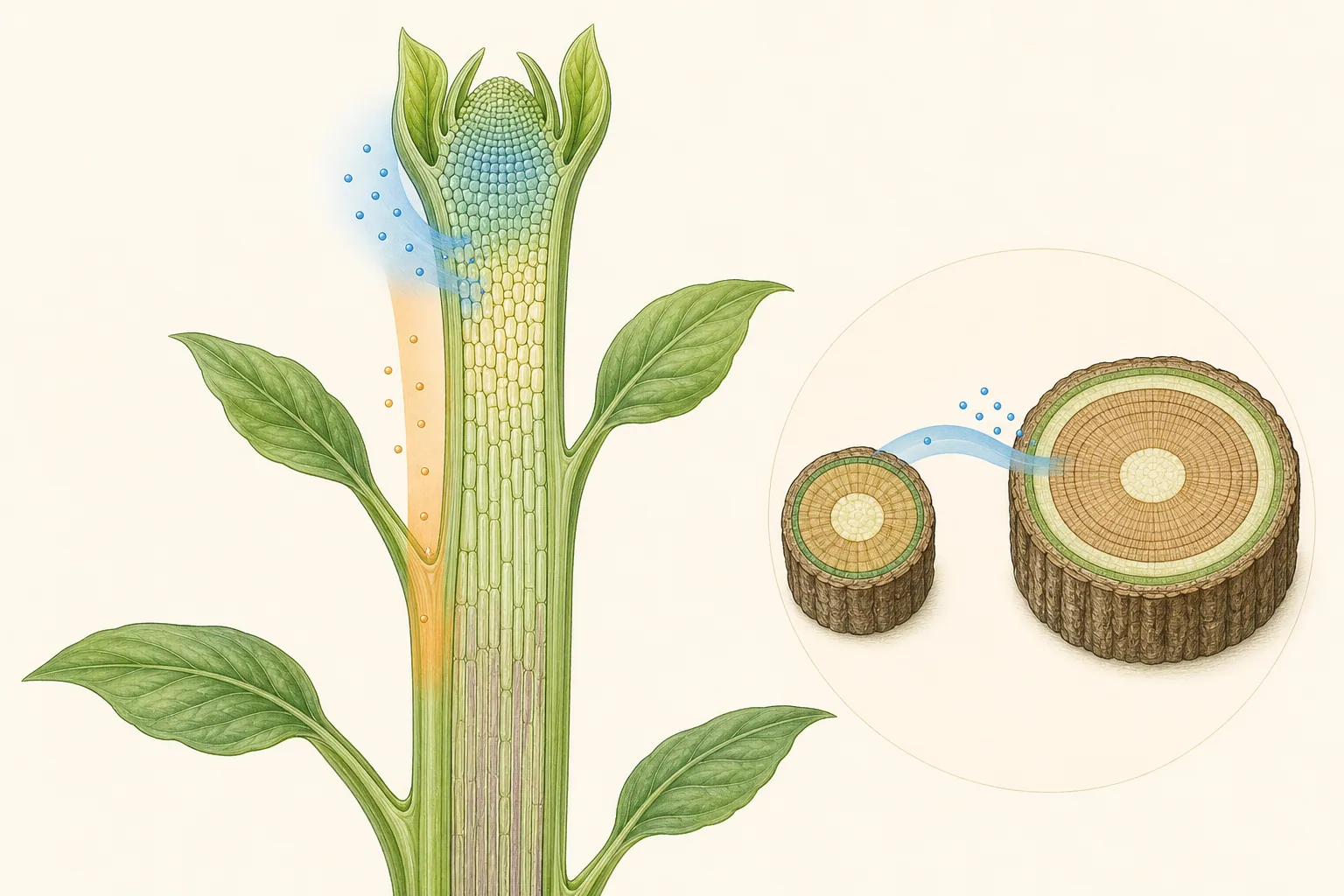
A qualitative model: proportions, speed and the length of each region are not those of a real plant. See the model conditions below.
Model conditions
A qualitative view of a young stem in a typical broadleaf (dicot) seedling that already has several true leaves. Proportions, cell sizes, speed and the length of each region are not those of a real plant. How many internodes elongate at once varies with species, individual and conditions. The direction a stem grows depends not only on fibers in single cell walls but also on how neighboring tissues pull on each other. Grasses and some other plants also have intercalary meristems near the base of internodes.
Plants do not become taller because the whole plant is pulled upward at once. In most plants, new cells are continually produced near the shoot tip. Those cells then elongate, expand, and differentiate into different plant tissues. As stems and internodes extend, the plant’s height increases.
This kind of length increase is called primary growth. It is different from an increase in stem diameter—what we usually call thickening or an increase in girth.
Where does a plant start growing taller?
Near the top of a stem is a group of cells that can keep dividing. This group is called the shoot apical meristem. A meristem is a plant growth tissue: some of its cells retain the ability to divide, while some of the new cells leave the region and gradually become leaves, buds, stems, and other tissues.
For that reason, the everyday phrase “the growing point” can be misleading if we imagine one tiny spot at the very end of the stem. A more precise explanation is that an important growth region is located near the shoot tip. It continually produces new cells and new organs. The exact location of active growth is not identical in every plant. For example, some grasses and other plants also have intercalary meristems near a leaf base or node.
The shoot apical meristem produces new cells while also forming tiny leaf and bud initials. These small developmental units can later become leaves, nodes, internodes, or side shoots. In this way, the stem axis continues to extend.
Cell division, cell elongation, and differentiation work together
Plant height growth is not caused by only one event. Several processes follow one another, and in some tissues they partly overlap:
- Cell division increases the number of cells. Cells in and around the shoot apical meristem divide to provide new material for building stems, leaves, and buds.
- Cell elongation and cell expansion increase the length and volume of new cells. Cells can stretch in directions allowed by their cell walls. Water, internal pressure, cell-wall properties, and the materials available to the plant all affect this process.
- Cell differentiation gives cells different structures and jobs. Some become part of the epidermis or supporting tissues, while others join the plant’s transport systems.
These processes are not necessarily three completely separate factory stations. Their timing and location can differ among plants, organs, and developmental stages. Still, the simple model “new cells are produced, then cells elongate and differentiate” is a useful way to understand how a stem can become longer.
Stems and roots differ here. In a root tip, division, elongation, and maturation follow one another roughly in order within a short stretch behind the tip. Below a shoot tip, cell division and cell elongation clearly overlap, the growing region is longer, and growth gradually stops farther down.
In more advanced plant biology, stem elongation refers specifically to an increase in the length of stem tissue. Height growth is what we notice in the whole plant, while stem elongation describes one of the processes that can produce that visible change. A plant may also grow new leaves, branches, or roots at the same time.
Why do longer internodes make a plant look taller?
Look at a section of stem and find two kinds of positions. A node is a place where a leaf, bud, or side shoot commonly occurs. An internode is the stem section between two nodes. You can think of nodes as connection points and internodes as the stretches between them.
When new stem tissue forms and cells elongate in the appropriate regions, an internode may become longer. If several internodes extend, the entire stem becomes longer and the plant often looks taller. The whole stem is not stretched at once, though. Elongation happens mainly in a few young internodes just below the shoot tip, and each internode stops lengthening once it matures, so the lower stem stays about where it was.
To learn how to identify nodes and internodes, read What Are Nodes and Internodes?. For the stem’s broader roles in support, transport, leaves, and buds, see What Are the Functions of a Stem?.
Growing taller is not the same as growing thicker
Both height growth and thickening are forms of plant growth, but they describe changes in different directions.
| Visible change | What mainly increases? | Common plant-biology concept |
|---|---|---|
| A stem or root becomes longer | Length | Primary growth, involving apical meristems and later cell elongation |
| A woody stem or root becomes thicker | Diameter or girth | Secondary growth, often involving lateral meristems such as the vascular cambium |
Primary growth mainly increases the length of roots and shoots. It is associated with apical meristems and the later elongation of cells. Secondary growth increases the diameter or girth of some roots and stems. In woody plants, lateral meristems can add new transport tissues over many years.
Many herbaceous plants rely mainly on primary growth to extend their stems, and their thickening does not follow exactly the same pattern as the trunk of a tree. This is why a tree’s way of increasing girth should not be treated as a universal model for every plant. For a closer look at diameter increase, continue with Why Do Some Stems Get Thicker?.
A taller plant is not automatically a healthier plant
An increase in height tells us that some plant parts have become longer. By itself, it does not tell us whether the whole plant is in good condition.
For example, some seedlings and indoor plants may receive too little light and develop longer internodes, thinner stems, and wider gaps between leaves. The plant may look taller while its form becomes loose and less compact. Gardeners often call this appearance leggy growth.
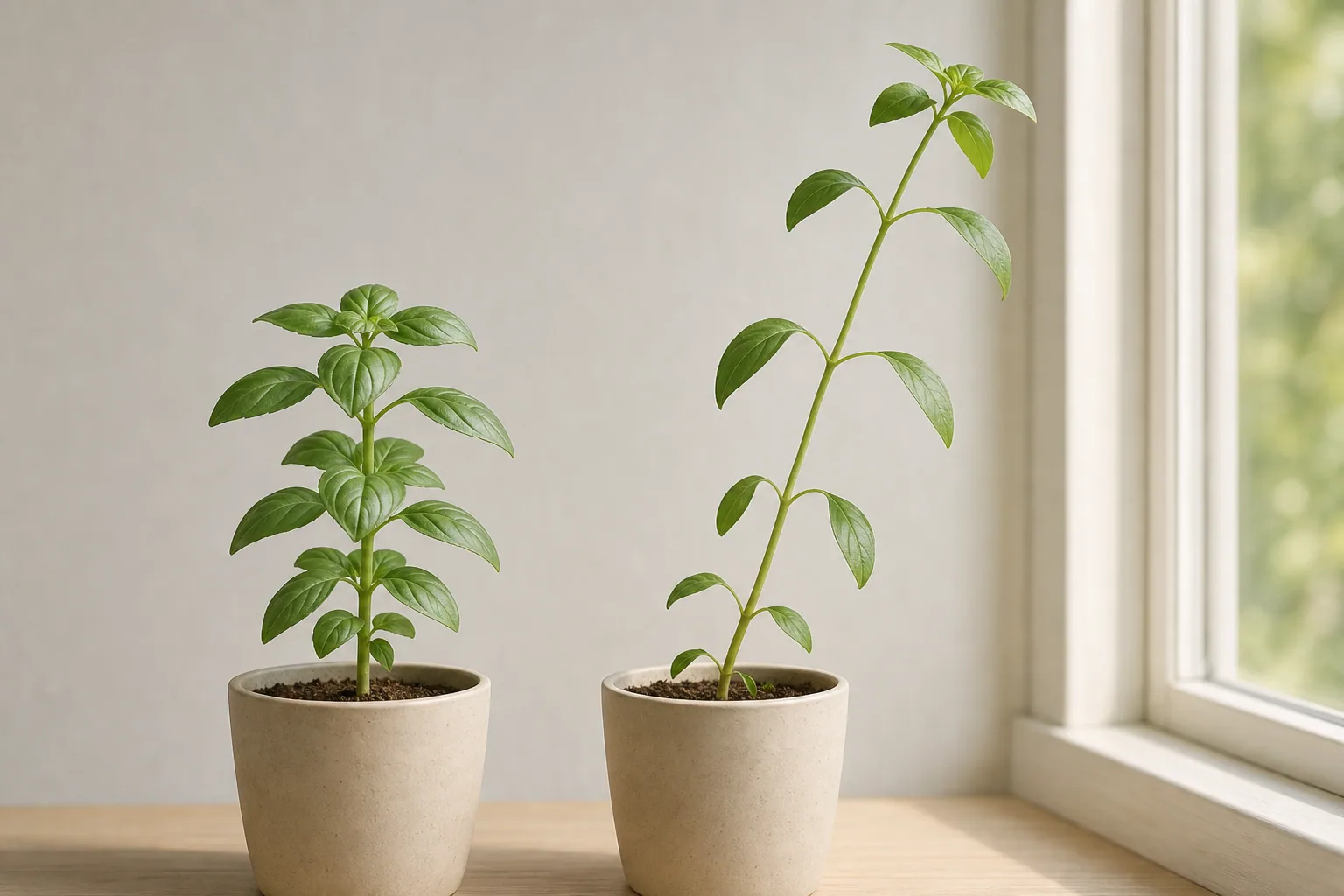
When asking whether a plant is growing well, also look at whether new shoots are continuing to develop, whether the stem is becoming unusually thin, whether internodes are opening up, and whether the leaves keep their usual arrangement. These clues tell us more than the tallest point on a ruler alone. For a closer look at this gardening observation, read Why Do Plants Become Leggy?.
Is growing toward a window the same as growing taller?
Not exactly. Growing taller mainly describes an increase in length. Phototropism describes a change in the direction of growth.
When light comes from one side, cells on the two sides of a young stem may elongate at different rates. The stem can then gradually bend toward the light source. Auxin participates in this kind of growth response, but it is not a universal “height switch” that makes every plant taller whenever its amount increases.
So a plant extending toward a window may be elongating and bending through phototropism at the same time. The two ideas are related, but they should not be treated as identical. Learn more about directional growth in Why Do Plants Bend Toward Light? and about one of the chemical signals involved in What Is Auxin?.
What is apical dominance?
The growing shoot tip can also influence the growth of buds in the leaf axils. This relationship is called apical dominance. It describes how a growing main shoot can regulate or temporarily suppress the outgrowth of axillary buds below it.
Apical dominance is not the same thing as the shoot apical meristem. The meristem is a tissue where new cells and organs are produced. Apical dominance is a pattern of growth regulation between the shoot tip and side buds.
The relationship involves auxin, cytokinins, sugars, strigolactones, and other interacting signals. It is therefore not accurate to say that the shoot tip simply takes all the nutrients, or that one hormone alone controls every side bud. The response can vary with plant species, variety, developmental stage, and environment.
How can you observe plant height growth?
You can make a simple observation without pulling a plant out of its pot or cutting open its stem:
- Photograph the plant from the same angle and record its overall height and new shoot growth every few days.
- Count newly formed nodes and compare the internode lengths in newer and older sections of the stem.
- Observe stem thickness, leaf density, and the condition of new leaves together with height. Do not record only the highest point.
- Note which direction the main light comes from, and whether the season or the plant’s position changes.
This kind of record helps show where a plant is growing and how it is growing. It cannot, by appearance alone, identify one certain reason for slow or limited height growth. Plant species, age, light, temperature, water, mineral nutrients, and internal signals can all affect growth rate together.
The same observation is more useful when only one condition changes at a time. Use plants of the same kind and similar size if you are comparing two settings, and treat the result as an observation rather than a universal treatment recipe.
Common Confusions
-
✕ When a plant grows taller, the whole stem stretches. ✓ Elongation happens mainly in a few young internodes below the shoot tip. Mature stem no longer lengthens, so the lower stem stays roughly where it was.
-
✕ A plant grows taller only from one tiny point at the very tip of the stem. ✓ An important meristematic region is located near the shoot tip. It produces new cells and organs, and other growth tissues may also contribute in some plants.
-
✕ Plants grow taller simply because their cells get bigger. ✓ Cell division increases the number of cells, while cell elongation and expansion increase length and volume. These processes work together with differentiation.
-
✕ Stem elongation, height growth, and growing bigger all mean exactly the same thing. ✓ Stem elongation means stem length increases; height growth is the visible increase in a plant’s vertical size; “growing bigger” is broader and may include leaves, roots, branches, biomass, or girth.
-
✕ Growing taller and growing thicker are the same kind of growth. ✓ Height growth mainly describes length increase and primary growth. Thickening or increased girth mainly describes diameter increase and often involves secondary growth and lateral meristems.
-
✕ A plant that bends toward a window is automatically healthier or is simply growing taller. ✓ Bending toward one-sided light may be phototropism. Direction, total light available, height growth, and compact plant form are different observations.
-
✕ A taller plant is always healthier. ✓ Low light can produce leggy growth, with long internodes, thin stems, and a loose form. Height should be considered together with new growth, stem support, and leaf arrangement.
-
✕ Apical dominance means the shoot tip takes all the plant’s nutrients. ✓ Apical dominance is a growth relationship in which the shoot tip influences axillary-bud outgrowth through several interacting signals.
-
✕ More water or fertilizer will always make a plant grow taller. ✓ Water and mineral nutrients are part of the conditions plants need, but excess or unsuitable conditions can cause problems. There is no universal height-growth recipe.
Frequently Asked Questions
Where does height growth occur in plants?
In many plants, new above-ground tissue is produced near the shoot apical meristem. New cells are then added to the developing stem, elongate, and differentiate into different tissues. Some plants also have other active growth tissues, so it is better not to describe one visible spot as the only growing point.
Do plants grow taller because their cells divide or because their cells get bigger?
Both contribute. Cell division increases the number of cells. New cells can then elongate and expand, increasing the length and volume of the stem, while differentiation gives them specialized structures and functions.
What is primary growth in plants?
Primary growth is growth that mainly increases the length of roots and shoots. It is associated with apical meristems and the subsequent elongation of cells. It is different from secondary growth, which mainly increases the diameter or girth of some stems and roots.
Why do longer internodes make a plant look taller?
An internode is the stem section between two nodes. When several internodes extend, the distances between leaves and buds increase, so the overall stem becomes longer and the plant often appears taller.
Is growing taller the same as stem thickening?
No. Growing taller describes an increase in length and is mainly associated with primary growth. Stem thickening describes an increase in diameter or girth and, especially in woody plants, is commonly associated with lateral meristems and secondary growth. Different plants thicken in different ways.
Does a nail in a tree trunk, or a low branch, move up as the tree grows?
No. A tree gains height from new shoot growth at its branch tips and top, while the lower trunk has already matured and stopped lengthening. A nail or branch therefore stays at about the same height. The trunk keeps thickening, so a nail may slowly become enclosed by new wood, and a thickening branch can even end up slightly closer to the ground along its lower edge. To see how trunks thicken, read Why Do Some Stems Get Thicker? and How Do Tree Rings Form?.
Does a taller plant mean a healthier plant?
Not necessarily. Some plants grow taller under low-light conditions by producing long internodes and thin stems. This leggy growth can make the plant look tall but loose. Also consider new growth, stem support, leaf spacing, and the overall form.
Why do some plants grow toward a window?
One-sided light can cause phototropism. Cells on the two sides of a young shoot may elongate at different rates, causing the shoot to bend toward the light source. This describes growth direction; it does not necessarily mean that the plant is growing taller or healthier.
What is the difference between phototropism and height growth?
Height growth describes an increase in length, while phototropism describes a directional growth response to light. A young shoot can elongate and bend toward a light source at the same time, but one term should not be used as a substitute for the other.
What is apical dominance?
Apical dominance is the influence of a growing shoot tip on the outgrowth of axillary buds below it. Auxin, cytokinins, sugars, strigolactones, and other signals can interact in this process. The result varies among plants and conditions, so it is not a single-hormone switch or a universal pruning rule.
Can more water or fertilizer always make a plant grow taller?
No. Water and mineral nutrients are important in the right context, but too much water can harm roots, and growth depends on many interacting conditions. Height alone cannot diagnose a nutrient or water problem, and this article does not provide fertilizer or watering prescriptions.
Why do plants often grow more slowly in winter?
Seasonal changes can alter light, temperature, day length, and dormancy. Some plants therefore slow their growth in winter, while others respond differently. Read Why Do Plants Grow More Slowly in Winter? for a related explanation.
Related Terms
- Meristem: A plant growth tissue that can continue producing new cells.
- Shoot apical meristem: The meristem near the shoot tip that produces new above-ground cells and organs.
- Primary growth: Growth that mainly increases the length of roots and shoots.
- Secondary growth: Growth that mainly increases the diameter or girth of some roots and stems.
- Cell division: The process that increases cell number.
- Cell elongation: The process in which a cell increases its length in a particular direction.
- Cell expansion: A broader term for an increase in cell size or volume, including elongation.
- Differentiation: The process through which cells acquire specialized structures and functions.
- Node: A stem position where a leaf, bud, or side shoot commonly occurs.
- Internode: The stem section between two nodes.
- Stem elongation: An increase in the length of stem tissue.
- Axillary bud: A bud located in the angle between a leaf and the stem.
- Apical dominance: The regulation or temporary suppression of axillary-bud outgrowth by a growing shoot tip.
- Phototropism: A growth response in which a plant changes its direction in relation to light.
- Auxin: A group of plant hormones involved in processes including cell elongation, phototropism, and apical dominance.
- Gibberellin: A group of plant hormones often discussed in relation to stem elongation and seed germination.
- Vascular cambium: A lateral meristem important in the secondary growth of many woody stems.
- Leggy growth: A gardening term for a loose form with long internodes, relatively thin stems, or wide leaf spacing. It is not always identical to the more specific botanical term etiolation.
Read Next
Evidence
References
These sources were used to check the plant-science concepts and gardening context in this article.
View sources and further reading (13)
- openstax.org — 30 1 the plant body
- openstax.org — 30 2 stems
- ncbi.nlm.nih.gov — NBK26922
- frontiersin.org — full
- openstax.org — 30 6 plant sensory systems and responses
- extension.umn.edu — lighting indoor plants
- cupac.bh.cornell.edu — CUPACplantanatomy.pdf
- pmc.ncbi.nlm.nih.gov — PMC6250904
- openstax.org — 30 3 roots
- osti.gov — 2352283
- extension.okstate.edu — training young shade and ornamental trees
- auf.isa-arbor.com — 46929
- extension.umd.edu — embedded wires nylon cord and wire baskets