Dormancy release is not the same as instant growth
When a plant comes out of dormancy, it usually does not switch from “off” to full growth overnight. A more accurate picture is a sequence: an internal restriction is eased, the environment begins to support growth, and a bud or underground growing point starts to develop again.
The first visible change may be a fuller bud or loosening bud scales. Roots may already be becoming active below the soil, where they are not easy to see. Only later might new leaves, shoots, or other organs become obvious.
Depending on the plant, dormancy may involve the whole plant, a bud, a seed, or an underground storage organ. In this article, “growing again” does not mean that fallen leaves come back to life. It means that a living bud, crown, rhizome, bulb, or another growing point forms new plant organs.
Regrowth often has to pass through two gates
For many temperate perennial woody plants, a two-gate model is a useful starting point.
Gate 1: internal dormancy release
Some buds remain unable to resume normal extension even during a short warm spell because the restriction is still maintained by the plant or bud itself. This state is often called endodormancy.
For some species, a period of suitable chilling must accumulate before this internal condition is gradually released. The chilling requirement differs among species and varieties, so there is no single number of cold hours that applies to every plant.
Gate 2: external conditions allow growth
Even after internal dormancy has eased, a bud may still be limited by outside conditions. Temperatures may remain too low, water may not be available to the roots, or other environmental signals may not yet support continuous growth.
This environmentally limited state is often called ecodormancy. Some sources also use quiescence when discussing growth that is restricted by external conditions, although terminology can vary by context.
This two-gate model explains why a plant may not break bud immediately after a few warm days. Warm weather alone does not prove that internal dormancy has been released, and it does not guarantee that the later temperature, moisture, and light conditions are suitable for sustained growth.
Plants also respond to more than temperature. Changes in day length and night length, seasonal warming or cooling, water available around the roots, and the plant’s internal condition can work together as signals. You can explore these ideas further in What Is Photoperiod in Plants? and How Do Plants Sense Day and Night?.
What happens inside a bud?
A plant bud is a small structure that contains a growing point. Its meristem is a growing region that can produce new cells, and it may also contain young leaf structures called leaf primordia. Protective bud scales may surround these delicate tissues.
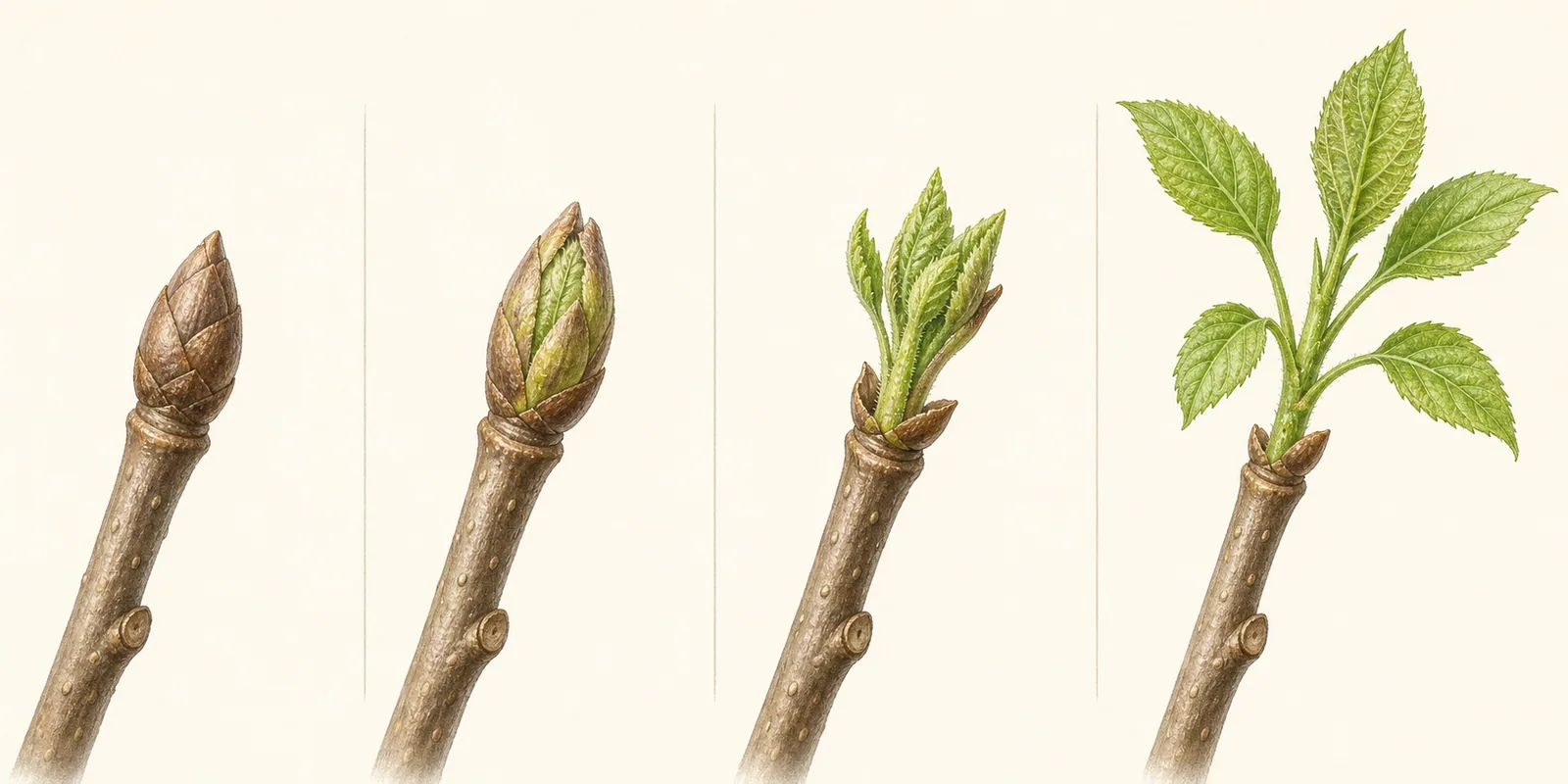
During dormancy, visible cell division and elongation are greatly reduced. Once the restrictions ease, activity inside the bud gradually resumes. The visible sequence often looks like this:
- Bud swell: The bud becomes fuller, and its protective scales may begin to separate.
- Bud break: Young leaves, a shoot tip, or part of an inflorescence begins to emerge.
- Shoot elongation: Young leaves expand, stem segments become more visible, and the shoot extends outward.
- Leaves take over more of the supply: As leaves expand, photosynthesis increases and contributes more organic material for later growth.
Dormancy release and bud break are related but not necessarily the same moment. Dormancy release may begin inside the bud before a person can see a clear change. Bud swell, opening scales, and emerging leaves are later, more visible stages. You can compare this with What Is a Plant Bud? Where Do New Shoots Come From?.
Where does early growth get its materials?
A new shoot often begins before it has enough mature leaf area to produce large amounts of organic material through photosynthesis. Early growth can therefore draw on carbohydrate reserves built up before dormancy and stored in branches, stems, roots, or underground organs.
This does not mean that an emerging shoot can grow indefinitely without light. Once leaves expand and begin photosynthesizing, newly produced organic material gradually becomes more important for supporting additional leaves, roots, stems, and other growing parts. See What Is Photosynthesis? for the basic process.
Roots and shoots do not always resume in the same order. Some underground storage organs begin producing roots below the soil before a visible shoot appears. In other plants, the aboveground bud becomes noticeable first. The sequence depends on the plant, the condition of its organs, and the surrounding temperature and moisture.
Underground storage organs can preserve a restart point
Some perennials keep important growing points below ground during an unfavorable season. Bulbs, corms, rhizomes, tubers, and tuberous roots are not the same structure, but they share a useful point of comparison: an underground organ may retain a growing point and stored resources that support early growth.
Using a typical bulb as a simple example, a shortened stem or basal plate can support the bud, while fleshy scales can store resources. When dormancy has eased and the surrounding conditions support growth, roots and a shoot may become active again. As leaves emerge and expand, photosynthesis gradually reconnects the plant with a new cycle of resource production.
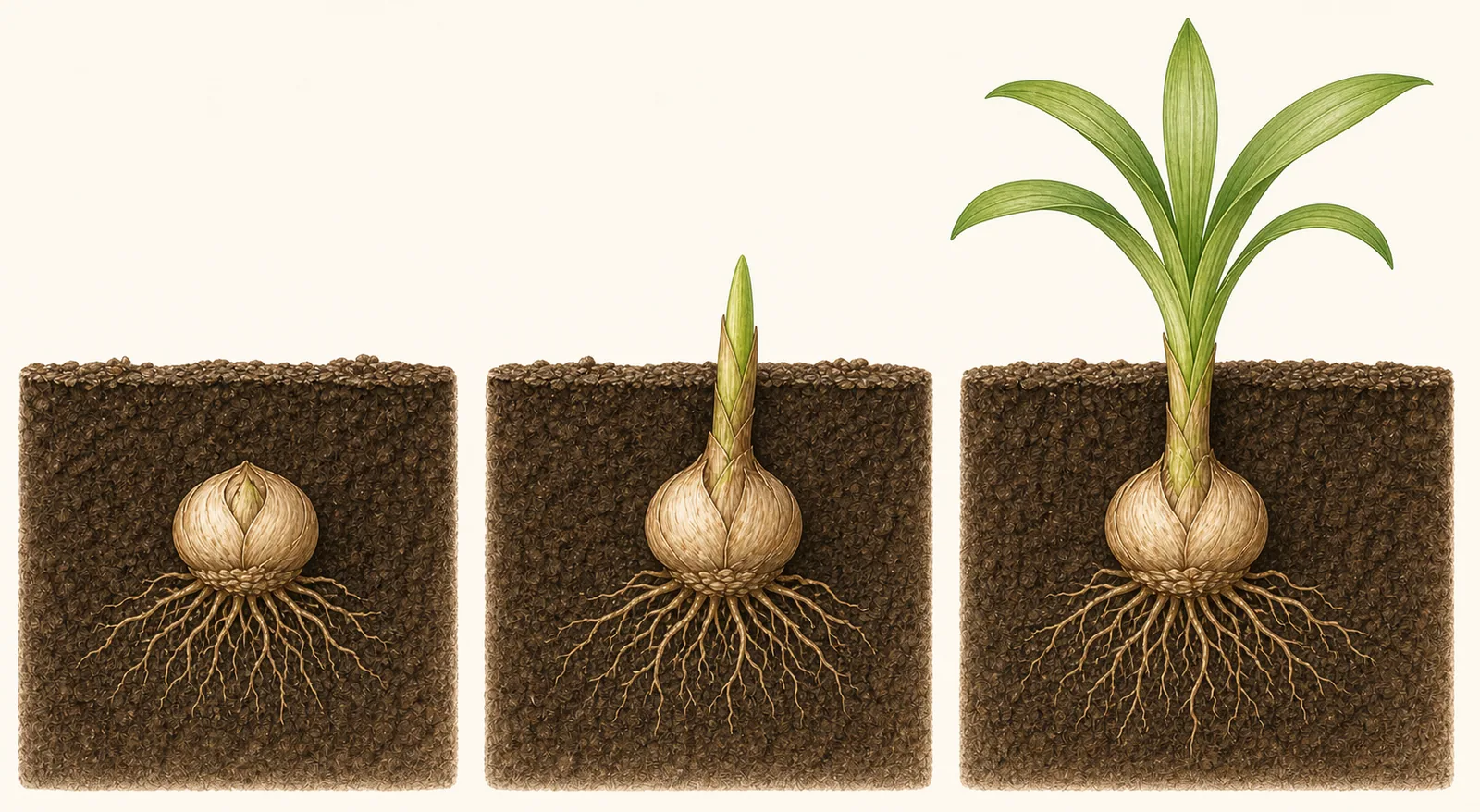
This is why the dieback of aboveground growth does not always mean that the plant has lost the possibility of another growth cycle. At the same time, the absence of leaves alone cannot prove that an underground organ is healthy. Plant type, season, and actual condition all matter.
For a related comparison of underground structures and propagation, read How Do Bulb Plants Reproduce?. Natural regrowth after dormancy and propagation are connected ideas, but they are not the same process.
Plants do not all use the same trigger to end dormancy
Temperate deciduous woody plants are often explained through chilling followed by warmer conditions that promote bud break. Some bulb-type plants restart from underground organs. These examples are useful models, but they do not represent every plant.
Many indoor evergreen plants simply grow more slowly in winter because of reduced light, shorter days, temperature changes, or shifts in the indoor environment. Slower winter growth is not automatically the same as a clearly defined seasonal dormancy. See Why Do Plants Go Dormant? and Why Do Plants Grow More Slowly in Winter? to keep these ideas separate.
Seed dormancy is also different from bud dormancy. Seed dormancy describes a living seed that delays germination. Bud dormancy describes a growing point on a shoot or another plant organ that does not expand. Both can be influenced by internal conditions and environmental signals, but one leads into germination while the other can lead to new leaves, shoots, flowers, or roots.
You can place this seasonal restart within the broader plant life cycle. For the seed pathway, see How Does a Seed Germinate? and What Conditions Do Seeds Need to Germinate?.
What to notice in a garden
When observing a woody plant outdoors, look for a bud changing from small and tightly closed to fuller, then check whether the protective scales are separating and green young leaves are becoming visible. These clues help describe a transition from dormancy toward bud break.
When observing a bulb or another underground storage organ, the first visible sign may be a small shoot tip above the soil. Roots may already be growing below the surface without being easy to see. Conversely, the temporary absence of leaves does not prove that no activity is occurring, and a visible shoot tip does not mean that every later stage will follow a fixed speed.
A useful record includes the plant’s identity, the season, recent temperature changes, light or day length, moisture around the roots, and the progress of the new shoot. These observations help build a plant biology picture; they are not a universal bud-forcing recipe or a way to diagnose a plant from one appearance alone.
Common points of confusion
-
✕ A plant always breaks bud as soon as the weather becomes warm.
-
✓ Some plants must first complete internal dormancy release and then receive suitable temperature, moisture, and other signals before bud break begins.
-
✕ Dormancy release and seeing new leaves are the same event.
-
✓ Dormancy release may begin inside the bud; bud swell, opening scales, and emerging leaves are later visible stages.
-
✕ New leaves after dormancy are the old leaves growing back.
-
✓ New leaves, shoots, or flowers are usually formed by a living bud or another meristematic growing point.
-
✕ Every plant needs a cold winter before it can grow again.
-
✓ Chilling requirements and dormancy patterns vary among plants and varieties. Some indoor plants simply slow down during winter.
-
✕ If the aboveground part has died back, the underground part must also be dead.
-
✓ Some bulbs and other underground storage organs retain growing points and stored resources, but their condition cannot be judged from the absence of leaves alone.
Frequently asked questions
Is a dormant plant dead?
Not necessarily. A dormant plant, bud, rhizome, bulb, or other storage organ may still be alive while visible growth is greatly reduced. However, the lack of new leaves by itself cannot prove that a plant is dormant. Plant type, season, and other conditions must be considered together.
Does a plant have to experience a cold winter before it can grow again?
No. Many temperate woody plants have a chilling requirement, but the requirement varies among plants and varieties. Some plants do not need a pronounced cold period. A safer general explanation is that each plant responds to its own seasonal signals and physiological state.
What is the difference between dormancy release and bud break?
Dormancy release describes the gradual easing of an internal condition that restricts growth. Bud break describes the visible stage when a bud swells, its scales open, and young leaves or shoots begin to emerge. They are connected, but they may not have a precise visible boundary.
Why has a plant not produced buds even though the weather has become warmer?
A short warm period may not be enough. Internal dormancy may not yet be released, or later temperature, moisture, day-length, and root conditions may still be unsuitable for continuous growth. Different plants can also respond at different rates.
Where do new buds usually come from?
New buds may arise from a terminal bud at the shoot tip, an axillary bud near a leaf, the crown of a plant, a rhizome, or another underground storage organ. Looking at the bud’s position and the plant’s organ structure is more accurate than treating every new bud as the same kind of structure.
Can a bulb grow again after its aboveground leaves die back?
It can. Some bulbs become dormant after their foliage dies back but retain a growing point and stored resources below ground. Roots, shoots, or leaves may resume later. Bulbs, corms, rhizomes, tubers, and tuberous roots differ in structure, so one type’s sequence should not be applied to all underground organs.
Is seed dormancy the same as bud dormancy?
No. Seed dormancy delays the germination of a living seed. Bud dormancy temporarily restricts the expansion of a growing point on a shoot or another organ. The two states can respond to internal and seasonal signals, but they lead to different developmental processes.
Key terms
- Dormancy: A state in which a plant or one of its growing parts greatly reduces visible growth while waiting for suitable conditions.
- Dormancy release: The gradual easing of internal restrictions that allows a bud or another growing point to become capable of renewed activity.
- Endodormancy: Dormancy maintained by conditions within the plant or bud itself; it is often used to explain chilling requirements in some temperate plants.
- Ecodormancy: A state in which growth remains limited by external conditions such as temperature or water availability after internal dormancy has eased.
- Bud break: The visible stage when a bud swells, its protective scales separate, and young leaves, shoots, or flowers begin to emerge.
- Meristem: A growing region whose cells can continue dividing and form new plant tissues.
- Chilling requirement: The amount and pattern of cool exposure that some plants need before internal dormancy can be released.
- Storage organ: A specialized organ that can retain a growing point and stored carbohydrates or other resources through an unfavorable season.
- Photosynthesis: The process by which green leaves use light to produce organic material, supporting later plant growth.
Keep reading
Evidence
References
These sources were used to check the plant-science concepts and gardening context in this article.
View sources and further reading (9)
- montana.edu — dormancy.html
- blog-fruit-vegetable-ipm.extension.umn.edu — understanding dormancy and chilling.html
- extension.msstate.edu — P3067 web 0.pdf
- frontiersin.org — full
- frontiersin.org — full
- open.lib.umn.edu — 10 2 unique storage organs
- extension.illinois.edu — planting bulbs
- pubmed.ncbi.nlm.nih.gov — 27053719
- open.lib.umn.edu — 7 1 meristem morphology