A few leaves falling from a newly purchased houseplant do not automatically mean that the whole plant is sick or dying. When a plant moves from a growing, selling, or display environment into a home, it may encounter changes in light, temperature, humidity, airflow, and how quickly the potting mix dries. Transport can also involve bumps, pressure, or short periods of cold or heat. These changes may lead to a temporary adjustment, or they may place the plant under environmental stress when the conditions differ greatly.
A more useful question than “Is leaf drop always abnormal?” is: Are the fallen leaves older lower leaves or new leaves? Is the loss small and gradual, or is it happening across many leaves in a short time? Did the leaves turn yellow, develop brown edges, or become limp first? Are new leaves and buds still changing after the plant arrived home?
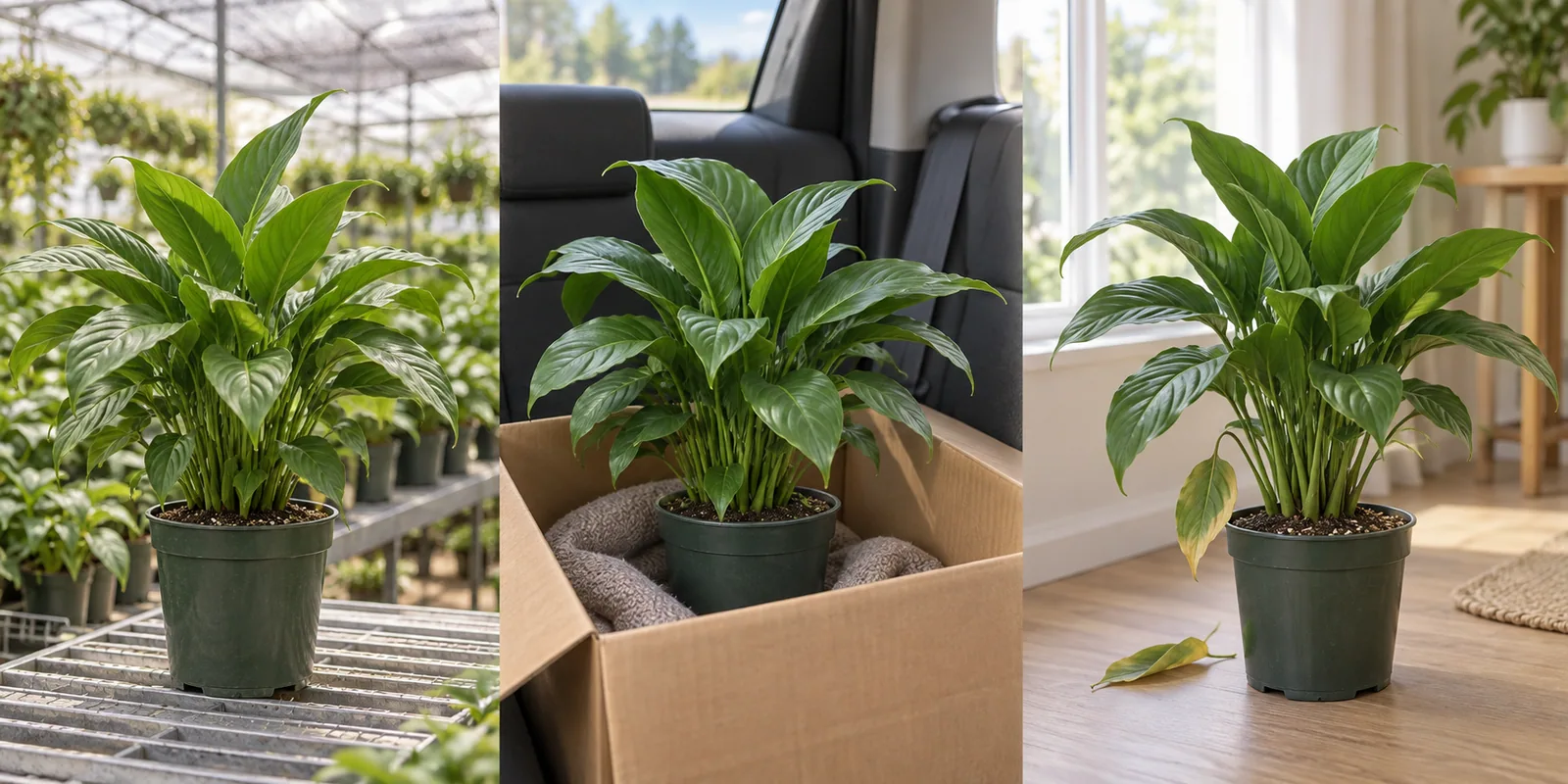
What changes between the store and home?
The light may be very different
Light in a shop, nursery, or greenhouse is not necessarily the same as light beside a window or deeper inside a home. Two places can both look bright to our eyes while providing different amounts of light, different directions of light, and different changes through the day. A plant moved suddenly from a relatively dim place into strong light may show scorch, fading, or leaf drop. A plant moved from brighter conditions into a darker home may also drop leaves or grow more slowly as the available light falls.
This does not mean that a home is always worse than a shop or nursery. It means that the light under which the existing leaves formed and the plant maintained growth may not match the new location. Plants also differ in the range of light they can tolerate, so “indoors” and “beside a window” are not enough to predict every plant’s response. For background, see Why Do Plants Need Sunlight? and How Is Indoor Light Different from Outdoor Light?.
Temperature, humidity, and airflow change too
A protected sales environment may become a spot near an air-conditioning outlet, heater, doorway draft, dry indoor air, or a place with a larger day-to-night temperature difference. Moving does not make every plant drop leaves in the same way, but a new temperature, humidity level, or airflow pattern can change how quickly leaves lose water and how quickly the potting mix dries.
If a plant is briefly exposed to unsuitable low temperatures during transport, the leaves may later become limp, brown, or fall. That is a different observation path from the plant gradually responding to a new indoor light environment after arrival. The actual response depends on the plant type, how much exposure occurred, and the condition of the leaves beforehand.
The water balance may no longer be the same
Leaves lose water through transpiration, while roots take up water from the growing medium. When light, temperature, airflow, or humidity changes, the rate of water loss from the leaves and the rate at which the potting mix dries may change as well. A fixed watering calendar therefore does not necessarily represent the same moisture conditions before and after the move.
Potting mix that stays too dry for too long may leave root water supply unable to keep up with the leaves’ needs. Potting mix that stays wet for a long time can leave less air around the roots, affecting root respiration and water uptake. Either situation may appear together with limpness, yellowing, or leaf drop, so fallen leaves should not be explained only as “underwatering.” For an observation sequence, see Why Check Potted Plants Before Watering on a Fixed Schedule? and How Does Water Move from Roots to Leaves?.
Transport can leave physical damage or a cold-and-heat timeline
Leaves may be squeezed, rubbed, bent, or torn while a plant is being carried. A leaf that breaks at the petiole because of contact is not exactly the same event as a leaf that separates after the plant forms or activates an abscission zone.
In winter or another cold setting, a tropical foliage plant may also experience leaf damage after a short period of cold exposure. For that reason, it helps to write down when the plant was purchased, when it reached home, and when leaf drop was first noticed. Leaf drop on the day of transport, several days after arrival, or after the plant has spent some time in a new position may provide different clues. The order of events is useful to record, but timing alone cannot prove one cause.
Why might a plant respond to environmental change by dropping leaves?
It may be rebalancing water status
After moving to a new environment, a plant can respond through stomatal opening and closing, changes in leaf water status, and later growth. In gardening, this within-lifetime physiological and growth response of one plant to new conditions is often called acclimation or acclimatization. It is not a conscious decision by the plant to drop leaves. It is also different from evolutionary adaptation, which describes inherited population-level changes across generations.
If water is lost from the leaves faster than the roots can supply it for a period of time, the leaves may droop. If the difference between the old and new conditions continues, some leaves may senesce or separate earlier. This is a reasonable physiological pathway, but it does not identify one cause by itself: light, root-zone moisture, temperature, and transport damage may all be present at once. For a closer look at location changes, read Why Do Plants Need to Acclimate After Moving?.
Lower light can reduce resources available for growth
Plants use photosynthesis to make organic matter that supports respiration, tissue maintenance, and the production of new leaves. If the new home provides substantially less light than the previous environment, fewer resources may be available for new growth. The plant may then grow more slowly, show changes in its leaves, or drop some leaves. This difference deserves particular attention when a plant moves from outdoors or a high-light setting into a home.
The response still depends on the plant type and the range of conditions it can tolerate. One plant’s reaction cannot automatically be applied to every other houseplant.
Older leaves may already be reaching a renewal stage
Leaves are not permanent organs. After an older leaf has carried out its functions for a period of time, it may gradually enter leaf senescence, a process in which cell activity, pigments, and the movement of materials change. Near the connection between the leaf stalk and the branch, an abscission zone may form or become active, allowing the leaf to separate.
Natural renewal and a response to a changed environment can happen at the same time. A leaf that falls after a plant reaches a new home is therefore not automatically evidence that transport caused it. To compare natural turnover with environmental clues more fully, read Why Do Plants Lose Their Leaves?.
Plant hormones also participate in leaf separation. Ethylene can promote leaf fall in some contexts, while other signals affect how the abscission zone develops and responds. This is useful background for understanding regulated leaf drop, but it cannot identify the cause of one newly purchased plant; for a deeper explanation, see What Is Ethylene?.
Start with a few old leaves—or a whole-plant change
You can sort a new plant’s leaf drop from several angles without forcing one leaf to provide the entire explanation.
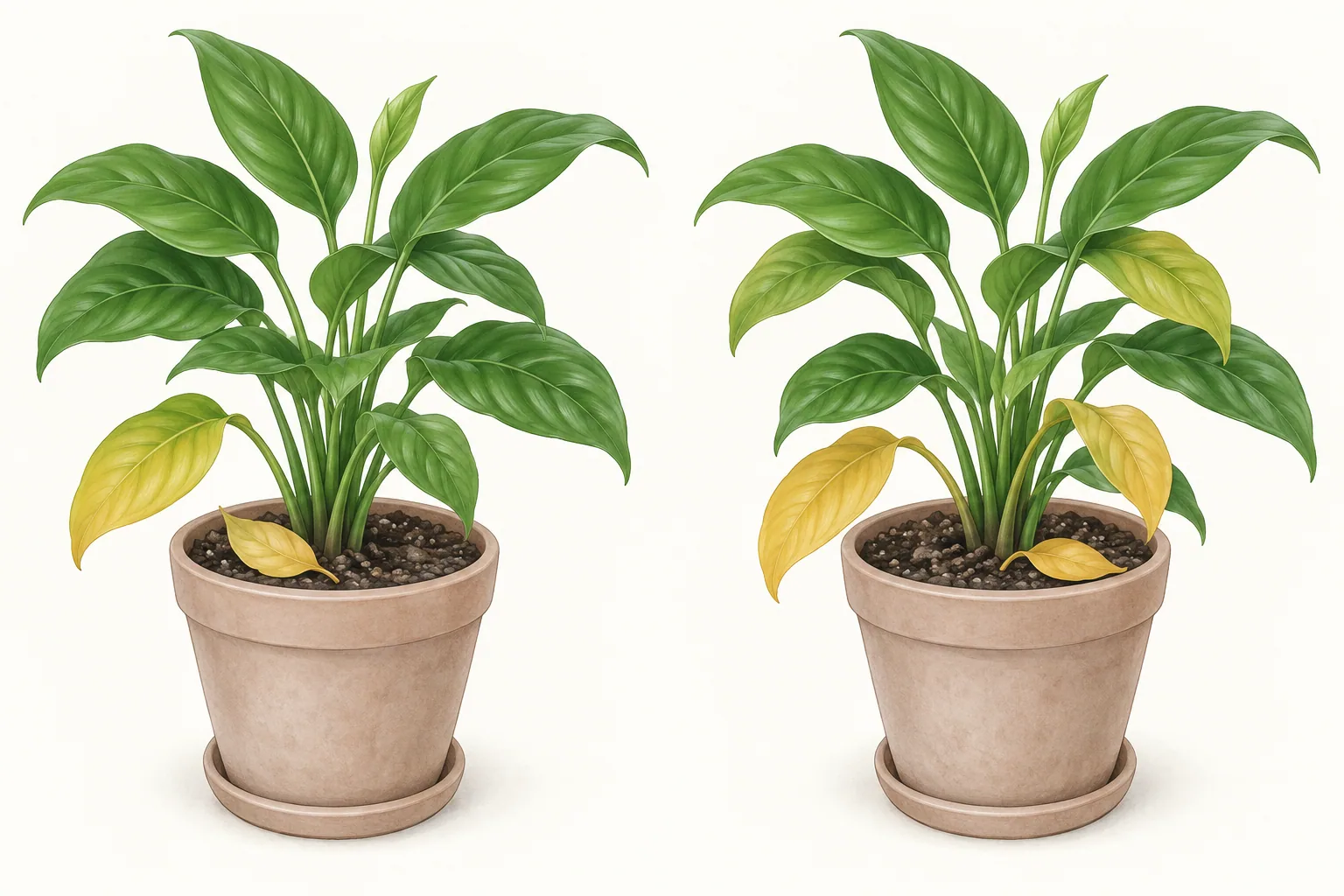
- A few older inner or lower leaves slowly turn yellow and fall: If the rest of the plant still looks steady, this may fit older-leaf renewal. Consider the plant type, overall condition, and what changes next; leaf position alone cannot establish the cause.
- New leaves, tender buds, or leaves at several levels change together: Record their positions, ages, and timing, then compare them with environmental changes before and after the move; the pattern alone does not identify a cause.
- Many leaves fall in a short time: Do not let the phrase “it is just acclimating” end the observation. Record the transport timing, cold or heat exposure, light change, root-zone moisture, and signs of physical damage. Then watch whether new parts of the plant join the change.
- Leaves first develop brown edges, brown spots, limpness, or obvious yellowing: These appearances can overlap with different light, water, temperature, or root-zone conditions. Use the observation approach in Why Do Plant Leaves Turn Yellow?, but do not treat one visible symptom as a confirmed cause.
- A leaf looks folded, broken, or rubbed: First consider whether it was damaged while being carried. Physical damage should not be mixed together with natural separation at an abscission zone.
The goal is not to force leaf drop into two boxes labeled “fine” and “a problem.” Put leaf age, amount, speed, appearance, and later new growth on the same timeline.
An observation route that does not rush to a conclusion
1. Record when the plant was purchased and brought home
Write down the purchase date, arrival date, when leaf drop was first noticed, and the places where the plant stayed. This helps you compare the order of transport, location changes, repotting, and seasonal changes.
2. Identify which leaves are falling
Compare lower old leaves, inner leaves, new leaves, and buds. Also note whether the leaves turned evenly yellow, developed brown or scorched edges, suffered a local bend or tear, or fell with little visible color change. These descriptions are easier to compare with later changes than “the plant looks unhappy.”
3. Compare the original setting with the home location
List differences in the direction and intensity of light, temperature and airflow, air dryness, and how quickly the growing medium dries. The purpose is not to create one fixed table for every plant. It is to find which conditions changed together during this particular move.
4. Observe the growing medium and whole plant, not only the surface
The surface of a potting mix can look dry or wet without fully representing moisture and air conditions around the roots. Record the pot, drainage, growing medium, and whether the plant was recently repotted. You can also read What Do Roots Do?. If the root zone has too little oxygen or an unstable water supply, the above-ground plant may show signs that resemble acclimation.
5. Watch later buds, new leaves, and the speed of leaf drop
A plant may not resume growth immediately after conditions change. Even so, later leaves, buds, and the whole-plant trend often provide more information than the first leaf that falls. If leaf drop keeps increasing, or limpness, yellowing, or brown damage spreads, do not explain everything as a “new-home adjustment.” Recheck the plant type and the combination of transport, light, temperature, water, and growing-medium conditions.
Common confusions
- ✕ A new plant drops leaves, so the seller must have sold a damaged plant.
- ✓ Moving can change light, temperature, humidity, airflow, and water conditions together. A small amount of leaf drop may be a response to the change, but continuing heavy leaf loss should not be explained by that one idea alone.
- ✕ A fallen leaf means the plant is underwatered.
- ✓ Media that stays too dry can create water-supply stress, while media that stays too wet can reduce air around roots. Compare the medium, roots, and whole plant together.
- ✕ Putting a new plant in the darkest place will let it adjust gradually.
- ✓ Adjustment depends on the light difference between the original and new locations and on what the plant type can tolerate. “Darker” is not a universal answer.
- ✕ A new plant should be repotted immediately to prevent leaf drop.
- ✓ Repotting also disturbs the root ball and growing medium. Changing the pot, location, water conditions, and light at the same time makes it harder to tell which change the plant is responding to.
- ✕ If a leaf did not turn yellow first, environmental change cannot be involved.
- ✓ Physical contact, cold or heat, a light transition, or an altered water balance can produce different appearances. Whether yellowing came first is not the only clue.
Frequently Asked Questions
Should I be concerned if a new plant drops only one or two leaves?
Not necessarily. If the leaves are lower and older, fall slowly, and the upper leaves, buds, and whole plant remain steady, the change may be close to natural renewal or a short-term response after moving. The number of leaves alone cannot establish that everything is fine, so continue watching whether the loss increases and whether new leaves unfold.
How long does leaf drop usually continue after I bring a plant home?
There is no fixed number of days that applies to every plant. The plant type, original light and temperature, transport conditions, and the difference between the old and new home environment all affect the timing. Some responses appear quickly, while others become visible only after light or moisture conditions have changed for a while. Recording the rate of leaf drop and whether the whole plant is becoming steadier is more useful than applying one universal deadline.
Why can a plant look beautiful in the store but start dropping leaves at home?
The sales or display environment may differ from the home in light, temperature, humidity, airflow, and how quickly the potting mix dries. After the move, the plant has to respond to this new combination of conditions. A sudden decrease in light, larger temperature changes, cold during transport, or a different moisture pattern may all be part of the timeline. This does not mean that the store’s plant condition was unreal; the two environments simply may not have matched.
If a plant drops leaves in the car or on the day of transport, was it definitely injured?
Not necessarily. A leaf may have been bent or rubbed during handling, or it may have been affected by cold, hot air, or a sudden change in light. Some leaves may also already have been close to natural separation. Look for a crease at the petiole, pressure marks, and whether the loss is limited to one area or appears in several parts of the plant. The time of leaf drop alone is not enough to settle the explanation.
Should I water a plant as soon as it arrives home?
Do not apply a watering action only because a leaf fell. Light, airflow, temperature, and the drying rate of the growing medium may already have changed after the move. Observe the medium and whole plant first, then record recent moisture changes. Both prolonged dryness and prolonged wetness can be associated with leaf drop.
If a plant still has new buds after dropping leaves, does that mean it has fully recovered?
New buds are a clue that later growth is still changing, but they do not by themselves show that the whole plant has fully stabilized. Look at whether the buds continue to unfold, whether other leaves remain steady, whether leaf drop is slowing, and whether the root zone and new location are still changing.
Will a fallen leaf grow back in the same place?
The leaf that has already fallen will not return to its original petiole. Whether the plant later produces a new leaf depends on the plant type, its buds or growing point, root condition, season, and environmental conditions. Focus on later new growth rather than expecting the same leaf to recover.
Can I keep calling it “adjusting to its new home” if leaf drop keeps increasing?
It is not useful to use adjustment as the only explanation for every continuing change. If leaf drop accelerates, or several areas develop yellowing, brown edges, limpness, changes in the stems, or persistent lack of new growth, put transport, light, temperature, water, growing medium, and plant type back together for another careful review. This article offers an observation route; one photograph cannot identify the cause for a plant.
Related Terms
- Acclimation / acclimatization: The physiological and growth response of one plant during its lifetime as it encounters different light, temperature, humidity, or airflow. In this article, it does not mean evolutionary adaptation across generations.
- Transpiration: The process by which a plant loses water vapor, mainly through its leaves, which affects the leaf’s water balance.
- Leaf senescence: The gradual process in which a leaf’s cell activity, pigments, and movement of materials change after the leaf has carried out a period of function.
- Abscission zone: A region near the connection of a leaf stalk or other plant organ where tissues can gradually separate.
- Root-zone hypoxia: Too little air around roots, which can affect root respiration and water uptake.
- Photosynthesis: The process by which plants use light energy to turn carbon dioxide and water into organic matter, providing an important source for growth.
Read Next
Evidence
References
These sources were used to check the plant-science concepts and gardening context in this article.
View sources and further reading (7)
- yardandgarden.extension.iastate.edu — recently purchased schefflera has begun drop leaves why
- yardandgarden.extension.iastate.edu — diagnosing houseplant problems improper environmental conditions
- yardandgarden.extension.iastate.edu — how care houseplants
- yardandgarden.extension.iastate.edu — moving indoor plants outside summer
- extension.missouri.edu — snowbird season for houseplants
- extension.umn.edu — moving houseplants outdoors
- openstax.org — 30 6 plant sensory systems and responses