Leaf drop is not automatically a problem
Leaf drop is not automatically a sign that a plant is sick or dying. Plants may lose older leaves as part of normal growth, or they may shed leaves early after drought stress, waterlogging, low light, temperature changes, or root disturbance.
Two broad patterns are useful starting points:
- A plant may be following its normal growth rhythm, such as seasonal leaf fall in many deciduous trees.
- A plant may be responding to environmental pressure and dropping leaves earlier than expected.
A fallen leaf by itself cannot tell you which pattern is happening. Ask a few broader questions instead:
- Is this plant normally deciduous, evergreen, or semi-evergreen?
- Are older leaves dropping, or are new leaves dropping too?
- Is the leaf drop gradual, or are many leaves falling within a few days?
- Has the plant recently experienced a change in water, light, temperature, location, or roots?
How does a leaf detach from a branch?
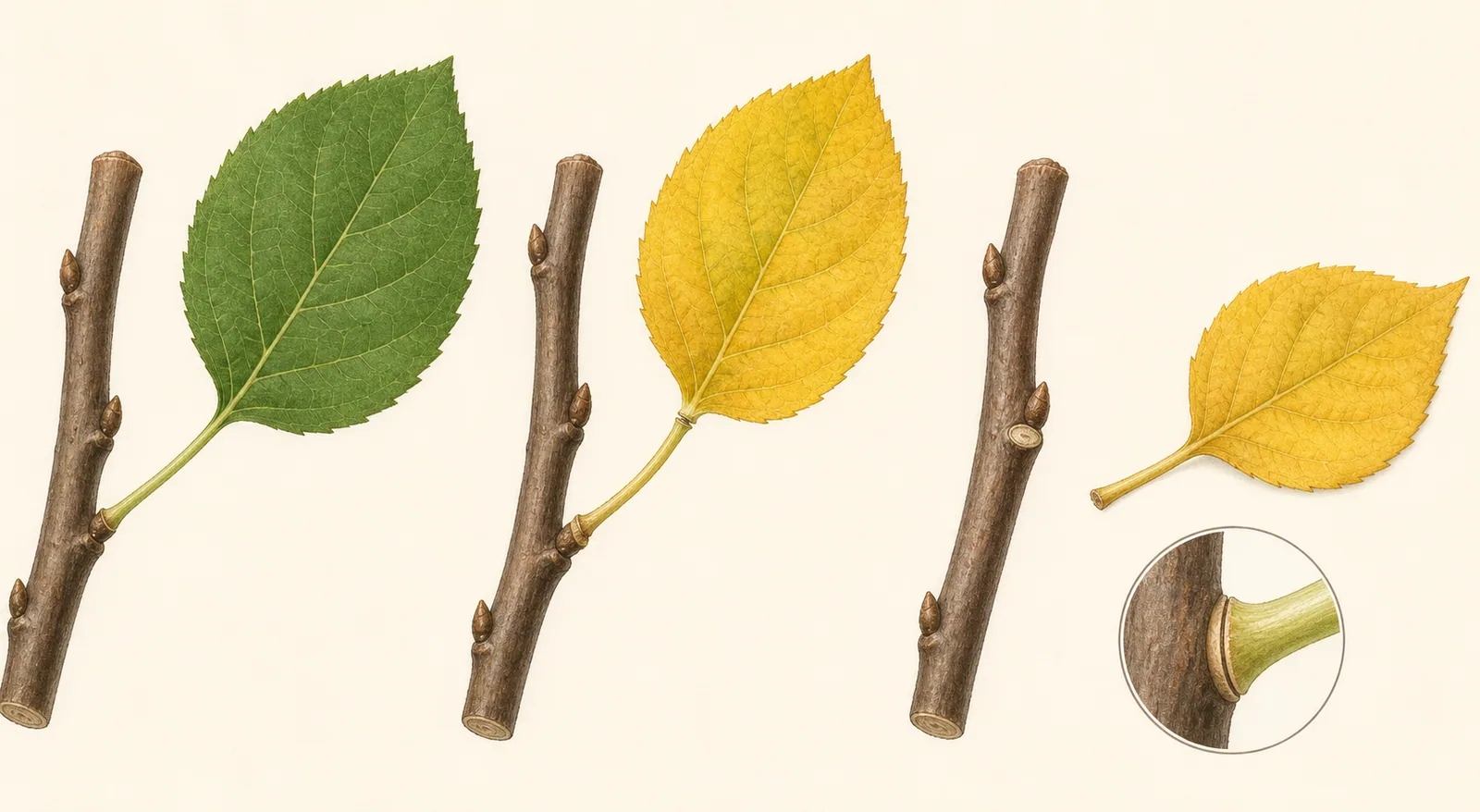
A leaf is connected to a stem or branch by a stalk called the petiole. In many plants, the petiole has a special region near its connection with the branch called the abscission zone.
Within or across this region, cells in a separation layer gradually change their connections. The tissue becomes easier to separate than it was during active leaf growth. On the stem side, protective tissue can begin to close the exposed surface. The leaf may then detach under its own weight, wind, rain, or other ordinary physical forces.
After the leaf is gone, the branch can retain a visible leaf scar. The scar is the mark left where the petiole was attached. This is why natural leaf drop is not simply a leaf being torn away from a branch.
Leaf aging is also part of the process. Leaf senescence is the gradual aging program in which a leaf changes its cellular activity and pigment condition after completing an important period of function. Chlorophyll may break down, so the leaf becomes yellow or allows yellow and orange pigments to become more visible.
In temperate deciduous plants, shorter days and cooler temperatures can act as seasonal signals. These signals occur together with leaf senescence, resource recovery, and preparation for a less favorable season. Some materials are moved out of the leaf before it detaches and are reused elsewhere in the plant.
Seasonal leaf fall can also occur during a dry season rather than a cold season. The timing depends on the plant species, day length, temperature, water availability, and developmental rhythm.
Plant hormones also take part in regulating abscission. In some plants and situations, ethylene signaling can promote changes in cell connections within an existing abscission zone, making the leaf easier to detach. Auxin distribution and signaling also influence this process. Ethylene may help promote detachment, but it does not create the tissue region itself or explain every case of leaf drop. No single hormone acts as a universal leaf-drop switch for every plant and every situation.
The names are easy to confuse:
- An abscission zone is a tissue region near the base of the petiole.
- Abscisic acid, often abbreviated as ABA, is a separate plant hormone involved in stress signaling.
An abscission zone and abscisic acid are not the same thing.
Deciduous and evergreen plants can both lose leaves
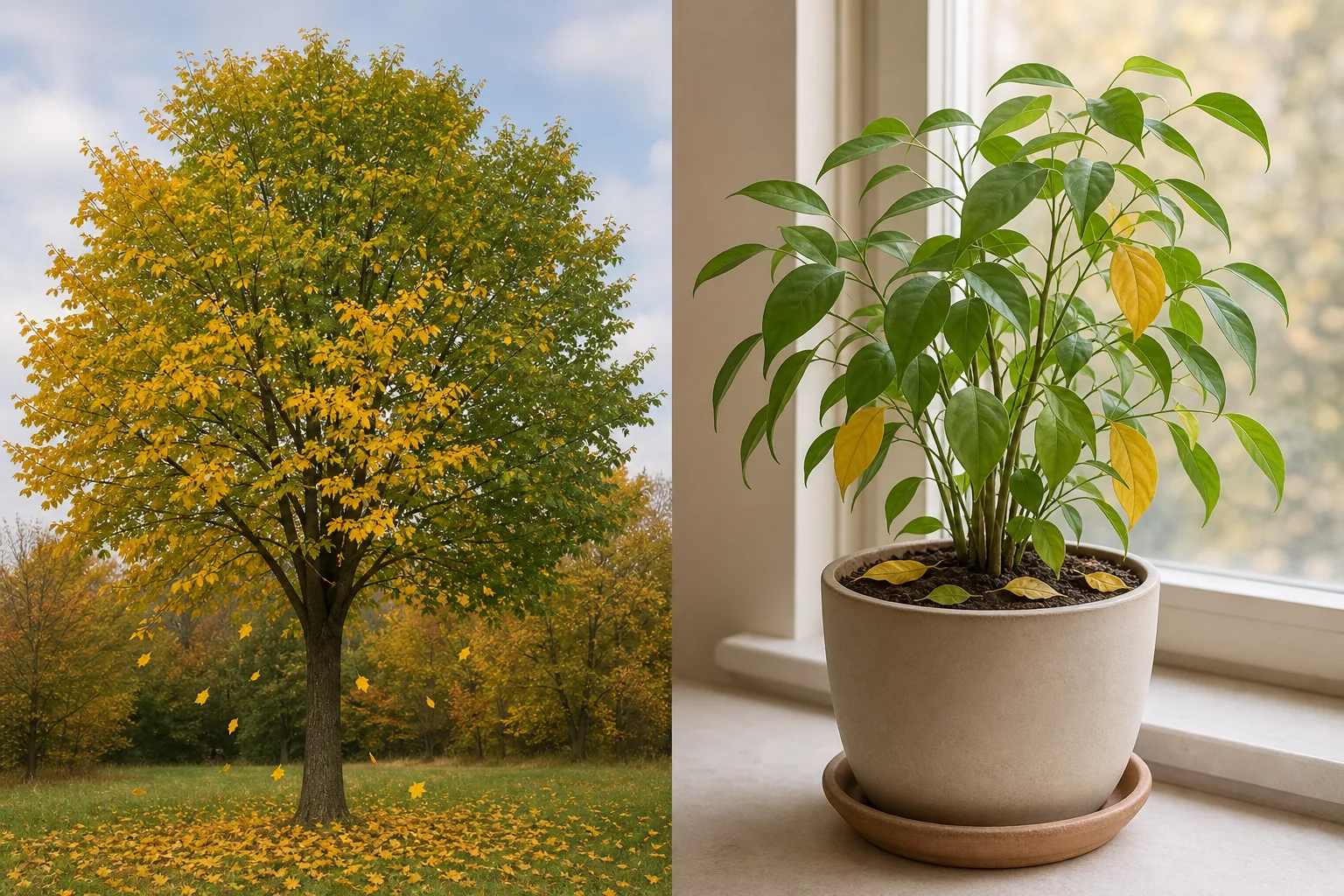
A deciduous plant usually loses most or nearly all of its leaves during a particular season or unfavorable period. Many temperate trees show autumn leaf fall, but some plants lose leaves during a dry season instead.
An evergreen plant keeps some living leaves across different seasons. Evergreen does not mean that every leaf remains on the plant forever. Older leaves still senesce and drop, but the replacement process is usually spread over time rather than concentrated into one large seasonal event.
This means that a few lower old leaves falling slowly from an evergreen plant can be very different from a sudden, widespread leaf drop affecting both old and new leaves.
Some plants are semi-evergreen, lose leaves only during a dry season, or change their behavior in response to local conditions. Plant identity and normal growth habit still matter.
When a potted plant suddenly starts losing leaves, compare the clues
Indoor potted plants may not experience an obvious autumn season, but they can still respond to sudden changes in their environment. The following observations can help organize what to check. None of them identifies one cause by itself.
- A few lower, older leaves drop slowly: If new leaves continue to grow normally, this may fit ordinary leaf turnover.
- Old and new leaves drop together within a short time: Review recent changes in water, light, temperature, location, repotting, or root conditions.
- Leaves become curled, wilted, brown, or crisp before dropping: Drought stress, heat stress, low humidity, or reduced water supply from the roots can be included in the observation list.
- Growth slows after the plant is moved to a darker location: Low light can reduce photosynthesis and growth, and older leaves may be shed as the plant adjusts to changed conditions.
These are observation directions, not a diagnosis chart.
Why can drought stress and waterlogging both cause leaf drop?
Drought stress and waterlogging appear to be opposites, but both can disturb the plant’s water balance.
During drought stress, the roots may not supply water as quickly as the leaves lose it through transpiration. If the imbalance continues, leaves may wilt, curl, develop brown or crisp edges, or drop earlier than expected. Reducing leaf area can be part of the plant’s response to continuing water shortage.
During waterlogging, the problem is not simply that water touches the leaves. If the potting medium remains saturated, water fills spaces that would normally contain air. This can create root-zone oxygen deficiency.
Roots need oxygen for respiration and normal function. When the root zone has too little oxygen, roots may take up water less effectively even though the potting medium is wet. The plant may then look wilted, soft, yellow, or may begin dropping leaves.
This is why “the soil is wet” and “the plant has enough usable water” are not identical statements. Too much watering can contribute to waterlogging when the medium stays saturated, but one watering event does not automatically mean that waterlogging is occurring.
Light and temperature can add to the same stress picture. Long-term low light may reduce photosynthesis and growth. Air-conditioning vents, cold snaps, heat waves, or a sudden move to a different light level can create short-term pressure. Several factors may overlap, so one visible symptom should not be assigned to one certain cause without broader context.
A useful order for observing leaf drop
When a plant starts losing leaves, use a consistent order rather than reacting to the fallen leaves alone.
- Identify the plant’s normal habit. Is it deciduous, evergreen, semi-evergreen, or known to lose leaves during a dry season?
- Check where the leaves are coming from. Are they lower old leaves, inner leaves, new leaves, or leaves from the whole plant?
- Compare the speed. A few leaves dropping slowly is different from many leaves dropping within several days.
- Describe the leaf condition. Are the leaves brown and crisp, curled, or wilted?
- Review recent changes. Consider watering rhythm, light position, temperature, air-conditioning, moving, repotting, potting-medium moisture, and drainage. Also note whether buds, new leaves, and stems are still growing.
The purpose of this order is not to calculate one guaranteed diagnosis from a single leaf. It is to turn “the plant is losing leaves” into a set of clues that can be compared over time.
Common confusions
-
✕ Any leaf drop means the plant is sick or dying.
✓ Leaf drop may be normal leaf turnover or seasonal leaf fall. Environmental stress is another possibility, so plant habit, speed, leaf position, and new growth should be considered together. -
✕ Evergreen plants should never lose leaves.
✓ Evergreen plants still replace older leaves. They retain living leaves across seasons, but individual leaves do not remain forever. -
✕ Wet potting medium means the roots are receiving enough water.
✓ Waterlogging can create root-zone oxygen deficiency and reduce normal root function. A plant can look wilted or lose leaves while the medium remains wet. -
✕ If leaves are falling, add water or fertilizer immediately.
✓ First compare plant habit, leaf position, leaf condition, moisture, light, temperature, roots, and recent changes. One action does not automatically match every form of leaf drop. -
✕ The abscission zone and abscisic acid are the same thing.
✓ The abscission zone is a tissue region near the petiole. Abscisic acid, or ABA, is a separate plant hormone. Neither should be treated as a universal on/off switch for leaf drop.
Frequently Asked Questions
Does leaf drop always mean that a plant is sick?
No. Leaf drop may be part of normal old-leaf turnover or seasonal leaf fall. It can also be associated with drought stress, waterlogging, low light, temperature changes, moving the plant, repotting, or root disturbance. Look at the plant’s usual habit, the position of the leaves, the speed of change, and whether new growth continues.
Do evergreen plants lose leaves too?
Yes. Evergreen means that a plant keeps some living leaves across seasons, not that every leaf stays forever. Older leaves can still senesce and drop one at a time.
Why is my plant losing leaves even though the potting medium is wet?
Long-term wet medium can reduce air around the roots and create root-zone oxygen deficiency. Roots may then function poorly and take up water less effectively, even though the pot feels wet. This is why wet medium alone cannot prove that the plant has adequate usable water.
Can drought and overwatering both cause leaf drop?
Yes, but the mechanisms differ. Drought stress can reduce the water supplied to leaves, while excessive watering may lead to waterlogging and low oxygen around the roots. Wilted, curled, crisp leaves and long-term wet medium are useful clues, but none of these signs alone proves one specific cause.
Is leaf drop normal after moving or repotting a plant?
A sudden change in light, temperature, airflow, or watering can be followed by temporary leaf drop. Repotting can also disturb roots. The response depends on the plant species, season, and difference between the old and new conditions. Observe the speed of leaf drop and whether new leaves, buds, or stems continue to develop.
If many leaves drop, does that mean the plant is dead?
Not necessarily. The amount of leaf drop alone cannot prove that a plant has died. Also observe the stems, buds, new growth, and whether the plant continues to change. Record when the leaf drop began, which leaves were affected, what they looked like, and what changed recently.
Related Terms
- Leaf drop: Leaves coming off a plant; this is the usual everyday term for a potted plant losing leaves.
- Seasonal leaf fall: Leaf loss associated with a seasonal cycle, especially in deciduous trees.
- Autumn leaf fall: Seasonal leaf loss that occurs in autumn in many temperate deciduous plants.
- Leaf senescence: The gradual aging process in which a leaf changes its cellular activity, pigments, and resource use.
- Deciduous: A plant habit in which most or nearly all leaves are lost during a particular season or unfavorable period.
- Evergreen: A plant habit in which some living leaves are retained across seasons, even though older leaves are still replaced.
- Abscission zone: A tissue region near the base of the petiole where leaf separation can be regulated.
- Separation layer: A layer of cells whose connections change, allowing an organ to detach.
- Petiole: The stalk that connects a leaf blade to a stem or branch.
- Leaf scar: The mark left on a stem or branch after a leaf has detached.
- Drought stress: Stress caused when water loss exceeds the plant’s ability to obtain and transport water.
- Waterlogging: A condition in which potting medium or soil remains saturated long enough to reduce air-filled spaces.
- Root-zone oxygen deficiency: Too little oxygen around roots for normal respiration and root function.
Read Next
Evidence
References
These sources were used to check the plant-science concepts and gardening context in this article.
View sources and further reading (10)
- openstax.org — 30 6 plant sensory systems and responses
- openstax.org — 30 key terms
- extension.unh.edu — learn science behind fall foliage
- extension.illinois.edu — 2019 10 08 why do tree leaves change color autumn
- extension.psu.edu — why do you just keep me hanging on
- extension.umd.edu — drought stress indoor plants
- extension.umd.edu — yellowing leaves indoor plants
- extension.umn.edu — how manage flood damage trees
- extension.usu.edu — needle drop
- site.extension.uga.edu — trees that hold their leaves