
Pothos is a familiar houseplant with the scientific name Epipremnum aureum. It belongs to the arum family, Araceae, and is an evergreen climbing vine that can grow along the ground or use a support to grow upward.
When a pothos hangs over the edge of a pot, its stems trail downward. When the plant encounters a tree trunk, a pole, or another surface, structures along its stem can help it attach and climb.
The pothos commonly grown indoors usually has smaller, heart-shaped leaves with entire margins—its juvenile growth form. When a shoot grows upward against a support in brighter conditions, later leaves may become much larger and take on a more mature form. Controlled studies show that light, upward growth, and contact with a support work together.

Matching the name “pothos” to the plant
Pothos, golden pothos, and devil’s ivy are common English names. They are everyday names, not the formal name of the genus.
Kew’s Plants of the World Online currently accepts Epipremnum aureum as the scientific name. Older horticultural references or botanical sources may also use names such as Pothos aureus, Rhaphidophora aurea, or Scindapsus aureus.
Pothos also includes many cultivated forms. The leaves may be entirely green or have yellow, creamy white, or pale green patterns. This means that not every plant sold or described as pothos will have exactly the same leaf color or variegation. A more reliable starting point for observation is to look at the vine-like stem, leaf arrangement, and climbing habit together.
How can one stem support leaves and keep growing forward?
A pothos stem is not as rigid as a tree trunk, but it still moves leaves outward one at a time as it grows. To understand the stem, start by looking for three locations: where a leaf connects to the stem, the section between two connection points, and the petiole, which is the stalk connecting the leaf blade to the stem.
In plant biology, the place where a leaf, bud, or other side structure connects to a stem is called a node. The stem section between two nodes is called an internode. The leaf blade usually does not attach directly to the main stem; the petiole forms the short connection between them.
These locations also provide clues about the direction of pothos growth. The stem elongates through each internode, separating one node from the next, while leaves, buds, and possible aerial roots commonly appear near nodes.
You can learn more about these basic structures in What Are Nodes and Internodes? and What Are the Functions of a Stem?. When observing a pothos stem, first find where the leaf and petiole connect. Then compare the neighboring nodes and the internode between them. This is more useful than deciding what every small brown mark must be based only on its color.
Aerial roots grow near stem nodes
A climbing pothos stem can produce adhesive aerial roots. When they first emerge, these roots may look like small brown bumps on the stem. As they extend from node areas or the stem surface and contact bark or another rough support, they can help the shoot attach and continue upward.
An aerial root is still a root; it simply grows outside ordinary potting soil. It has a different form from the main stem and the petiole. The stem is the continuous axis that extends through the plant, the petiole connects the leaf blade to the stem, and an aerial root projects outward from the stem area.
When observing a plant, do not identify every brown bump as an aerial root. Consider its position, direction of growth, shape, and relationship to a node or a support surface. For a broader introduction, see What Are Aerial Roots?.
Pothos aerial roots remind us that roots do not interact only with soil. In some plants, roots also interact with air, bark, or other supporting surfaces. This does not mean that every aerial root can replace the roots inside the pot, or that aerial roots can absorb unlimited water from dry air.
Why are some pothos leaves smaller and others larger?
Pothos grown in an indoor hanging pot commonly keeps a juvenile growth form: the leaves are smaller, heart-shaped, and mostly entire along the margins. This appearance can make it seem as though pothos will always produce small leaves.
When a shoot grows upward against a support under suitable light, later leaves may become much larger. The most consistent mature change is increased leaf size. Some leaves develop a few irregular, shallow splits that extend inward from the margin. Fully enclosed perforations, when present, are generally sparse or subtle compared with those of a monstera.
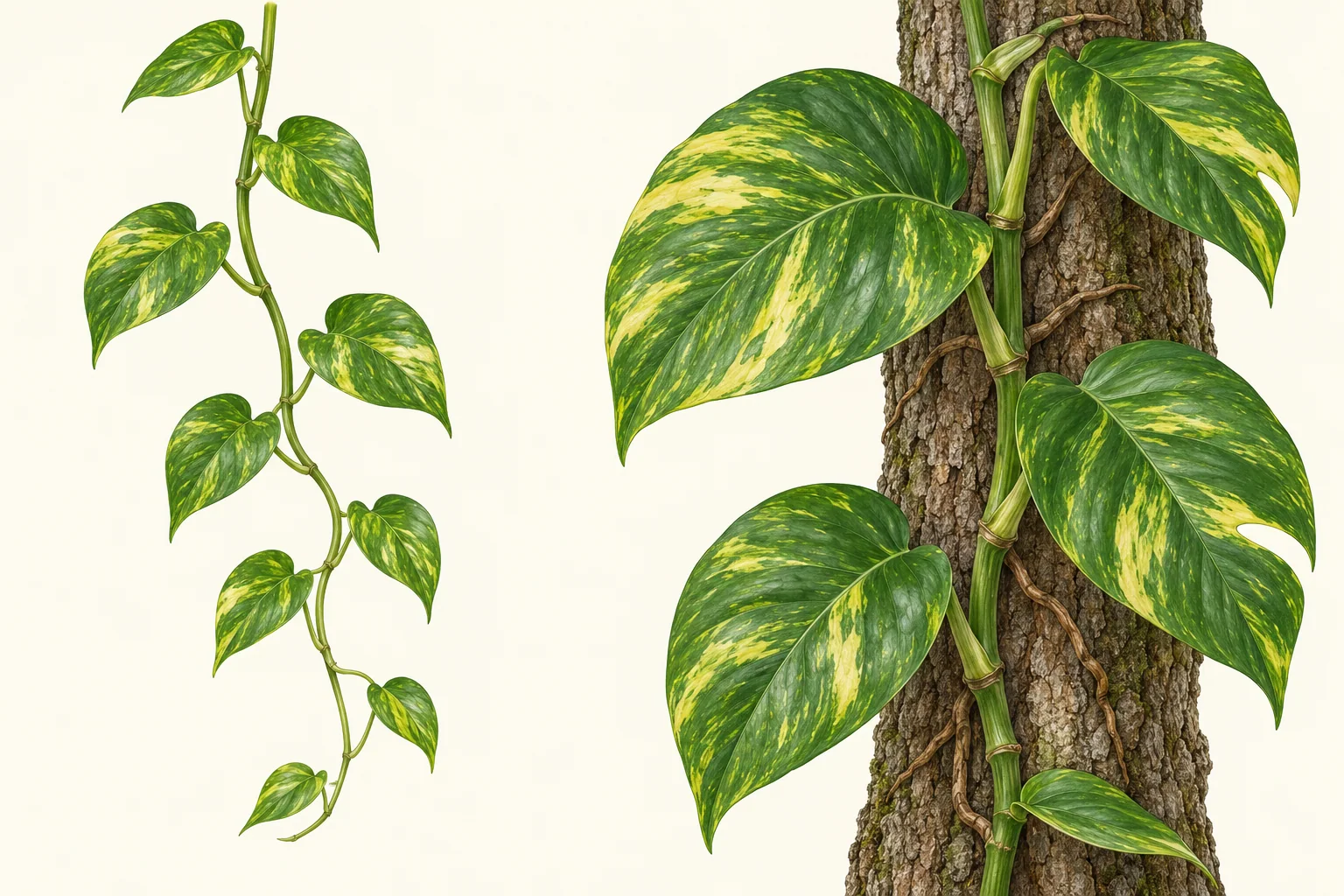
A mature leaf is not necessarily a juvenile leaf enlarged in exactly the same proportions. Developmental stage and growth position can also change its outline. When reading the leaf, distinguish a split that begins at the margin from a perforation enclosed by leaf tissue; neither feature alone proves a growing condition or identifies the species.
Two boundaries are important here. First, giving a plant a support does not guarantee that it will produce large mature leaves. Light, plant age, overall growth, and cultivar can all influence leaf development. Second, a mature pothos should not automatically be confused with monstera or another large-leaved arum-family plant.
What do yellow or white patterns have to do with green areas?
Variegation is one of the ornamental features found in many pothos cultivars. Green areas usually contain more chlorophyll. Yellow, creamy white, or pale green areas may contain less chlorophyll or differ in chloroplast and pigment development. Pothos is therefore a useful plant for observing the relationship between leaf color and chlorophyll, and it also shows that light is not the only factor affecting variegation.
However, variegation should not be reduced to a fixed light formula. In some variegated cultivars, insufficient light may make new variegation less noticeable. On the other hand, very intense light or heat may damage paler parts of the leaf.
Cultivar differences and leaf development also affect how variegation appears. The statement “more light always creates more variegation” is not a reliable general rule. For the broader observation pathway, see Why Do Variegated Plants Turn Green? and Indoor Light and Outdoor Light: What Is the Difference?.
What pothos can teach us about plant biology
Pothos may look like an ordinary houseplant, but it connects several basic plant biology ideas.
Leaves receive light and carry out photosynthesis. Stems support leaves and connect different parts of the plant. Nodes and internodes help us describe how leaves and other structures are arranged along a stem. Aerial roots show how roots can interact with a support surface rather than growing only in soil.
When trailing stems, climbing stems, indoor light, and variegated leaves are considered together, pothos demonstrates that a plant’s appearance is not a single fixed model. It develops through the interaction of plant organs, growth stage, and growing conditions.
Common points of confusion
- ✕ Pothos is the formal genus name of golden pothos.
- ✓ Epipremnum aureum is the currently accepted scientific name; pothos is a common name.
- ✕ Every small brown bump on the stem is a pest problem.
- ✓ Pothos may produce adhesive aerial roots near nodes or along the stem, but position and shape should be considered rather than color alone.
- ✕ Small leaves on a hanging plant mean pothos can never grow larger leaves.
- ✓ Indoor trailing plants often keep a juvenile leaf form. Light, upward growth, and contact with a support work together to influence leaf expansion, but do not guarantee it.
- ✕ More light always produces more variegation.
- ✓ Low light may make some patterns less noticeable, while excessive light or heat may damage leaves. Cultivar and leaf development also matter.
- ✕ A mature leaf is simply a juvenile leaf scaled up.
- ✓ Mature leaves most consistently become larger and may develop a few irregular shallow splits; enclosed perforations are usually sparse or subtle.
Frequently asked questions
What is the scientific name of pothos? Are pothos and golden pothos the same plant?
The plant commonly called pothos is mainly Epipremnum aureum. Pothos and golden pothos are common English names. “Golden pothos” often refers to a yellow-variegated form, while “pothos” may be used more broadly in everyday speech. The scientific name is more precise when identifying the plant.
What are the small brown bumps on a pothos stem?
If a structure projects from the stem, resembles a small root, and appears near a node or support surface, it may be an aerial root. Pothos can use adhesive aerial roots to help climb. However, color alone is not enough to identify every bump, especially from a single photograph.
How can I tell a node, an internode, and an aerial root apart?
A node is the point where a leaf, bud, or other side structure connects to the stem. An internode is the stem section between two nodes. An aerial root is a root-like structure that projects outward from the stem area.
Start by finding the petiole and the point where the leaf connects to the stem. Then look at the stem section between neighboring nodes. Finally, check whether a root-like structure extends outward from the stem.
Why are indoor pothos leaves usually smaller?
Indoor pothos often remains in a juvenile growth form, and trailing plants commonly produce smaller leaves with entire margins. Research shows that brighter light, upward growth, and contact with a support can work together to increase leaf expansion. This is a multi-factor response, not proof that indoor pothos can only make small leaves.
Will pothos always grow large mature leaves after it starts climbing?
No. Upward growth, contact with a support, light, plant age, cultivar, and overall plant condition can all influence leaf development. Larger mature leaves may be more likely when several of these conditions occur together; providing a support does not guarantee a particular result.
Will pothos develop many holes like a monstera?
The most consistent change in mature pothos is a large increase in leaf size. Some leaves may develop a few irregular shallow splits from the margin. Fully enclosed perforations are usually sparse or subtle, so mature pothos should not be pictured as inevitably producing rows of large monstera-like holes.
Why are the yellow or white patterns on my pothos becoming less noticeable?
In some variegated cultivars, insufficient light may make new patterns less noticeable. Excessive light or heat can also damage paler leaf areas. Variegation is influenced by cultivar and leaf development, so it cannot be explained by one light condition alone.
Can pothos flower?
Pothos is an angiosperm, but research literature describes it as extremely shy-flowering. Maturity may be one prerequisite for responding to floral signals, yet it is not sufficient: mature climbing plants in a controlled study still did not flower naturally. The accurate takeaway is that the species itself flowers very rarely, not that large leaves or outdoor growth guarantee an inflorescence.
Are pothos aerial roots the same as the roots inside the pot?
They are both roots, but they grow in different positions and may have different interactions with their surroundings. Pothos aerial roots mainly help the stem attach to a support as it climbs. They should not automatically be treated as a replacement for the plant’s roots growing inside the pot.
Related terms
- Pothos: A common name mainly used for Epipremnum aureum.
- Climbing vine: A plant with flexible stems that can grow along the ground or use a support to grow upward.
- Node: The point where a leaf, bud, or other side structure connects to a stem.
- Internode: The stem section between two nodes.
- Petiole: The stalk that connects a leaf blade to the stem.
- Aerial root: A root that grows in the air or outside ordinary growing media; its function depends on the plant.
- Variegated leaf: A leaf with areas of different colors or shades.
Keep exploring
Evidence
References
These sources were used to check the plant-science concepts and gardening context in this article.
View sources and further reading (15)
- powo.science.kew.org — urn:lsid:ipni.org:names:87014 1
- plants.ces.ncsu.edu — epipremnum aureum
- hort.extension.wisc.edu — pothos epipremmum aureum
- gardeningsolutions.ifas.ufl.edu — pothos
- ask.ifas.ufl.edu — EP151
- research.fs.usda.gov — 32760
- openstax.org — 30 2 stems
- openstax.org — 8 1 overview of photosynthesis
- askabiologist.asu.edu — chlorophyll and chloroplasts
- doi.org — j.flora.2022.152139
- doi.org — peerj.19214
- aroid.org — A Review of Epipremnum (Araceae) in cultivation [Aroideana 27, 199 205] Boyce 2004.pdf
- doi.org — srep28598
- doi.org — erq020
- doi.org — s00709 011 0325 y