The Same Bag Can Have Two Very Different Jobs
If you see a flower, flower cluster, or young fruit covered with a bag, the purpose depends on what has been covered and when. Flower bagging mainly controls which pollen can reach a flower. Fruit bagging mainly protects a young fruit that has already begun to develop.
Bagging is therefore not a button that makes a plant set fruit. It is a physical barrier used at a particular stage of reproduction or fruit development. The plant species, the material of the bag, the timing, airflow, and the surrounding environment all affect what the barrier can do.

Flower Bagging: Limiting Unwanted Pollen Exposure
To understand flower bagging, it helps to know a few flower parts. The anthers, part of the stamens, produce pollen. The stigma, at the top of the pistil or carpel, is the receptive surface where pollen can land. You can review these structures in the main parts of a flower and the difference between stamens and pistils.
In seed saving, plant breeding, or research, a flower or flower cluster may be enclosed before it opens. The aim is to reduce the chance that insects, wind, or another carrier brings unknown pollen to the stigma. This makes it easier to track which pollen source was involved later. In this context, flower bagging is a form of pollen isolation or controlled pollination.
The barrier can also block a pollinator that the plant needs. If a flower normally depends on insects, wind, or another carrier to move pollen, simply covering it does not complete pollination. It may remove the very route by which pollen would have reached the stigma. This is why controlled-pollination situations may combine isolation with a chosen pollination event, and then cover the flower again to reduce the chance of unwanted pollen mixing in. What is pollination? and why hand pollination is used explain the pollen-transfer part in more detail.
The central idea is simple: a flower bag controls access to the pollen-receiving part of the flower. It does not make pollination unnecessary, and it does not by itself determine whether a flower will become a fruit. Flower structure, the timing of flower opening, and whether a plant uses self-pollination or pollen from another plant all matter.
Fruit Bagging: Adding a Barrier Around a Developing Fruit
Fruit bags are generally used after a flower has passed through the pollination and early fruit-set stages, when a young fruit has begun to develop. At that point, the purpose changes from controlling pollen access to reducing direct contact between the developing fruit and its surroundings.
Depending on the crop and the bag material, a fruit bag may reduce some exposure to insects, pathogens, birds, strong sunlight, rain, wind, or rubbing against nearby surfaces. It may also help keep the fruit surface cleaner or change its appearance. The important wording is reduce some exposure or damage, not completely block every problem.
A bag cannot reverse a wound or an infection that happened before it was used. A loose opening, a torn bag, standing water, or excessive humidity can also weaken the barrier effect. These are reasons fruit bagging should be understood as a protective measure with limits, not as a guarantee of a perfect fruit.
The bag is not an entirely neutral shell, either. Its material, color, and breathability can change the light reaching the fruit and the microclimate around its surface. Temperature, humidity, evaporation, and air movement may all differ inside the bag. Those changes can affect color, surface condition, or other aspects of development, but the outcome is not always the same across plants, varieties, bags, seasons, and local conditions.
In other words, fruit bagging can do two things at once: provide a physical barrier and alter the small environment around the fruit. It does not replace the leaves’ role in making sugars, complete fertilization, or automatically make the fruit larger, sweeter, earlier, or more attractive.
Why Flowering and Fruit Development Must Be Kept Separate
The difference becomes clearer when the reproductive sequence is laid out and the bagging target is followed into early fruit development:
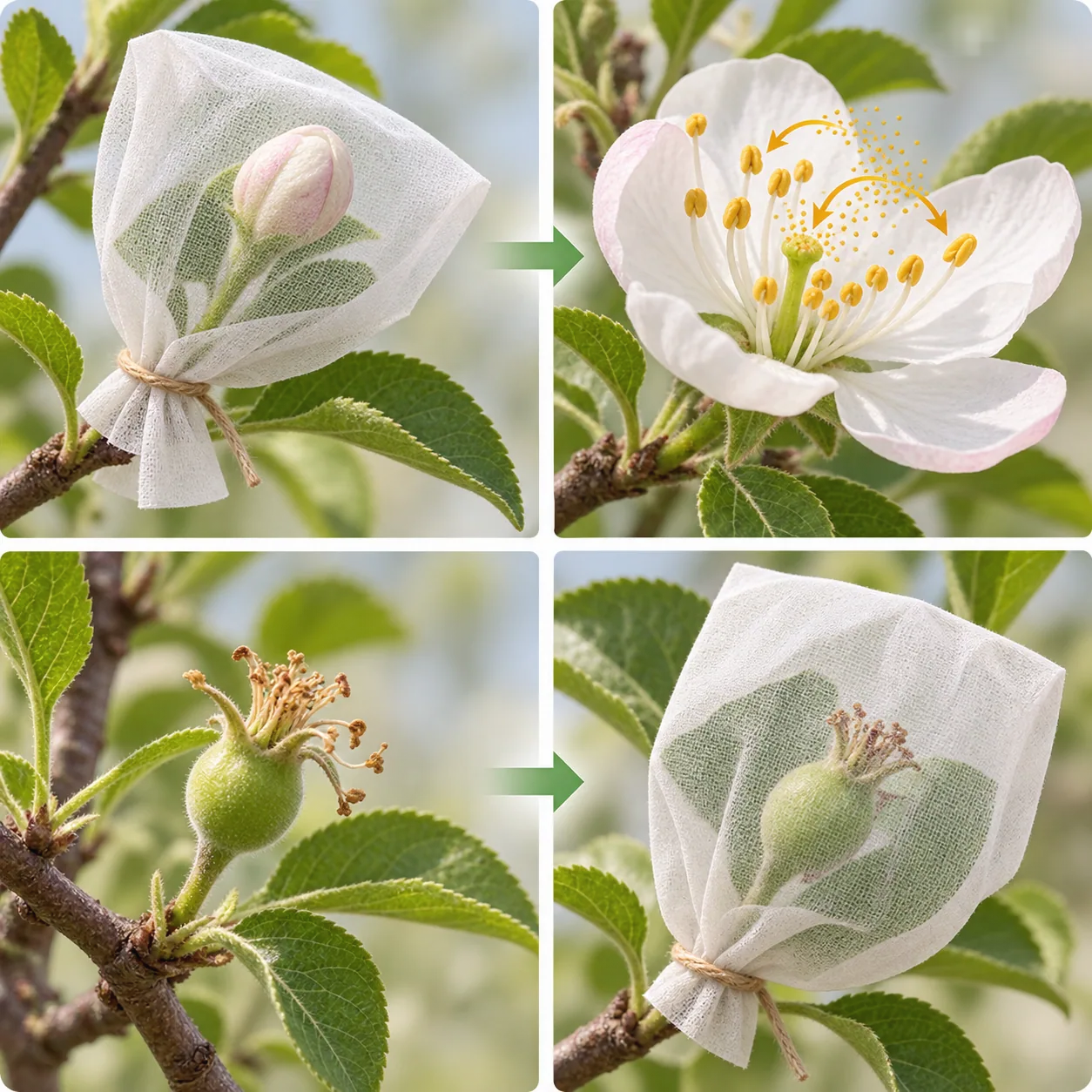
- Pollen moves from an anther to a stigma. This is pollination.
- If the pollen is compatible, it may germinate on the stigma and grow a pollen tube through the style toward an ovule.
- In many flowering plants, if the pollen is compatible, the pollen tube may reach an ovule and reproductive cells may unite in fertilization.
- After fertilization, ovules usually develop into seeds and ovary tissues contribute to the fruit. Some plants can also form fruit without fertilization, a pattern called parthenocarpy. The flower-to-young-fruit transition is commonly described as fruit set, so seeing a young fruit alone does not prove that fertilization occurred.
These are connected stages, but they are not one instantaneous event. What happens after pollen lands on a stigma? explains why pollen landing on a stigma is not the same as fertilization.
This sequence also explains the usual contrast between the two kinds of bagging. Flower bagging can affect whether pollen reaches the stigma. Fruit bagging is more often used after the relevant pollen transfer and early fruit set, to manage the developing fruit’s exposure to the outside environment.
There is no single number of days that applies to every plant. A crop-specific source may describe an earlier or later window, and a different species may respond differently. Covering too early, covering too late, choosing a material that does not suit the situation, or limiting airflow can all change the outcome. A useful general rule for understanding the idea is: first identify the developmental stage, then ask whether the bag is controlling pollen or protecting a young fruit.
Bagging, Hand Pollination, and Thinning Are Not the Same Operation
These practices may appear together in horticultural discussions, but they intervene at different points:
- Hand pollination helps or controls the movement of pollen to a stigma.
- Bagging isolates a flower from some pollen sources or reduces outside contact with a flower or young fruit.
- Flower or fruit thinning removes some flowers or young fruits and changes how many developing structures the plant continues to support.
For example, a controlled-pollination project may isolate a flower, use a chosen pollen source, and cover the flower again. Later, a developing fruit may be covered for a different protective purpose. That does not mean all three practices are always needed, or that one can replace another. Why do growers thin flowers and fruit? provides the comparison with resource allocation and crop load.
What to Notice When You See a Bag on a Plant
Bagging can be used as a plant-science observation clue rather than as a diagnosis or a universal instruction. Ask:
- Is the bag around a closed flower, an open flower, a flower cluster, or a young fruit that is already swelling?
- If it is around a flower, could the bag be isolating pollinators or unknown pollen? The bag itself is not evidence that pollination has already happened.
- If it is around a fruit, can you see the relationship between the fruit stalk and the opening of the bag? The barrier may reduce outside contact, but it does not show that the fruit will definitely mature.
- Is the material a breathable mesh, paper, or something else? Different materials can change light, temperature, humidity, and airflow in different ways.
- If you compare bagged and unbagged fruits, are the plant, variety, season, position, and bag material also comparable? One observation does not become a rule for every fruit.
These questions connect a visible gardening practice to plant biology: anthers and stigmas explain pollen movement, pollination and fertilization explain the path toward seeds and fruit, and the microclimate explains why a bag is more than something simply wrapped around a plant.
Common Confusions
- ✕ Flower bagging and fruit bagging are just two names for the same job.
- ✓ Flower bagging mainly concerns pollen and pollinators; fruit bagging mainly concerns the developing fruit and its surrounding environment.
- ✕ Once a flower is covered, it no longer needs pollination.
- ✓ If the flower has not been pollinated, the bag may also keep out the pollinator. A plant that needs pollen transfer still needs a suitable way for pollen to reach the stigma.
- ✕ Pollen touching a flower means fertilization has happened.
- ✓ Pollen must reach a receptive stigma, and later stages can include pollen germination, pollen-tube growth, and fertilization.
- ✕ Fruit bagging always makes fruit bigger, sweeter, earlier, or more attractive.
- ✓ A bag can change outside exposure and the fruit’s microclimate, but the result depends on the plant, variety, bag, timing, and environment.
- ✕ A fruit bag removes every pest or disease problem.
- ✓ A bag is a physical barrier that may reduce some contact or damage. Earlier damage, tears, poor closure, standing water, or high humidity can still matter.
- ✕ Bagging is the same as thinning or hand pollination.
- ✓ Thinning changes how many flowers or young fruits remain, hand pollination changes pollen transfer, and bagging provides isolation or protection.
FAQ
Why are fruits on trees often covered with paper or mesh bags?
Developing fruit may be exposed to some insects, pathogens, birds, strong sunlight, rain, wind, or rubbing. A fruit bag adds a physical barrier and can also change the light, temperature, and humidity around the fruit. Its purpose is to reduce some outside interference, not to promise a flawless fruit.
Why bag a flower before it opens?
In seed saving, breeding, or research, covering a flower before it opens can reduce contact with pollinators and outside pollen. The flower can then be observed or included in a more controlled pollination context. The purpose is to control the pollen source, not to let the flower skip pollination.
Can flower bagging affect pollination?
Yes, it can. If a plant depends on insects, wind, or another carrier, a bag may keep that carrier away. Flower bagging therefore needs to be understood together with the plant’s pollination biology and, in some contexts, a chosen pollination method. Even if pollen later reaches the stigma, the bag alone cannot show that fertilization succeeded.
Why cover a flower again after hand pollination?
Re-covering can reduce the chance that another carrier brings a different pollen source to the flower. This makes the intended pollen source easier to track. It does not ensure pollen compatibility, pollen-tube growth, fertilization, or fruit formation.
When should fruit be bagged?
There is no universal number of days. For plants whose fruit formation depends on pollination and fertilization, fruit bags are often used after the flower has passed through those stages and early fruit set, when the young fruit is developing. Some plants can form fruit without fertilization, so the appropriate timing still depends on the species, variety, material, climate, and purpose described by the relevant crop information.
Can fruit bagging change sweetness or size?
It can affect some development or appearance traits, but the result is not universal. Bag material changes the light and microclimate around the fruit, and different studies or crops can show different patterns. It is more accurate to say that bagging may influence certain traits than to say it always improves sweetness or size.
Can a fruit bag create moisture problems?
It can, depending on the material, airflow, rain, and local conditions. Water or high humidity inside a bag may reduce the intended barrier effect or affect the fruit environment. This is one reason a bag should not be treated as a neutral or completely sealed shell.
Why not put an ordinary plastic bag over every flower?
A material that traps heat or moisture may harm a flower or create an unsuitable local environment. Flowers also differ in structure, opening time, and pollination requirements. A method used for one plant should not be assumed to fit every other plant.
Glossary
- Flower bagging: Covering a flower or flower cluster, often to isolate it from unwanted pollen or pollinators during controlled pollination or seed saving.
- Fruit bagging: Covering a developing fruit before harvest to reduce some outside exposure and, depending on the material, alter the fruit’s microclimate.
- Pollen isolation: Reducing the chance that an unspecified pollen source reaches a stigma.
- Pollinator: An insect, wind current, animal, or other carrier that can move pollen to a stigma.
- Pollination: The movement of pollen to a receptive stigma.
- Pollen tube: A tube that can grow from a germinating pollen grain through the style toward an ovule.
- Fertilization: The later union of reproductive cells after the pollen-transfer stage.
- Fruit set: The transition from a flower to a young fruit that continues to develop; the details vary among plants.
- Fruit microclimate: The light, temperature, humidity, evaporation, and air movement close to the fruit, including conditions changed by a bag.
- Anther: The pollen-producing part of a stamen.
- Stigma: The receptive surface at the top of a pistil or carpel where pollen can land.
What to Read Next
Evidence
References
These sources were used to check the plant-science concepts and gardening context in this article.
View sources and further reading (20)
- kmweb.moa.gov.tw — subject.php
- kmweb.moa.gov.tw — subject.php
- kmweb.moa.gov.tw — subject.php
- tndais.gov.tw — theme data.php
- hort.extension.wisc.edu — bagging apples for insect and disease control
- clemson.edu — clemson fruit bags.html
- cce.cornell.edu — saving future one seed time
- extension.usu.edu — collecting and storing seeds from your garden
- ask.ifas.ufl.edu — EP549
- ask.ifas.ufl.edu — HS1520
- propg.ifas.ufl.edu — 10 seedsdevelopment pollination.html
- uaf.edu — pollination fruit development tomatoes.php
- treefruit.wsu.edu — flowering fruit set pollination
- propg.ifas.ufl.edu — 09 seedsdevelopment parthenocarpy.html
- seed.agron.ntu.edu.tw — luffa.htm
- openstax.org — 32 2 pollination and fertilization
- yardandgarden.extension.iastate.edu — pollination requirements tree and small fruits
- treefruit.wsu.edu — flowering fruit set pollination
- doi.org — plants10020358
- epubs.icar.org.in — 410688