
Some succulent leaves really can become plantlets
Some succulent leaves can remain alive after separating from the parent plant and may form roots and a new shoot near the leaf base—the part that was attached to the stem. Over time, that new growth can develop into a small independent plant. This is commonly called leaf propagation or propagation from leaf cuttings. In plant biology, it is vegetative propagation, a form of asexual reproduction.
The important word is some. A thick leaf is not automatically a complete starter plant, and not every succulent can regenerate from a leaf. The outcome depends on the species or cultivar, whether the leaf base remains intact, whether the tissue still has regenerative ability, and whether the detached leaf can stay active while new roots and shoots develop.
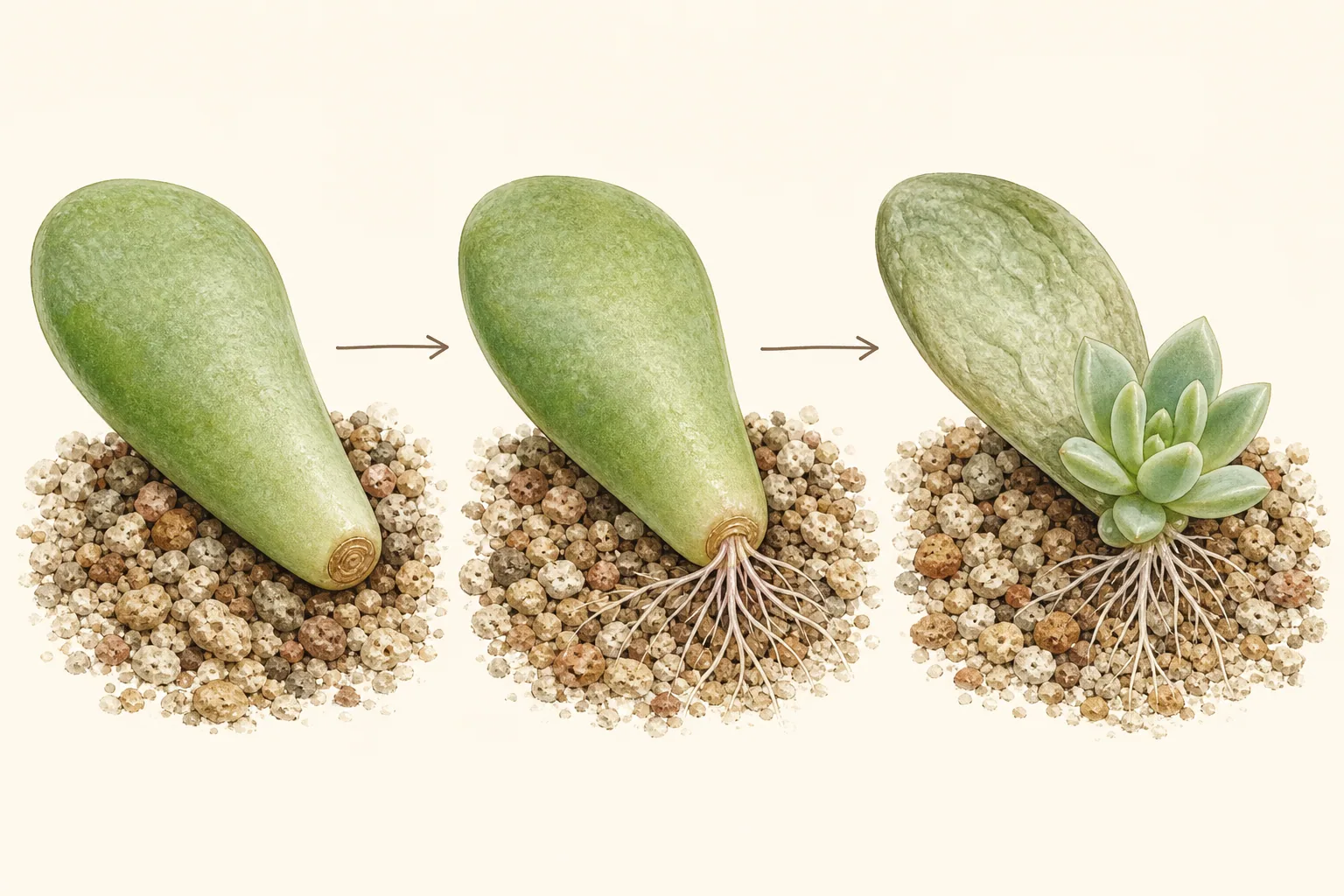
A root is only one part of a new plant
For a detached leaf to become an independent plant, at least two important systems have to be rebuilt. New roots can absorb water and help anchor the plant. A new bud or shoot growing point has to produce new leaves and, eventually, more of the shoot system.
That is why seeing roots is not the same as seeing a completed plant. A leaf may form roots but fail to form a new stem and leaves. In that case, it is still showing a regeneration response, not necessarily a fully established plantlet. When a new bud forms at the leaf base and continues growing, it has a better chance of developing into a plant with its own roots, shoot, and leaves.
This is also an important difference between leaf cuttings and many stem cuttings. A stem cutting may already contain a node or bud, so it may mainly need to produce new roots. A leaf cutting often has to rebuild both the root system and the shoot system, which is a stricter biological requirement.
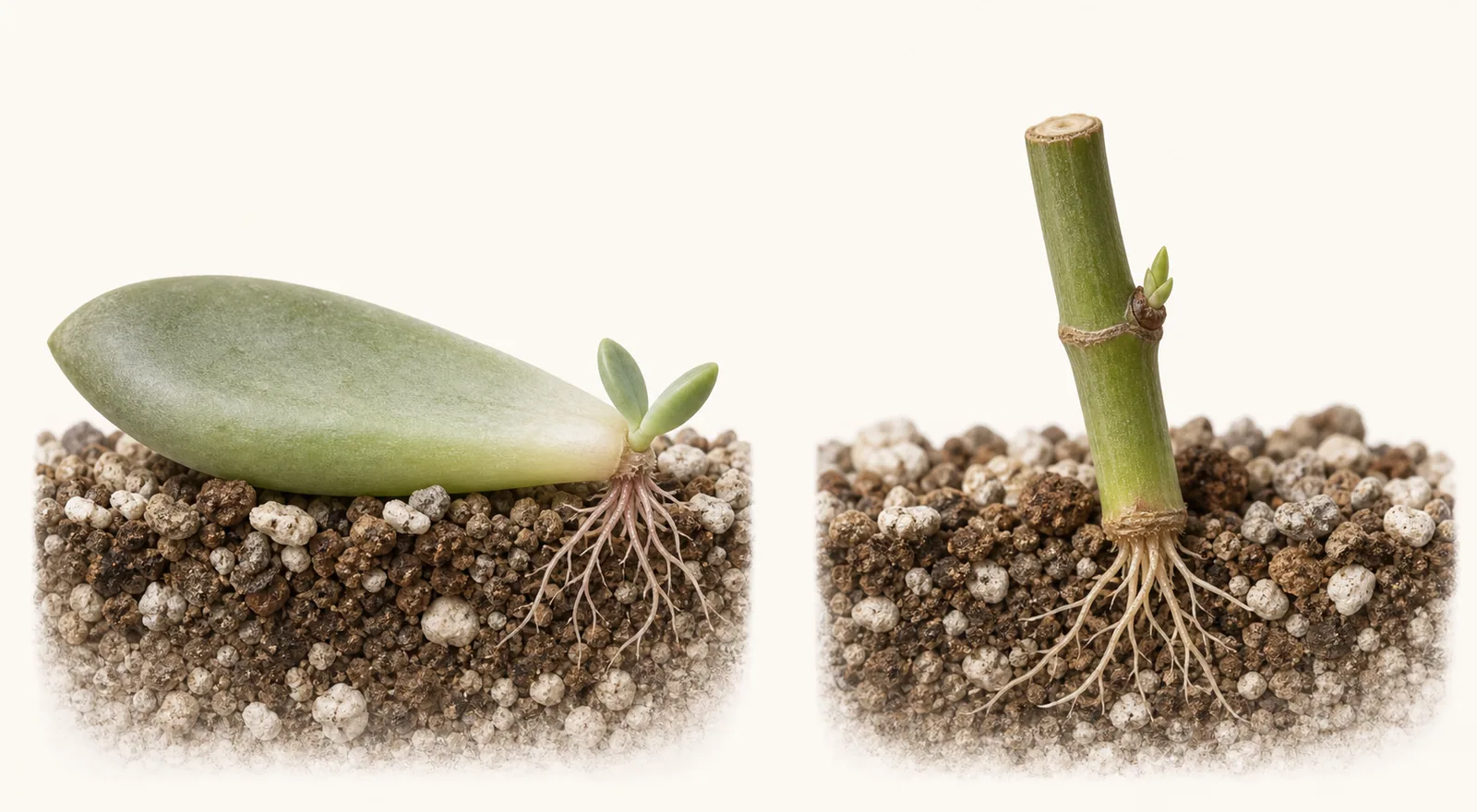
A node is a point on a stem where a leaf or bud may arise. An axillary bud is a bud in the angle between a leaf and its stem. When a stem cutting retains a node and its axillary bud, the above-ground growth point is already present; the cutting may mainly need to form roots.
Why a succulent leaf can wait before it has roots
“Succulent” describes a water-storing form or strategy found across many different plant groups. Some succulents store much of their water in thick leaves; others store more in stems or roots. The succulent leaves most often used to illustrate leaf propagation are typically fleshy, so the detached leaf may use its stored water and other resources to remain active for a while.
This temporary reserve matters because a leaf without new roots cannot absorb water from the growing medium in the same way as an intact plant. A newly forming shoot also does not yet have enough new leaf area to carry out all the photosynthesis it will eventually need. The original leaf can therefore act as a temporary support or resource reserve while regeneration begins near the leaf base.
Stored water only helps a leaf last through this rootless stage. It does not automatically create a new bud. A thin or damaged leaf, or a leaf kept in conditions that encourage decay, may stop regenerating. Excess moisture can be associated with rot in succulent leaf propagation.
The leaf base and nearby tissue can be the key
The leaf base is the attachment area that holds a leaf onto the stem. In some succulents that can be propagated from whole leaves, keeping this area intact is an important regeneration clue. In other leaf-cutting methods or plants, a wound near a main vein can also become a regeneration site. Which tissue forms roots or shoots still depends on the species and the condition of the tissue.
An adventitious root is a root that forms somewhere other than the usual root system, such as from a leaf or stem. An adventitious bud is a bud that forms at a non-typical bud position rather than at the plant’s usual axil or shoot tip. “Adventitious” here means “arising from an unusual organ position”; it does not mean random or abnormal.
The tissue involved may include a meristem, a growth region whose cells can keep dividing and producing new cells. A wound may also develop callus, a mass of newly proliferating cells near the injured area. Callus is not the same thing as a root or a bud. Depending on the plant and the conditions, some of the regenerating tissue may later form adventitious roots or adventitious buds.
For this reason, an intact leaf base often gives some leaf-cutting plants a better opportunity to regenerate than a small piece taken from the middle of a leaf. This is a useful biological clue, not a guarantee for every succulent. Leaf segments are a separate case in some plants.
“Leaf propagation” does not describe one single process
Succulents are not one botanical family or one uniform kind of plant. They include many different lineages with different body forms, storage organs, growth points, and propagation patterns. Some species or cultivars can be propagated from whole leaves; others are more commonly continued through stem cuttings, offsets, pups, or division.
Two familiar leaf-related examples should not be merged into the same diagram:
- Kalanchoe leaf-margin plantlets: In some Kalanchoe, daughter plantlets form along the leaf margin. These are often described as epiphyllous buds. This is a leaf-edge plantlet pattern, not the same as a detached whole leaf forming roots at its leaf base and then producing a new shoot.
- Sansevieria leaf segments: Some Sansevieria can be propagated from leaf segments. The segments have an upper and lower direction, so this is not the same process as placing an intact, fleshy leaf flat and observing regeneration at its leaf base.
These examples explain why the useful question is not simply “Is it a succulent?” Ask instead: which part of this plant contains or can produce a new growing point? A leaf, a leaf margin, a stem segment, an offset, and a division each represent different starting materials and different regeneration patterns.
What you may observe in a pot
With a suitable species, a detached leaf may remain fairly plump at first. Later, you may see fine roots near the leaf base, a small bud, or new leaves forming beside the original leaf. Roots and shoots do not have one universal order: one plant may show roots first, another may show a bud first, and another may take longer before either is visible. Some species studies also observe callus forming near a wound before roots or buds develop, but that is not a fixed process for all succulents.
The original leaf may gradually become thinner or wrinkled as the developing plantlet uses some of its stored resources. This can be an observation clue, but the appearance of a wrinkled parent leaf cannot by itself prove that a new plant will continue growing.
The growing medium is not only a question of “wet or dry.” New roots need access to water, but they also need air around them. Excess moisture and a lack of aeration can put pressure on the leaf base and new roots. Understanding this balance is more useful than memorizing one watering or medium formula for every succulent.
Common points of confusion
- ✕ A thick succulent leaf can always grow into a new plant.
- ✓ Leaf thickness mainly reflects water storage. It may help a detached leaf remain active before roots form, but it cannot replace the regenerative tissue needed for a new shoot; the species, an intact leaf base, and tissue condition still matter.
- ✕ A leaf that has grown one root has already propagated successfully.
- ✓ A root is only one part of a new plant. A continuing shoot, new leaves, and a developing root system are also needed for an independent plantlet.
- ✕ Callus is the same thing as a new root.
- ✓ Callus is a group of proliferating cells near a wound. It may be associated with later regeneration, but it is not itself a root or a complete plantlet.
- ✕ Simply placing any succulent leaf on a growing medium guarantees propagation.
- ✓ Only some plants can do this. The leaf base may need to remain intact and active, and the surrounding conditions must support regeneration.
- ✕ Leaf propagation always follows one fixed sequence.
- ✓ A species may show roots first, buds first, both together, or no completed regeneration. Even the order seen in one species should not automatically be applied to all succulents.
- ✕ Kalanchoe leaf-margin plantlets, a whole succulent leaf, and a Sansevieria leaf segment are all the same type of leaf cutting.
- ✓ They represent different patterns: plantlets along a leaf margin, regeneration from a whole leaf or leaf base, and directional regeneration from a leaf segment.
- ✕ “Succulent” names one botanical family with one propagation method.
- ✓ “Succulent” is a broad horticultural and functional description. Different plants may rely on leaves, stems, offsets, pups, or division.
Frequently Asked Questions
Can a succulent leaf really grow into a whole new plant?
Some can. A leaf from a suitable species may form adventitious roots and an adventitious bud or shoot, which can eventually develop into a plantlet. A leaf that has only produced roots has not necessarily completed regeneration.
Can every succulent be propagated from a leaf?
No. “Succulent” covers many plants with different growth forms and growing-point locations. Some are better represented by leaf cuttings, while others more commonly continue through stem cuttings, offsets, pups, or division. The species or cultivar matters.
Why can a thick succulent leaf still fail to propagate?
Leaf thickness mainly reflects water storage. It may help a detached leaf remain active before roots form, but it cannot replace the regenerative tissue needed for a new shoot. The species, an intact leaf base, and the condition of the tissue still matter.
What is the difference between succulent leaf propagation and stem cuttings?
Leaf propagation starts with a leaf and may require the leaf to regenerate both new roots and a new shoot. A stem cutting often retains a node or bud, so its main regeneration task may be forming roots. The two methods share some ideas, but they are not interchangeable.
Is leaf propagation a type of cutting propagation?
Yes. Leaf propagation is one form of cutting propagation because it starts with part of a parent plant rather than a seed. The broader term includes leaf, stem, and root cuttings, but each type begins with different tissues and may need to rebuild different organs.
Why does a succulent leaf grow roots but no new leaves?
Root formation and shoot formation are different regeneration tasks. The leaf may lack tissue capable of producing an adventitious bud, or that species may not be able to complete a new plant from a leaf. Roots alone do not prove that a whole plantlet will follow.
Does a leaf need a petiole to propagate?
Not necessarily. In many succulent leaf cuttings, the important part is the intact leaf base where the leaf attached to the stem, not a long, obvious petiole. Different plants use different starting materials, so a rule for one kind of leaf should not be applied to another.
Do roots appear before new shoots?
There is no single order that applies to every plant. Some leaves show roots first, some show a bud first, and some show neither for a while. The key question is whether the plant gradually establishes both a root system and a continuing shoot, not which one appeared first.
Are Kalanchoe plantlets along the leaf margin the same as leaf cuttings?
No. In some Kalanchoe, daughter plantlets form along the leaf margin from epiphyllous buds. That is different from a detached whole leaf forming adventitious roots near its leaf base and then producing a new shoot. Both are forms of asexual reproduction, but they are not the same process.
Is callus on a leaf the same as a root?
No. Callus is a group of cells that may form near a wound. Depending on the plant, some regenerating tissue may later produce roots or buds, but callus itself is not a root and does not guarantee a complete plantlet.
Why does the original leaf become wrinkled?
The developing plantlet may use some of the water and stored resources in the parent leaf, so the leaf may become thinner or wrinkled. This is a possible observation during regeneration, not a guarantee that the new plant will keep growing.
Is a leaf-propagated plant a seedling?
Usually not. A seedling is normally a young plant that began from a seed. A plant produced from a leaf is more naturally called a plantlet or daughter plant. It may later become an adult plant, but it did not begin as a seedling.
Related terms
- Vegetative propagation: Producing a new plant from a vegetative organ such as a leaf, stem, root, offset, or bud.
- Asexual reproduction: Reproduction that does not involve the fusion of gametes; vegetative propagation is one form of it.
- Leaf cutting / leaf propagation: Propagating a plant from a leaf or a leaf-based cutting rather than from a seed.
- Leaf base: The part of a leaf nearest the stem, including the attachment area.
- Node: A point on a stem where a leaf or bud may arise.
- Axillary bud: A bud in the angle between a leaf and its stem that may continue the shoot.
- Adventitious root: A root that forms from a non-root organ or a non-typical root position, such as a leaf or stem.
- Adventitious bud: A bud that forms at a non-typical bud position and may develop into a new shoot or plantlet.
- Callus: A mass of proliferating cells that may develop near a wound; it is not itself a root or bud.
- Meristem: A plant growth region whose cells can keep dividing and producing new cells.
- Plantlet / daughter plant: A small new plant produced from a parent plant part; these terms are more suitable here than seedling.
Related reading
Evidence
References
These sources were used to check the plant-science concepts and gardening context in this article.
View sources and further reading (14)
- propg.ifas.ufl.edu — 05 cuttingtypes leaf.html
- fieldreport.caes.uga.edu — starting plants from cuttings for the home gardener
- yardandgarden.extension.iastate.edu — how propagate succulents
- yardandgarden.extension.iastate.edu — common and popular succulent species
- extension.illinois.edu — propagation
- ucanr.edu — succulents
- openstax.org — 32 3 asexual reproduction
- content.ces.ncsu.edu — 13 propagation
- pubs.ext.vt.edu — 426 002.html
- plant-directory.ifas.ufl.edu — kalanchoe species
- propg.ifas.ufl.edu — 01 cuttingterms adventitiousroot.html
- propg.ifas.ufl.edu — 16 cuttingterms wounding.html
- doi.org — 336859
- extension.wvu.edu — succulents 101